
Hi, I am Helen. With over ten years in the sanitary ware industry, I help developers, designers, and procurement teams navigate complex villa and high-end residential projects. At George Group, I focus on mitigating project risks by integrating ADA grab bar requirements as part of the overall bathroom safety, spatial planning, and engineering system.
ADA grab bar requirements are fundamentally spatial design and engineering constraints that define safety, usability, and compliance in residential bathroom projects. In modern luxury design, these rules are no longer just regulatory details. They are not standalone product specifications, but spatial constraints that shape how bathrooms are designed and approved. They directly impact your user experience, compliance risk, and long-term project value.
If you want to protect your project timeline and budget, start here.
Quick Answer: Key ADA Requirements
In modern residential bathroom design and compliance planning, ADA grab bar requirements are defined by five core installation and safety rules:
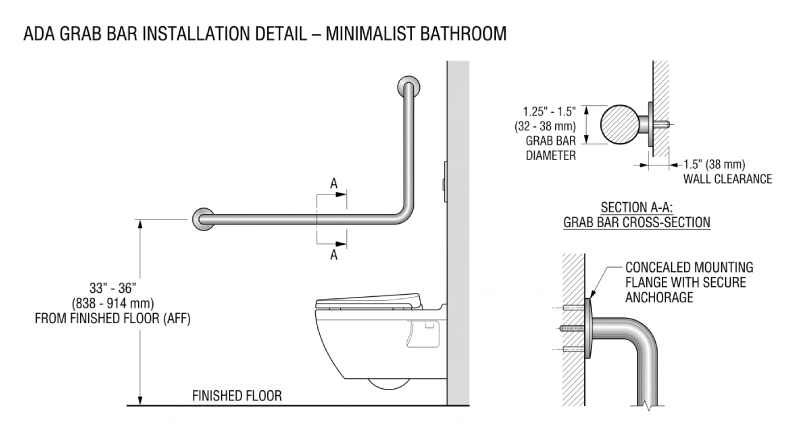
Height: 33–36 inches from the finished floor.
Diameter: 1.25–1.5 inches for a comfortable grip.
Wall clearance: Minimum 1.5 inches between the bar and the wall.
Load capacity: Must support at least 250 lbs of force (we recommend 300+ lbs for luxury projects).
Placement: Essential in toilet, shower, and bathtub areas to create a continuous safety path.
Together, these five rules define the core framework of Ada grab bar requirements in residential bathroom design.
Standard Source: Based on the 2010 ADA Standards for Accessible Design, which are widely adopted in residential and multi-family projects.
Let’s dive into what this means for your specific procurement and design strategy.
Table of Contents
What Are ADA Grab Bar Requirements in 2026?
ADA grab bar standards act as a strict set of spatial design constraints, dictating the exact measurements, structural loads, and clearances required for safe bathroom navigation. Even if private single-family villas are sometimes legally exempt from federal ADA laws, modern high-end buyers demand “aging-in-place” designs. Integrating these standards into your projects ensures multi-generational safety, reduces developer liability, and helps improve long-term property value and market competitiveness.
The biggest mistake developers make is treating these requirements as an afterthought. When grab bars are viewed as optional accessories rather than an integrated safety system, projects inevitably suffer from poorly planned layouts and compliance failures.
What Is the Correct Height for ADA Grab Bars?
The mandatory ADA grab bar height is 33 to 36 inches from the floor to the top of the gripping surface. This specific height is a strict constraint of human reach, aligning with the natural leverage point of an adult, whether they are standing or transitioning from a wheelchair. It provides the essential stability needed to prevent severe falls.
A frequent and costly error is measuring before the finished flooring is installed. I once consulted on a luxury villa project in California where the installation team measured 34 inches from the concrete slab. Later, they added a thick leveling layer and premium marble tiles. The result? The grab bars dropped below 32 inches, failing the inspection and resulting in a $10,000 rework cost. Always define the finished floor level (FFL) as your installation baseline.
What Diameter and Clearance Are Required for ADA Grab Bars?
Proper ADA grab bar dimensions mandate a bar diameter between 1.25 and 1.5 inches, alongside a clearance space of exactly 1.5 inches between the wall and the bar. These are vital ergonomic constraints. The 1.25 to 1.5-inch diameter perfectly fits the natural anatomical grip of a human hand. Meanwhile, the strict 1.5-inch wall clearance gives knuckles enough room to avoid scraping, while preventing an arm from slipping through and snapping during a fall.
Avoid the temptation of choosing thin, non-standard decorative bars just because they “look sleek,” or mounting bars flush against the tile. This violates the spatial constraint, making the bar useless in an emergency and risking inspection failure. These are non-negotiable compliance thresholds, not design preferences.
Where Should ADA Grab Bars Be Placed in Bathrooms?
Placement defines the user’s safety movement path within the bathroom system. ADA grab locations must be systematically mapped out in every wet zone to ensure continuous support.
What Are ADA Grab Bar Requirements for Toilets?
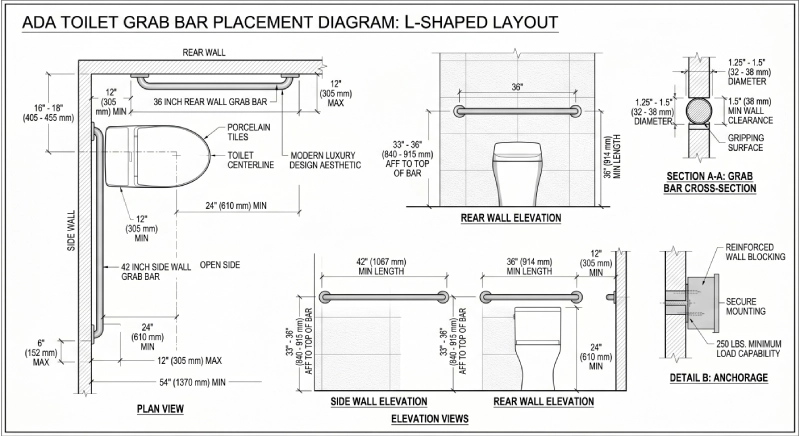
For toilet areas, the standard requires a 42-inch side wall bar (starting a maximum of 12 inches from the rear wall) and a 36-inch rear wall bar. This specific setup creates an L-shaped safety movement path, ensuring continuous support when sitting and standing. This ADA toilet grab configuration matches human movement perfectly. A common design flaw is placing the side bars too far forward, forcing the user to lean dangerously to reach them.
For a detailed breakdown of toilet-specific layout, structural requirements, and common installation risks, see our guide on ADA toilet grab bar requirements for residential projects.
What Are ADA Grab Bar Requirements for Showers?
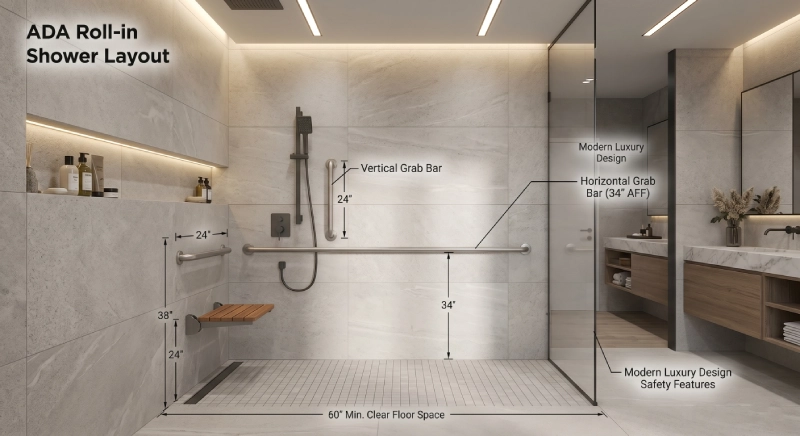
Shower setups demand continuous bars on three walls for roll-in designs, or strategically placed bars adjacent to built-in seats. Because showers are extreme slip-risk zones, mixing horizontal bars for balance and vertical bars at the entrance helps users safely cross wet thresholds. A major mistake to avoid is installing ADA shower grab bars directly behind a shower seat, which renders them completely inaccessible when the user is sitting down.
What Are ADA Grab Bar Requirements for Bathtubs?
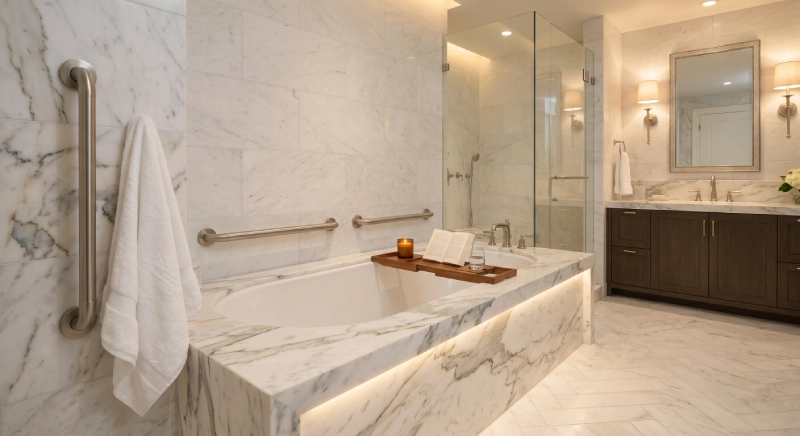
Bathtubs require vertical entry bars alongside two horizontal back-wall bars (one high and one low). This arrangement effectively manages the height constraint of stepping over a tub wall while navigating a wet, slippery surface. Never compromise by using temporary suction-cup bars instead of permanently mounted, high-capacity ADA bathtub grab bars.
While ADA bathtub grab bar requirements clearly define placement, height, and structural support, many developers and designers encounter a different challenge in real projects—how to integrate these safety elements without compromising the visual quality of high-end bathrooms.
In luxury villa environments, standard grab bars often create an overly institutional appearance that conflicts with the intended design language.
To explore how ADA bathtub grab bars can be both fully compliant and aesthetically integrated, see our detailed guide: How Developers Can Meet ADA Bathtub Grab Bar Requirements Without the “Hospital Look” in Luxury Bathrooms
This article outlines practical strategies for achieving ADA compliance while maintaining premium design standards in bathtub-focused bathroom projects.
What Happens When ADA Grab Bar Requirements Are Not Followed?
Ignoring these requirements leads to a complete breakdown of your bathroom’s structural safety system. For developers, compliance failures directly affect municipal approval timelines and cause severe construction cost escalation. You face immediate inspection failure, project delays, and massive liability exposure if an end-user gets hurt.
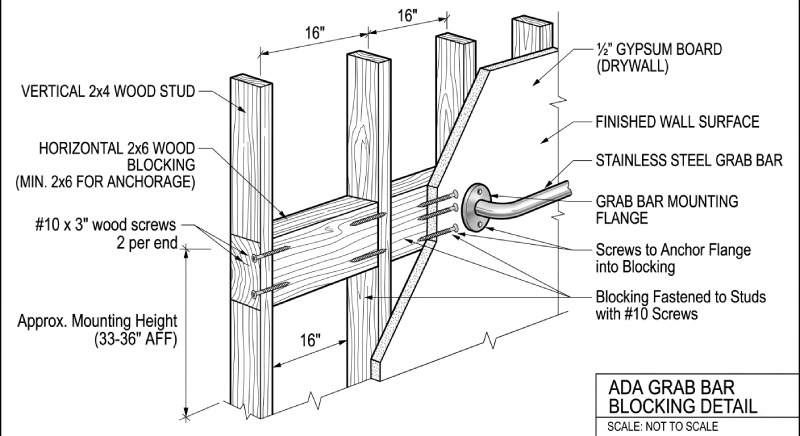
The most expensive consequence is the retrofit cost. Because the ada mandates a minimum 250-lb load capacity, failing to install solid wood or metal blocking behind the wall during the framing stage means you cannot simply screw a grab bar into drywall later. You will have to tear open expensive completed tile walls to install the necessary backing. This is why ada compliance must be planned during design, not corrected after installation.
Even when contractors follow general ADA guidelines, inspections often fail due to small but critical measurement errors such as the 33–36 inch height rule and wall positioning conflicts.
To understand the most common real-world mistakes that lead to failed inspections, see our detailed breakdown: ADA Bathroom Grab Bar Height: Why Contractors Still Fail Inspections (33–36 Inch Rule)
How Do You Choose ADA Grab Bars for Luxury Bathroom Design?
The right choice involves sourcing premium 304/316 stainless steel or solid brass hardware equipped with concealed mounting flanges and custom finishes. The true challenge is balancing strict ADA compliance with luxury bathroom aesthetics. High-net-worth clients want the safety of a hospital without the sterile, institutional appearance.
Specifying standard, exposed-screw chrome bars will instantly ruin a multi-million dollar interior design. At George Group, we solve this by providing custom PVD finishes (like Matte Black and Brushed Gold) that allow ADA compliant grab bars to blend seamlessly with your luxury faucets and shower hinges.
Many developers assume that selecting ADA-compliant products guarantees project success. In reality, most failures happen during installation.
Learn how to prevent these issues with our complete guide to ADA Grab Bar Installation for Luxury Residential Projects.
What Should Developers Consider When Buying Grab Bars in Bulk?
Bulk purchasing requires a highly strategic procurement process tailored for large-scale villa or hotel projects. Grab bars should be treated as standardized architectural components within residential construction systems, not interchangeable accessories. You need a supply chain built on firm standardization logic.
A fatal flaw is buying strictly on the lowest unit price. You must evaluate the supplier’s MOQ, tiered pricing, and lead time stability. If the brushed gold finish of batch one doesn’t match batch three, or if products are poorly packaged and arrive scratched, your project handover will be severely delayed. Consistency across batches is critical for large-scale residential delivery.
Do ADA Grab Bar Suppliers Provide CAD or BIM Files?
Top-tier suppliers will always provide accurate 2D CAD blocks and 3D BIM/Revit models for architectural integration. This level of support ensures your design intent is fully translated into construction execution. By integrating the exact ADA grab bar dimensions into your digital model, your team can perform clash detection early, reducing cross-disciplinary coordination errors between architects, contractors, and suppliers during construction. This significantly reduces on-site errors and rework costs.
Guessing spatial constraints on-site is a recipe for disaster. Without BIM files, contractors often install grab bars where they block toilet paper dispensers or interfere with shower valve operation.
Why Developers Choose Professional ADA Grab Bar Manufacturers?
Finding a trusted manufacturer mitigates project headaches. Developers choose professional suppliers like George Group because we understand both strict compliance and high-end luxury.
We do not just sell metal bars; we provide certified laboratory reports proving our products exceed the 250-lb structural constraint.
Typical Standard Factory
George Group High-End Series
FAQs About ADA Grab Bar Requirements
1. What are ADA grab bar requirements for residential projects in 2026?
They define the required height (33–36 inches), diameter (1.25–1.5 inches), wall clearance (1.5 inches), load capacity (minimum 250 lbs), and placement zones in toilets, showers, and bathtubs.
2. What is the standard ADA grab bar height in residential bathrooms?
The mandatory ADA grab bar height is 33 to 36 inches, measured strictly from the finished floor level (FFL) to the top of the gripping surface. Failing to account for tile and leveling layers is a common installation error.
3. What materials are best for ADA-compliant grab bars?
For luxury residential projects, premium Grade 304 or 316 Stainless Steel, or solid Brass, are the best choices. They provide the necessary structural strength to exceed the 250-lb load requirement while resisting rust in highly humid environments.
4. What happens if ADA grab bars are installed incorrectly?
Incorrect installation destroys the safety movement path, leading to immediate municipal inspection failures. This causes project delays and incurs massive retrofit costs, as fixing poorly supported bars requires tearing down finished luxury tile walls to install structural blocking.
5. Are ADA grab bars required in villa developments?
While private single-family villas are sometimes legally exempt from strict federal codes, leading developers treat ADA standards as mandatory. Integrating them future-proofs the property, reduces developer liability, and increases ROI by appealing to buyers looking for multi-generational, aging-in-place designs.
6. Can ADA grab bars be customized for high-end bathrooms?
Absolutely. You can balance strict spatial design constraints with luxury aesthetics. Professional B2B suppliers offer custom lengths, concealed mounting hardware, and premium PVD finishes (like brushed gold or matte black) to completely eliminate the institutional “hospital look.”
Conclusion: ADA Compliance is the Future of Luxury Design
Navigating ADA grab bar requirements doesn’t have to be a bottleneck in your residential bathroom projects. As we have explored, these spatial design and engineering constraints are not just about passing municipal inspections. They are about creating safe, inclusive, and high-value spaces that stand the test of time. By planning your structural blocking early, calculating from the exact finished floor level, and choosing the right concealed-mount hardware, you can perfectly balance strict safety standards with multi-million dollar aesthetics.
At George Group, we treat your compliance and design goals with the highest level of engineering rigor. Do not leave your project approval and interior aesthetics to chance. Let us help you execute your design intent flawlessly.
Whether you are at design stage or procurement stage, early planning ensures compliance and cost control.
Ready to secure the best ADA solutions for your next project?
Take action today and choose the right support for your stage:
- Procurement: Request a physical sample to verify premium custom finishes and structural quality.
- Decision: Get a custom project quote for bulk pricing and guaranteed lead times.
References
U.S. Access Board: 2010 ADA Standards for Accessible Design – Chapter 6: Plumbing Elements and Facilities (Section 609: Grab Bars)
Department of Justice (ADA.gov): 2010 ADA Standards for Accessible Design Official Documentation
We provide integrated one-stop bathroom solutions covering tubs, sanitaryware, fittings, and system coordination for hotel and commercial projects.
▼ Submit the form below to connect with our team and explore project-based collaboration. ▼