
Hi there! I’m Helen, and I’ve spent the last ten years navigating the intricate world of the sanitary ware industry. If you’re a luxury villa developer, a residential project consultant, or someone in a construction coordination role, you know that the “devil is in the details.”
Over the past decade at George Group, I’ve seen countless high-end developments in the US, Australia, and the Middle East. One thing I’ve learned? An ADA shower grab bar requirement isn’t just a “checkbox” for compliance. It’s a critical safety and structural feature. In many projects, ADA issues are only discovered during the final inspection—when rectification means tearing down walls, facing massive demolition costs, and enduring project-crippling delays. In most cases, these issues are not reversible without destroying finished work.
In high-end villa projects, accessibility is no longer a compromise—it is part of a more refined and user-centered living experience. For projects targeting families or elderly users, they play a vital role in safety. If you integrate them early into your on-site reality, you reduce retrofit risks and minimize post-handover complaints. Let’s dive into how you can get this right the first time.
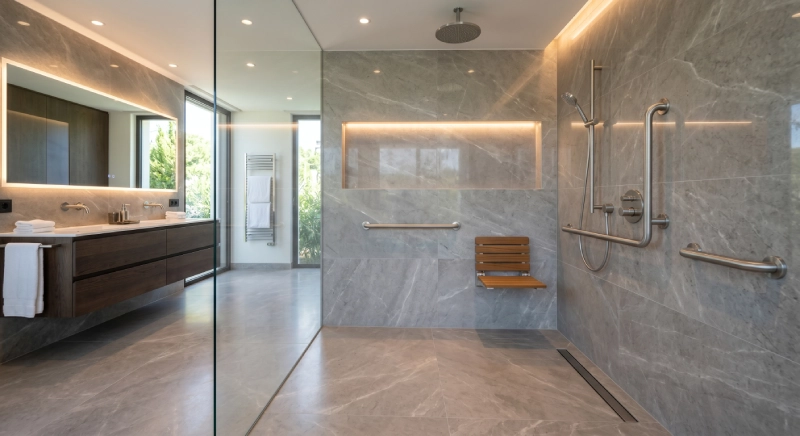
Table of Contents
What are the ADA requirements for shower grab bars?
When we talk about the basic rules, we are looking at guidelines designed to ensure safe use for any person, regardless of physical ability.
The basics are straightforward:
Height: The exact ADA shower grab bar height must be between 33 and 36 inches above the finished floor.
Diameter: The gripping surface must be 1.25 to 1.5 inches thick.
Weight Capacity: They must support a vertical or horizontal force of at least 250 lbs.
Spacing: There must be a 1.5-inch clearance between the bar and the wall.
However, in real villa projects, compliance isn’t just a list of numbers. It is determined by how these dimensions are translated into practical installation within complex spatial layouts. A perfectly manufactured bar won’t save a poorly planned bathroom. Ultimately, failure originates from execution, not specification.
Where should grab bars be placed in an ADA shower?
The “where” is just as important as the “what.” Many project teams procure the right hardware but fail entirely on the ADA shower grab bar placement.
Depending on your villa’s layout, placement spans three areas:
The Control Wall: Where the showerhead and valves are located.
The Back Wall: The longest wall of the shower.
The Side Wall: The wall opposite the controls.
This is where a dangerous “design intent vs ADA requirement mismatch” often occurs. In many cases, bars are installed on the “visually correct” wall favored by the interior designer, rather than the legally required wall—leading to immediate inspection failure. This disconnect between design and practical installation is one of the most common causes of rework. This is typically where field coordination between designers and site teams breaks down.
What are the differences between ADA shower types (transfer vs roll-in)?
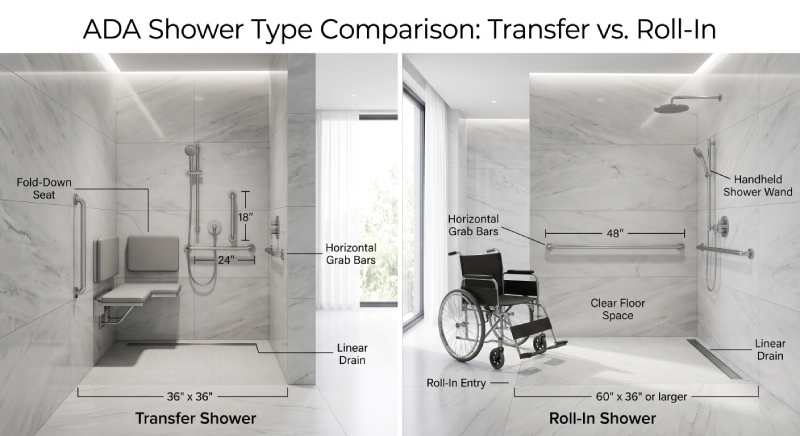
Choosing the wrong layout for your specific shower type is a guaranteed way to fail compliance, especially in multi-unit villa developments where even small inconsistencies can scale into significant risks.
Transfer Shower (36" x 36")
Roll-in Shower (60" min width)
From a developer’s perspective, roll-in showers are increasingly preferred in luxury villas due to their seamless, open spatial experience. However, they carry extreme coordination complexity and high tolerance sensitivity during installation.
What is the correct height for ADA shower grab bars?
As mentioned, the official ADA shower grab bar height is 33 to 36 inches. But here is a critical piece of field coordination advice: Aim for 34 or 35 inches.
This reduces sensitivity to site-level variation during finishing works. This buffer accounts for tile thickness, slope variation, and on-site installation tolerance. This is especially critical in luxury projects using natural stone, thick marble, or heavy porcelain finishes, where a millimeter-level variation can affect compliance. If your installer aims for exactly 33 inches on the rough-in and the marble floor ends up a fraction higher, you’ve just failed inspection.
How much weight must ADA grab bars support?
The code states that grab bars must support 250 lbs of force. But here is the catch: Load capacity depends as much on the ADA shower grab bar installation as on the product itself.
In practice, improper anchoring into non-structural walls is the leading cause of hidden compliance failure. You can buy the highest-grade stainless steel bar, but if it’s screwed into just drywall, it will fail. The worst part? This structural weakness is usually only discovered during a final inspection or a physical load test, right before handover.
Do ADA grab bars require wall reinforcement?
This is a high-stakes question. The answer is a resounding YES.
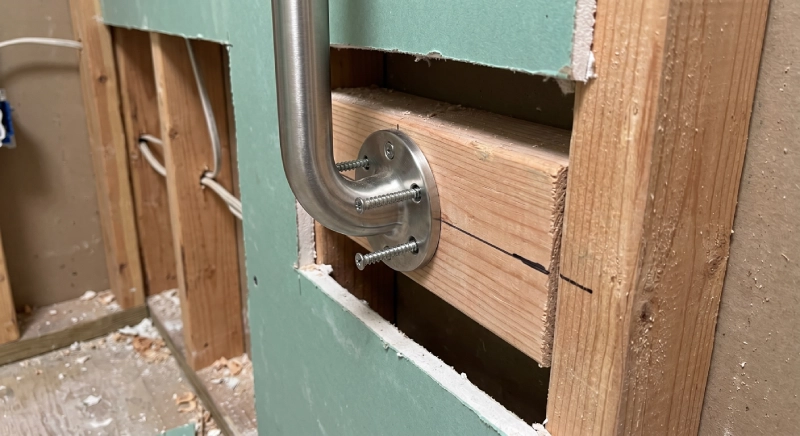
Without structural reinforcement, even certified grab bars will fail. You cannot rely on toggle bolts or drywall anchors for a B2B commercial or high-end residential project. You need:
Wood Blocking: Typically 2×6 or 2×8 lumber installed between studs.
Steel Backing: 16-gauge steel plates if using metal studs.
This step must be completed before waterproofing and tiling. Once finishing work is completed, you enter an irreversible stage. At this point, compliance becomes dependent on demolition rather than correction. If you miss this window, retrofitting reinforcement triggers a massive cost multiplier effect, requiring you to destroy and rebuild the finished wall.
How do grab bars interact with other shower elements?
ADA compliance is not achieved by installing grab bars alone—it depends on how they interact with other spatial elements during practical installation.
Shower Seat: Grab bars must align with the seat height for safe transfer.
Control Valve: Users must be able to operate controls without the bar blocking access.
Glass Door & Entry: Door swings must not interfere with grip zones.
Most ADA failures in villa projects are not product failures, but coordination failures. Meeting the code requires a paradigm shift: ADA is a field coordination effort, not just a standalone fixture.
What are the most common ADA shower grab bar installation mistakes?
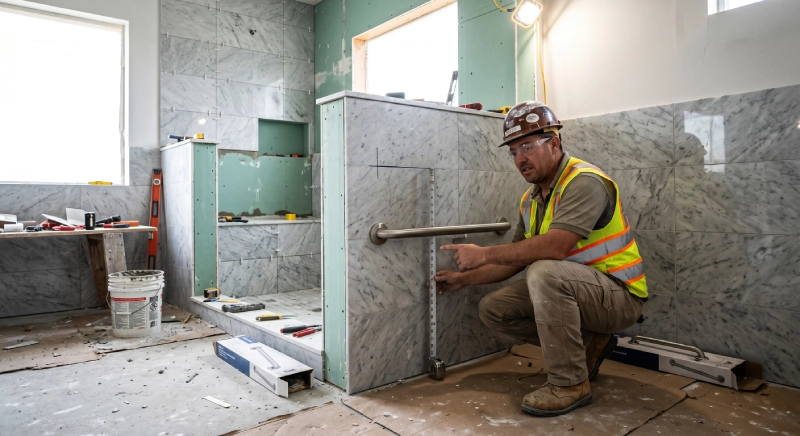
After a decade in B2B sanitary ware, I’ve seen the same expensive errors repeat themselves on site:
Installing bars upside down: Some directional bars have specific orientations.
Wrong Placement: Misinterpreting the ADA shower grab bar placement rules and putting the bar on the wrong wall.
Interference with Equipment: Placing the bar too close to soap dispensers.
Ignoring the Finish: Using slippery, polished finishes. For ADA shower grab bars for children or the elderly, a “brushed” or “peened” surface is practically safer.
Lack of Wall Blocking: Closing walls before structural backing is verified.
Multi-unit inconsistency: Allowing different trades to interpret the layout differently across multiple villas, leading to inconsistent execution and immense inspection risk.
How do you ensure ADA compliance in a real project?
To ensure your villa project passes inspection, you need a clear project scenario, not just a purchase order.
Phase 1: Design. Ensure placement points are marked precisely on the architectural drawings.
Phase 2: Rough-in. Verify the structural blocking is in place before the walls are closed.
Phase 3: Procurement. Partner with a reliable B2B supplier.
Phase 4: Pre-Inspection. Validate measurements with a tape measure before the official inspector arrives.
Projects that follow this strict sequence significantly reduce coordination errors between architects, MEP engineers, and site contractors.
What grab bar sizes and specifications should you procure for projects?

Rather than selecting grab bars individually, most large-scale villa projects standardize a complete grab bar package across all units, especially in multi-unit villa developments. This provides immense multi-project replication value, improving consistency across sites and reducing ADA shower grab bar installation errors caused by fragmented procurement.
At George Group, we recommend standardizing the following:
Material: Stainless Steel 304 (standard) or 316 (for coastal developments).
Sizes: Maintain standard sets of 18”, 36”, 42”, and 54” bars.
Mounting Kits: Heavy-duty flange covers for a clean, luxury finish.
Real Project Scenario: Field Coordination in a Saudi Arabia Luxury Villa
To understand how proper procurement and field coordination prevent on-site failures, let’s look at our recent Saudi Arabia Luxury Villa Bathroom Project.
The Challenge: A private luxury villa in Riyadh required 15 custom bathrooms. For a multi-unit property of this scale, relying on local trades to interpret layout intent unit-by-unit is a recipe for non-compliance and mismatched fixtures.
The Solution: George Group stepped in to provide a complete turnkey solution—manufacturing everything under one roof to ensure zero compromise.
The On-Site Reality:
3D Installation Blueprints: We didn’t just ship products. We provided step-by-step 3D blueprints that dictated exact spatial layouts. This eliminated the typical “design vs. site” mismatch, ensuring blocking and ADA shower grab bar placement were perfectly coordinated before the walls were closed.
Aesthetic Continuity: Because we supplied the entire package, we ensured that heavy-duty safety features matched the premium PVD-coated brushed champagne gold finishes of the bespoke vanities and faucets.
Logistical Precision: To prevent on-site chaos and incorrect installations across the 15 units, every crate was meticulously packed and labeled by specific room (e.g., “Master Bath A”, “Guest Bath 3”).
By treating the bathrooms as a coordinated project scenario rather than a list of individual parts, we eliminated the guesswork for the local installers, ensuring a spectacular, compliant result.
FAQ: ADA Shower Grab Bar Requirements for Projects
1. Are ADA grab bars required in all villa projects?
No. ADA is mandatory in public and specific residential projects in the U.S., but developers increasingly adopt them voluntarily in luxury villas to future-proof the asset.
2. Can ADA grab bars be installed after finishing?
Technically yes, but it triggers a cost multiplier. Without pre-installed reinforcement, retrofitting causes severe tile damage.
3. Who is responsible for ADA compliance on site?
Ultimately, the developer bears the financial risk of rework. However, daily compliance relies on tight field coordination between the architect drawing the plans, the framing crew installing the blocking, and the tile installers managing the final wall thickness.
4. Do inspectors measure ADA grab bar height differently across states?
While the federal ADA code is universal, local inspectors often have different practical tolerances during their walkthroughs. This is why we always recommend aiming for a 34 to 35-inch height—it creates a safe buffer against strict local scrutiny.
5. Can ADA grab bars be adjusted after tile installation?
No, not easily. Because grab bars require heavy-duty structural blocking behind the wall, adjusting a bar’s location after the tile is set generally requires breaking the tile, cutting into the wall, and redoing the waterproofing.
6. What material is best for grab bars in coastal villas?
For coastal or highly humid environments, Stainless Steel 316 provides the necessary corrosion resistance over standard 304.
How to avoid ADA inspection failure and rework?
Rework is the silent killer of project margins. Moving a grab bar by two inches means replacing premium tiles, re-doing waterproofing membranes, and delaying the final handover.
From ADA Requirements to Practical Installation To ensure compliance without rework, projects must adopt this on-site reality sequence:
Layout planning based on shower type
Reinforcement validation before finishing (the irreversible stage)
Coordinated placement with MEP fixtures
Standardized, project-wide procurement
Pre-inspection site verification
This approach transforms ADA compliance from an unpredictable site risk into a controlled project scenario that protects your margins across multiple units.
Partner with George Group for Your Next Project
If you’re currently in the design or pre-construction phase of a luxury villa development, we can help you validate your on-site reality before construction begins. Don’t leave compliance to chance or field guesswork.
Take action today to secure your project:
Send us your bathroom drawings for a free ADA layout validation.
Request a B2B procurement quote for standardized, compliance-ready grab bar packages.
Contact George Group today and let me, Helen, help you coordinate a flawless, inspection-proof accessibility plan for your developments.
References & Data Sources
U.S. Access Board (ADA 2010 Standards for Accessible Design):
Section 609 (Grab Bars): Official specifications for the 33–36 inch mounting height, 1.25–1.5 inch gripping diameter, 1.5-inch wall clearance, and 250 lbs minimum load capacity.
Section 608 (Shower Compartments): Official spatial layout and dimensional requirements for 36″ x 36″ Transfer Showers and 60″ minimum Roll-In Showers.
Source: Access-Board.gov – Chapter 6: Plumbing Elements and Facilities
George Group Project Case Study:
Saudi Arabia Luxury Villa Bathroom Project: Real-world application of standardized procurement, 3D installation blueprints, and field coordination in a multi-unit luxury development.
Source: George Group Official Site
We provide integrated one-stop bathroom solutions covering tubs, sanitaryware, fittings, and system coordination for hotel and commercial projects.
▼ Submit the form below to connect with our team and explore project-based collaboration. ▼