
Many hotel and apartment developers pick premade vanities to save money — then spend more fixing gaps, mismatched finishes, and poor fits across dozens of rooms.
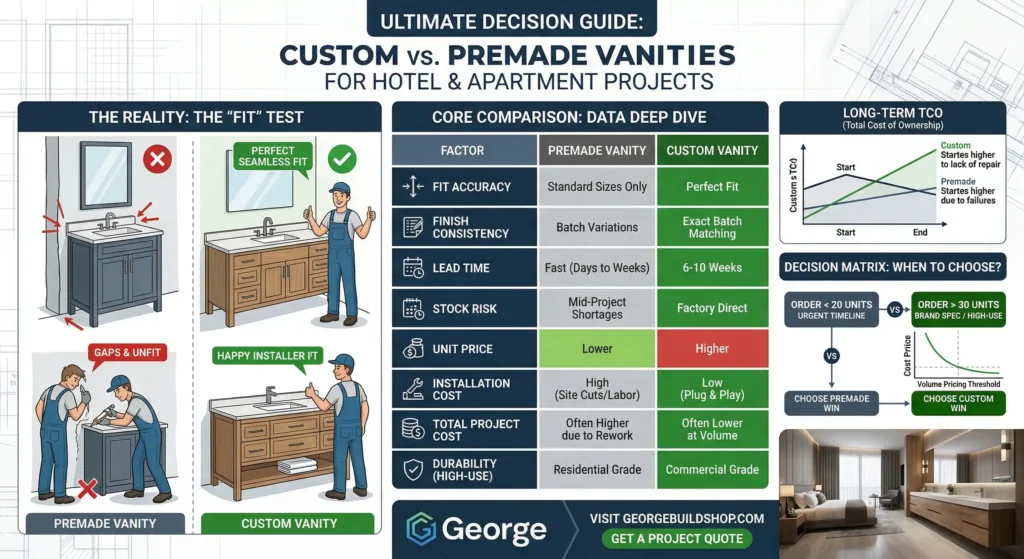
Custom bathroom vanity vs premade is not just a price question. For multi-unit projects, custom vanities fit exact spaces, match brand styles, and reduce rework. Premade units work best when layouts are standard, deadlines are tight, and the budget allows no flexibility on lead time.
I have worked with buyers from hotel chains, apartment developers, and real-estate firms across the Middle East and Southeast Asia. The choice between custom and premade comes up in almost every project. The answer is not the same for everyone. Let me walk you through the key factors I look at.
Table of Contents
Why Does This Choice Matter More in Hotel, Resort, and Apartment Projects?
A small size error in a single home is easy to fix. The same error across 200 hotel rooms becomes a very expensive problem.
In hotel, resort, and apartment projects, each room must look the same and function the same. One wrong vanity size means rework in every room. Hotel bathroom cabinets must also match brand color standards and survive daily guest use. That raises the stakes far beyond a typical home purchase.
Consistent Finish Across All Rooms
Premade vanities come in fixed finishes. If a batch changes slightly between orders, rooms will not match. I have seen this cause serious complaints from hotel brand managers.
Exact Fit for Non-Standard Layouts
Most hotel bathrooms are not built to standard bathroom vanity cabinet sizes. Walls shift. Plumbing moves. A premade unit leaves gaps or blocks access panels.
Brand Standard Matching
Hotel brands have strict style guides. Custom vanities can be built to match exact colors, hardware styles, and surface textures. Premade units rarely meet those specs without modification.
| Factor | Custom Vanity | Premade Vanity |
|---|---|---|
| Finish consistency | High | Medium |
| Fit accuracy | High | Low to medium |
| Brand style match | High | Low |
When I talk to procurement managers like Emma, they always bring up the same pain point — one supplier runs out of a finish mid-project, and suddenly half the rooms look different. With custom production, the factory holds your spec on file. Every unit from batch one to batch ten matches. That alone saves hours of coordination and thousands in touch-up costs.
Which Option Fits a Project Budget and Timeline Better?
Budget and timeline pull in opposite directions for most buyers. Premade feels cheaper at first. Custom feels slower. But neither point is always true.
Premade vanities have lower unit prices and ship faster from stock. Custom vanities cost more per unit and need 4–8 weeks of lead time. For tight deadlines, premade wins. For large orders where rework costs are high, custom often costs less in total.
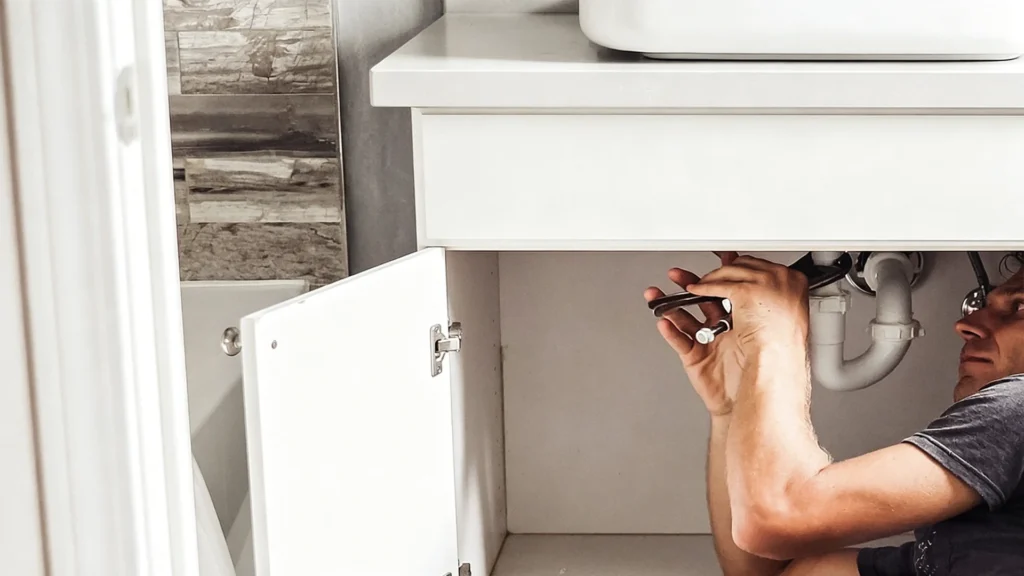
Unit Price vs Total Project Cost
Premade unit prices look attractive. But when you add delivery delays, site cuts, filler panels, and touch-up labor, the real cost rises fast.
Lead Time Planning
Custom bathroom vanity sizes require production time. I always tell clients to plan 6–10 weeks ahead. That time investment pays off when installation goes smoothly.
Stock Risk for Premade
Premade vanities depend on warehouse stock. Large projects may face mid-run shortages. That breaks timelines just as badly as a slow production run.
| Factor | Custom Vanity | Premade Vanity |
|---|---|---|
| Finish consistency | High | Medium |
| Fit accuracy | High | Low to medium |
| Brand style match | High | Low |
One client I worked with in Dubai ordered premade units for a 150-room hotel to save six weeks of wait time. On arrival, 30 units had a finish mismatch from a second production batch. Re-ordering took four weeks. The total delay matched the original custom lead time — with extra cost added. Planning ahead with custom production removes that risk entirely.
Project Snapshot: 150-Room Dubai Hotel
- ⚠️ Pain Point: Premade stock caused a 4-week delay and 30 mismatched room finishes.
- 💡 Solution: Transitioned to our One-Stop Custom Bathroom & Vanity Design service.
- ✅ Result: 100% finish consistency, zero on-site rework, and on-time project handover.
Which Option Causes Less On-Site Rework and Installation Trouble?
Installation problems are where most project budgets leak. Buyers rarely track this cost until it is too late.
Custom vanities are built to the exact dimensions of each bathroom. This means fewer gaps, no filler strips, and faster installation. Premade vanities often need on-site cutting, caulking, and panel additions to fill non-standard spaces. In multi-unit projects, that extra labor adds up fast.
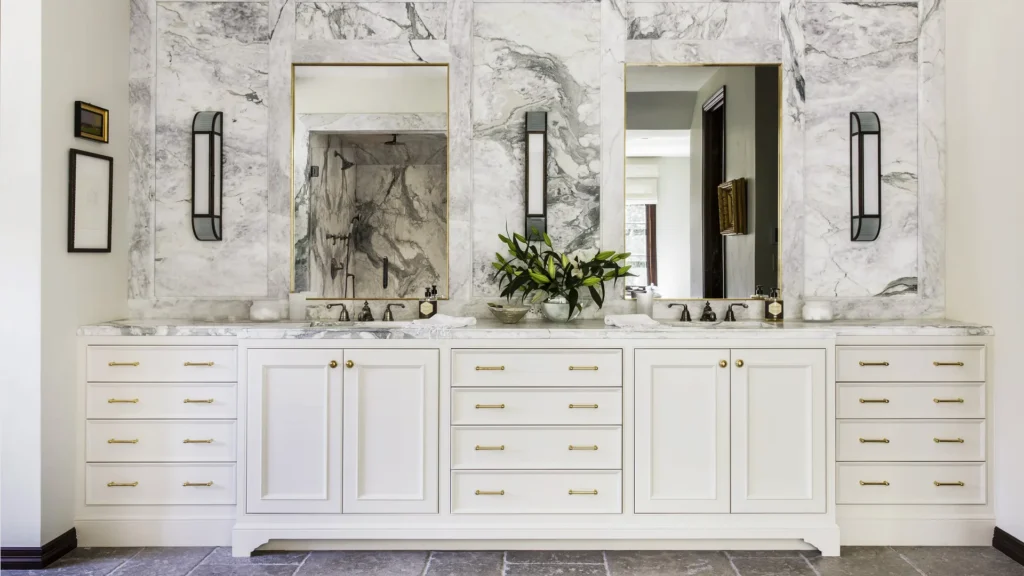
Gap and Fit Issues
Standard bathroom vanity cabinet sizes do not match every bathroom. When a premade unit is 2–3 cm too short, the installer fills the gap with caulk or a filler panel. It looks cheaper and takes more time.
Plumbing Alignment
Custom vanities are designed around the actual plumbing location. Premade units require flexible hose extensions or drilling to realign. That adds cost and failure risk over time.
Installation Speed Per Room
A well-planned custom vanity drops into place and connects in less time than a premade unit that needs site modification. Across 100 rooms, that speed difference matters.
| Issue | Custom Vanity | Premade Vanity |
|---|---|---|
| Gap filling needed | Rare | Common |
| Plumbing realignment | Rare | Common |
| Installation time per room | Shorter | Longer |
I once walked a job site where the contractor had spent two full days per floor just adding filler strips to premade vanities. The project manager had not budgeted for that labor. When I added up the cost across twelve floors, the “cheaper” premade option had cost more than custom would have. The lesson is simple: measure the real cost, not just the unit price.
Can Custom Bathroom Vanity Pricing Get Close to Premade in Large Orders?
Most buyers assume custom always costs more. That is true for single units. It is not always true for large project orders.
Custom bathroom vanity cost drops significantly at volume. For orders above 50–100 units, factory setup costs spread across the full run. Material purchasing improves. Some Foshan factories can match or come very close to wholesale bathroom vanity with sink pricing when the order is large and the design is not complex.
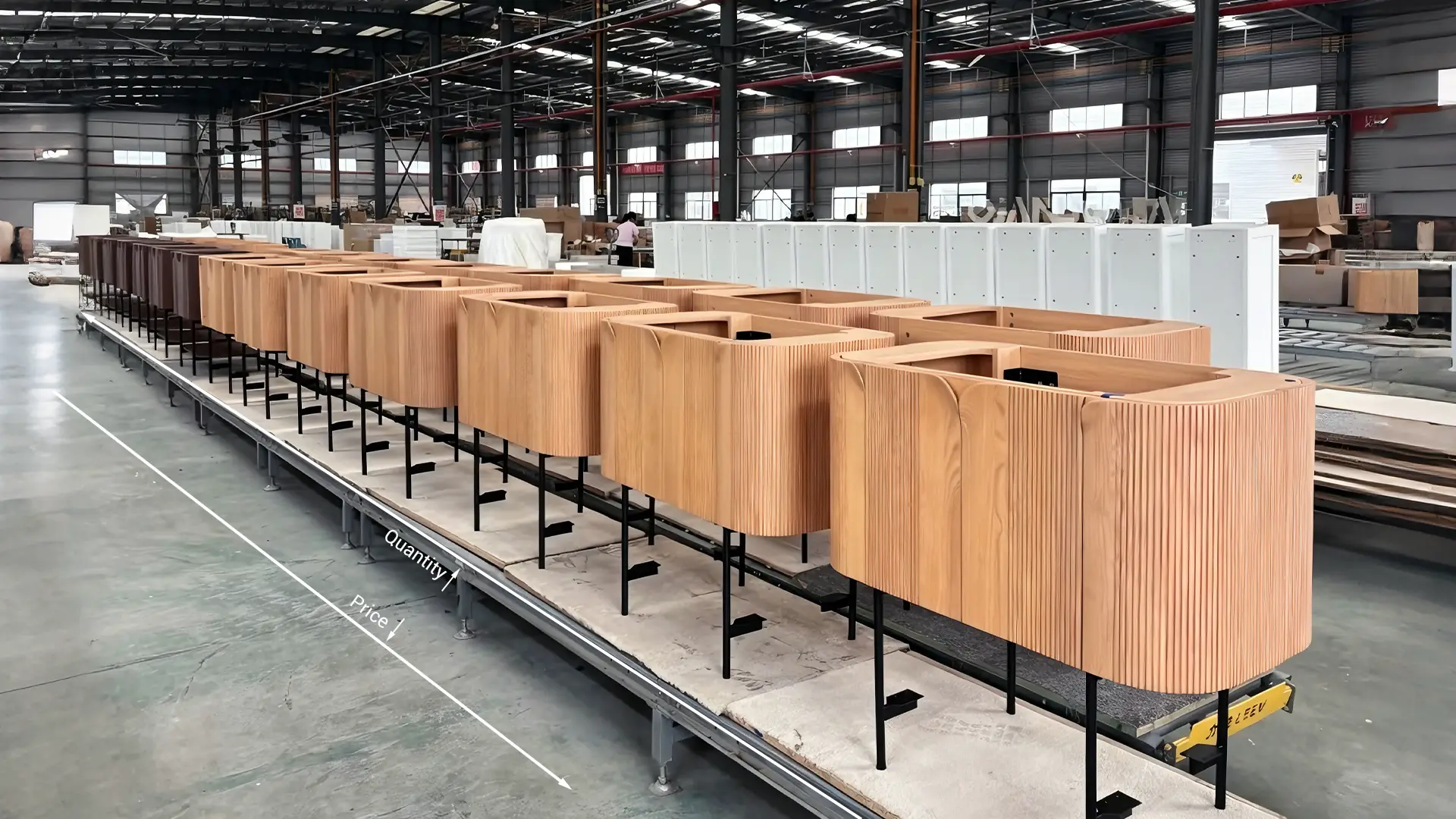
Volume Pricing Thresholds
Factories set up custom runs with fixed setup costs. The more units in the order, the lower the per-unit cost. At 100+ units, pricing becomes very competitive.
Design Complexity Factor
Simple door styles, standard finishes, and basic hardware keep custom costs low. Complex carvings or rare materials raise them. Most hotel projects use clean, simple designs that keep pricing reasonable.
Factory Location Advantage
Foshan factories carry lower labor and material costs than most Western alternatives. Working directly with a Foshan supplier removes middleman markups from wholesale bathroom vanity with sink orders.
| Order Size | Custom Price Level | Premade Comparison |
|---|---|---|
| Under 20 units | High | Premade cheaper |
| 20–100 units | Medium | Close |
| 100+ units | Low | Often equal or better |
I source from Foshan factories directly. When a client brings a clean design and an order over 80 units, I can usually negotiate pricing that surprises them. The key is keeping the design simple and giving the factory enough lead time. Complex finishes and rushed timelines are the two biggest drivers of custom price increases. Control those two factors and custom pricing becomes very practical.
Which Option Offers Better Long-Term Value in High-Traffic Projects?
A hotel bathroom vanity is used by a different person almost every night. That is very different from a home bathroom. Durability matters much more.
Custom vanities built for hotel use can be specified with commercial-grade board, moisture-resistant coatings, and heavy-duty hardware. Premade vanities are mostly built for home use. They are not always rated for the daily wear of hotel environments. Over a 5–10 year period, custom vanities often cost less in maintenance and replacement.
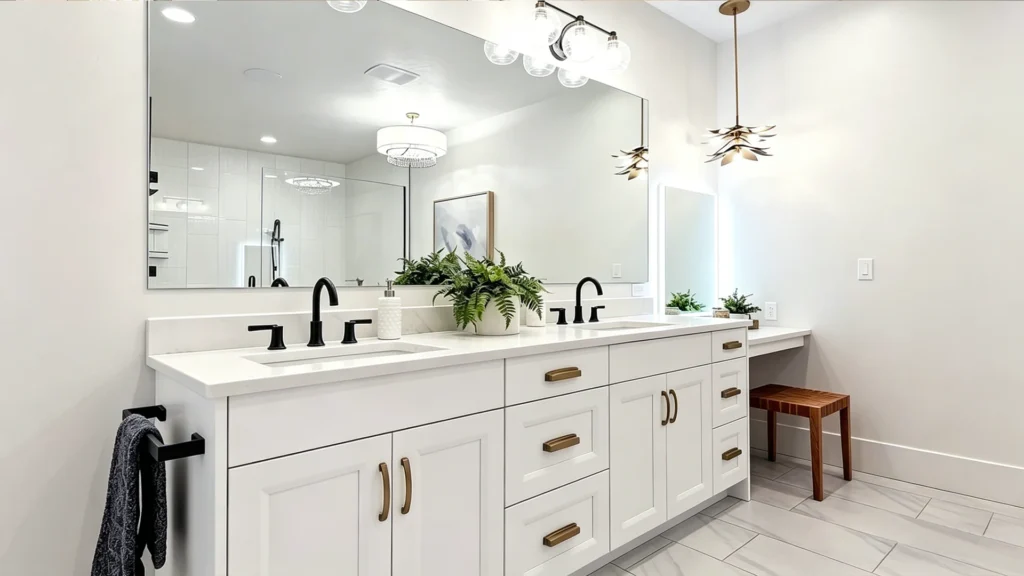
Board and Core Material
Hotel-grade custom vanities use moisture-resistant MDF or plywood cores. Many premade units use standard particleboard. In a high-humidity bathroom used daily, that difference shortens the premade unit’s life.
Hardware Durability
Custom orders allow buyers to specify commercial-grade hinges, drawer slides, and handles. Premade units include standard residential hardware. That hardware wears out faster under daily hotel use.
Replacement and Repair Cost Over Time
When a hotel bathroom cabinet fails, the cost is not just the part. It includes labor, room downtime, and guest experience impact. Units built to last 10 years instead of 5 years cut that cost in half.
| Factor | Custom (Hotel-Grade) | Premade (Residential) |
|---|---|---|
| Core material | Moisture-resistant | Standard |
| Hardware grade | Commercial | Residential |
| Expected life (high-traffic) | 8–12 years | 4–7 years |
I have seen premade vanities in a budget hotel show swelling drawer fronts within 18 months. The property had to replace 40 units in year two. The original saving of $30 per unit turned into a $12,000 replacement bill — plus labor and room downtime. When I help clients plan a vanity spec, I always ask about the expected project life. That number changes the math completely.
How Should Developers, Contractors, and Procurement Teams Choose the Better Option?
The right choice depends on your project type, order size, and how much risk you can accept during installation and over the product’s life.
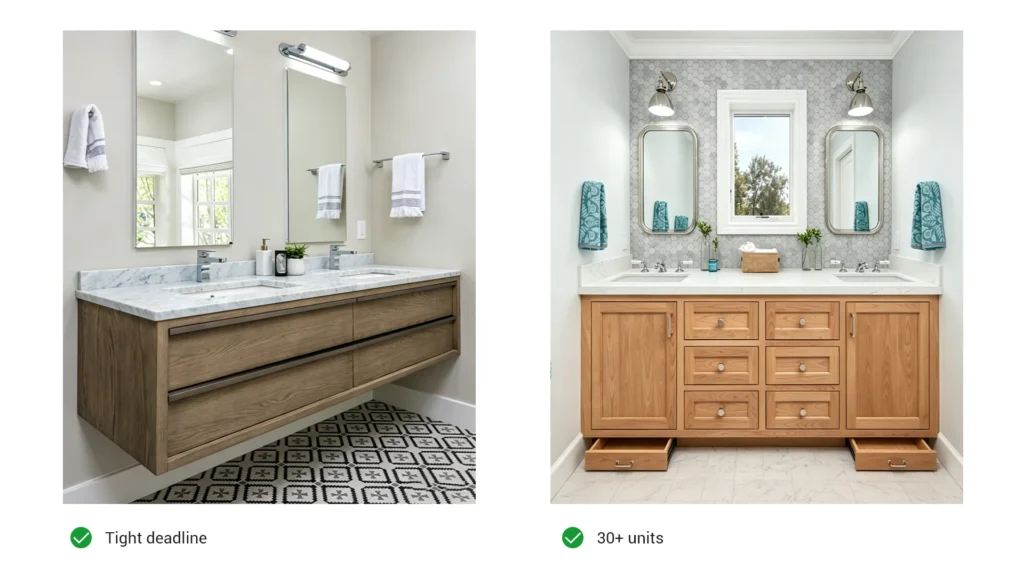
Choose custom bathroom vanity for projects with 30+ units, non-standard layouts, brand finish requirements, or long product life goals. Choose premade when the layout is standard, the deadline is very tight, and the order is too small to justify custom setup costs.
Step 1: Check Your Layout First
Measure every bathroom in the project. If more than 20% of rooms have non-standard dimensions, custom is the safer option. One size does not fit all in real hotel or apartment construction.
Step 2: Calculate Total Cost, Not Unit Cost
Get a full cost estimate including installation labor, filler panels, and expected maintenance. Compare that number — not just the unit price — against a custom quote for the same project.
Step 3: Plan Your Timeline Early
Custom requires 6–10 weeks of production time. If you contact a Foshan supplier early in the design stage, you can get custom vanities without delaying your build schedule.
| Situation | Better Choice |
|---|---|
| 100 hotel rooms, brand spec | Custom |
| 10 apartment units, standard layout | Premade |
| Tight deadline, no room to wait | Premade |
| Non-standard sizes, long project life | Custom |
I always tell procurement teams to make this decision at the design stage, not the purchasing stage. When you decide late, you lose negotiating power with factories and lose time in the build schedule. The teams that get the best results are the ones who bring their floor plans to a supplier early, ask for a full custom quote, and compare it honestly against premade total costs. That is the only fair comparison.
Conclusion
Custom bathroom vanities work better for most hotel, resort, and apartment projects. Premade works when speed and small orders matter most. Have a project to discuss? Visit georgebuildshop.com and reach out to Helen directly.
Ready to Eliminate Project Risks and Save on Total Costs?
Choosing the right vanity is just the beginning. Whether you are outfitting a luxury resort or a massive apartment complex, you need a partner who understands the stakes of high-volume commercial projects.
As your one-stop building materials and sanitary ware supplier, we go beyond manufacturing custom vanities in our Foshan facilities. We offer complete bathroom space design and a full suite of sanitary products. Tell us about your layout, deadlines, and brand requirements below, and our expert team will provide a comprehensive project quote to keep you on budget and on time.