
Many project buyers ask about custom bathroom vanity cost and get a factory price, then later discover that number was only part of the story. The real cost hits at the job site. By then, it is too late to change suppliers.
A custom bathroom vanity typically costs between $300 and $2,500+ per unit at factory price, depending on size, material, countertop, and finish. But for hotel, resort, and apartment projects, the total landed cost — including freight, packaging, installation, and rework risk — can be 30% to 60% higher than the quoted cabinet price.
I have worked with procurement buyers across the Middle East, Southeast Asia, and Europe. Almost every one of them came to me after a bad experience with a low quote. This article will walk you through every cost layer so you can budget correctly from the start.
Table of Contents
What Is the Real Cost of a Custom Bathroom Vanity for Project Buyers?
If you only look at the unit price, you are missing most of the picture. Many project buyers have told me the same thing: the vanity looked affordable until the shipping invoice arrived. Then the site issues began.
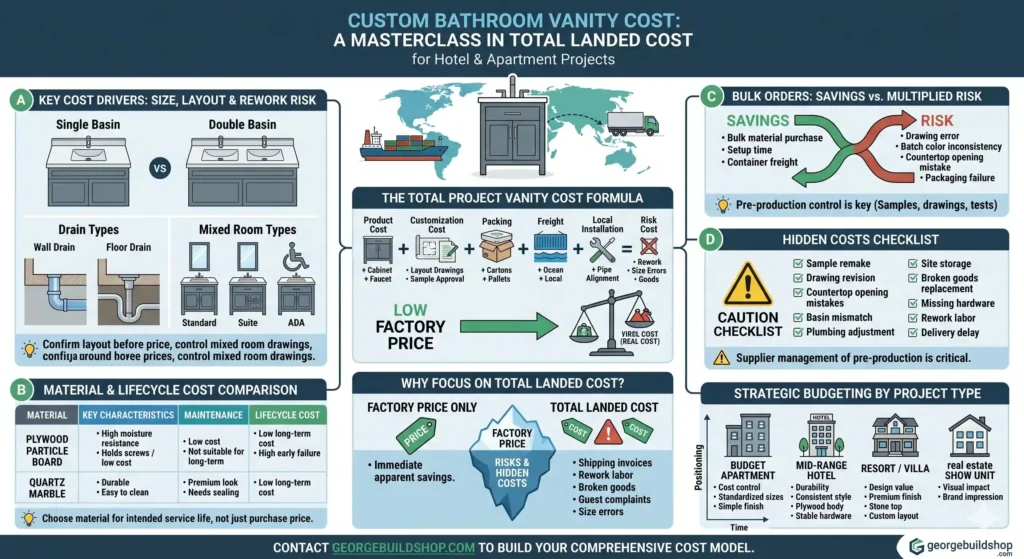
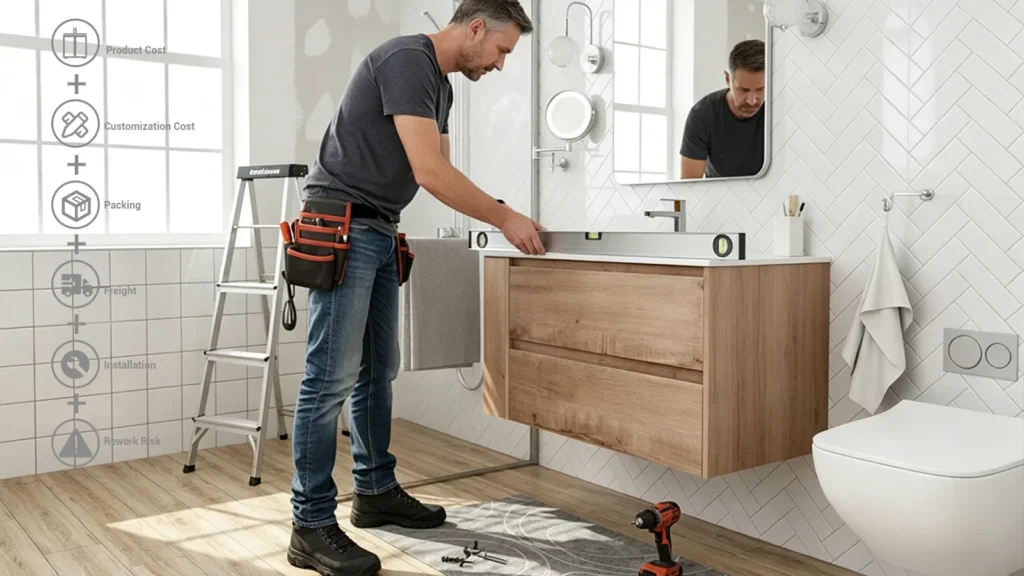
The real cost of a custom bathroom vanity for project buyers includes cabinet cost, countertop, basin and faucet matching, hardware, customization, packaging, freight, installation, and rework risk. The correct formula is: Total Project Vanity Cost = Product Cost + Customization Cost + Packing + Freight + Local Installation + Risk Cost.
Cabinet Cost
This covers the vanity body, drawer boxes, doors, internal structure, and surface finish. Plywood cabinets cost more than particle board, but they last longer in humid bathroom environments. For hotel and apartment projects, the cabinet cost is the base, not the total.
Countertop Cost
Quartz, sintered stone, marble, ceramic, and artificial stone all carry different prices. Countertop cost also includes cutting, edge treatment, and basin opening. A wrong basin opening on a bulk order can stop an entire installation. I have seen this happen.
Basin and Faucet Matching
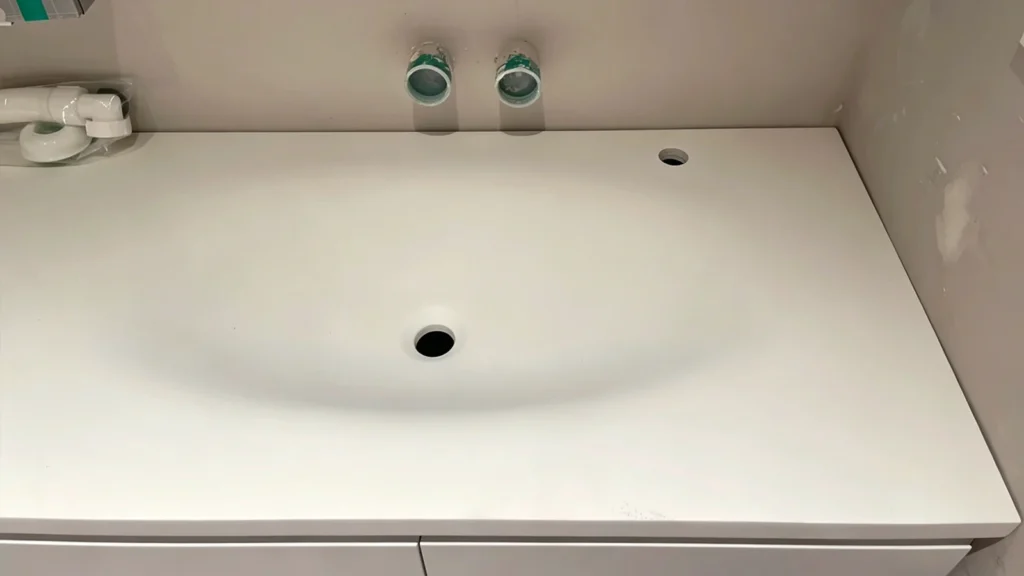
Integrated basins, under-mount sinks, and vessel sinks each require different countertop openings and faucet hole positions. If the basin type is confirmed late or changed after production, the countertop becomes scrap. This cost is often invisible in the initial quote.
Hardware Cost
Hinges, drawer slides, handles, and soft-close systems are small in unit cost but add up fast across 200 or 500 rooms. Using low-quality hardware in a hotel means early failures and guest complaints. Replacement in a finished room costs far more than buying better hardware upfront.
Customization and Packaging Cost
Custom sizes, color matching, layout drawings, and sample approval all carry cost. Export packaging — foam, corner protection, cartons, and pallets — protects the product in transit. Skipping proper packaging on bulk orders is one of the most common causes of arrival damage.
Freight, Import, and Installation Cost
Ocean freight, customs duties, local delivery, site fitting, plumbing alignment, and wall preparation all belong in your budget. These are not optional extras. They are part of how much does a custom bathroom vanity cost in a real project.
Rework Risk Cost
Wrong sizes, color mismatches, missing parts, and damaged goods all create rework. In a 300-room hotel project, even a 5% rework rate can cost more than the savings from choosing a cheaper supplier.
When I help project buyers plan their budget, I always start with this formula. The product cost is only one line. The risk cost is the line that surprises most people. A supplier who helps you control total landed cost is worth more than one who simply offers the lowest cabinet price.
Why Should You Focus on "Total Landed Cost" Instead of Just the Factory Price?
A low factory price feels like a win during negotiation. But that number does not account for what happens between the factory and the finished room. I have watched buyers lose money on quotes that looked 20% cheaper.
Total Landed Cost = Product Cost + Customization Cost + Packing + Freight + Installation + Rework Risk. A quote that skips or underestimates any of these layers will cost more in the end than a higher quote that controls all of them.
Cheap Quotes Can Hide Serious Risks
A lower price often means thinner packaging, less quality control, or no drawing review process. Any one of these gaps can result in damaged goods, wrong sizes, or mismatched colors. Across a large project, fixing these problems costs more than the savings.
Size and Opening Errors Are Expensive
If a countertop basin opening is cut wrong, the countertop must be remade. If the vanity size does not match the wall space, on-site carpentry is needed. Both of these outcomes add real labor and material cost that never appeared in the original quote.
📊 Micro Case Study: Saving a 200-Room Resort Project
🚨 Pain Point: The client faced a 3-week construction delay because standard vanities did not align with pre-fixed wall drains, risking massive on-site carpentry costs.
🛠️ Solution: Our team provided a full 3D bathroom space design, redesigning the cabinet bases to match exact plumbing layouts and supplying all 1-stop pre-drilled basins and faucets.
✅ Result: 100% flawless installation upon arrival. The client saved over $15,000 in rework risk and launched on time.
Color Inconsistency Across Rooms
Finish color inconsistency across 100 or 300 rooms creates a visible quality problem. Hotels cannot accept this. Replacing or repainting installed vanities in a finished room is far more expensive than getting color approval right during sample stage.
In my experience, the buyers who focus only on factory price often end up spending 20% to 40% more by project completion. The buyers who build a full cost model at the start — including freight, packaging, and risk — make better decisions. The average cost of a custom bathroom vanity project is not a number. It is a process you control.
How Do Size and Layout Change the Final Vanity Price?
Many buyers assume vanity price simply grows with size. Bigger vanity equals higher price. In reality, layout decisions affect cost far more than raw dimensions. A smaller vanity with complex layout requirements can cost more than a larger standard one.
Vanity price is shaped by single vs. double basin, drawer count, open shelving, wall drain or floor drain position, pipe avoidance requirements, mirror cabinet or side cabinet additions, and mixed room type orders. These choices change production complexity, not just material quantity.
Single Basin vs. Double Basin
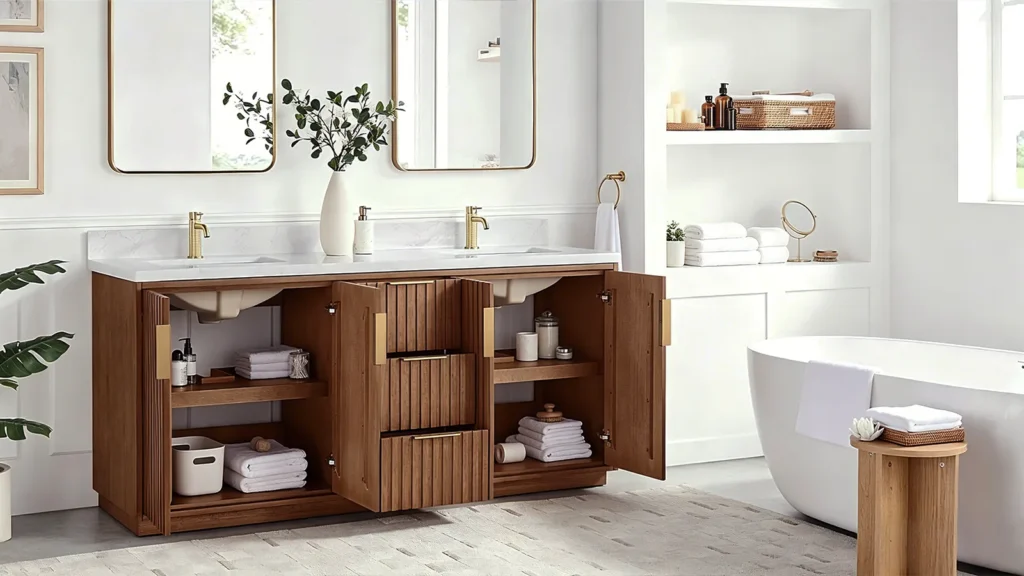
A double basin vanity is not simply twice the cost of a single. It requires a wider countertop, two openings, two sets of faucet holes, and more precise plumbing alignment. For hotel rooms with different layouts, mixing single and double basins in one order increases production and logistics complexity.
Drain Type and Pipe Position
Wall drain and floor drain vanities require different cabinet base structures. If the drain position is fixed in the wall and the vanity design does not account for it, on-site modifications become necessary. This is one of the most common hidden costs in hotel bathroom projects.
Mirror Cabinets, Side Cabinets, and Tall Cabinets
Adding mirror cabinets or side storage units increases unit cost and shipping volume. These additions also require coordination with bathroom lighting and wall anchor positions. Buyers who confirm these requirements early avoid expensive scope changes during production.
Mixed Room Types in One Order
When a project includes multiple room types — standard rooms, suites, and accessible rooms — with different vanity sizes, the order becomes harder to manage. Drawing control, production scheduling, packaging labeling, and site delivery all become more complex and more likely to create errors.
I have worked on projects where the buyer finalized custom bathroom vanity sizes only after construction was partially complete. Each late change added cost. The lesson is simple: fix the layout before you fix the price. A supplier who helps you review layout early saves you more than any discount.
How Do Materials and Countertops Change the Final Price?
Material selection changes the unit price, but it also changes the lifecycle cost. Choosing the cheapest material in a high-humidity hotel bathroom often leads to replacement within two to three years. That replacement cost is real, and it belongs in your budget.
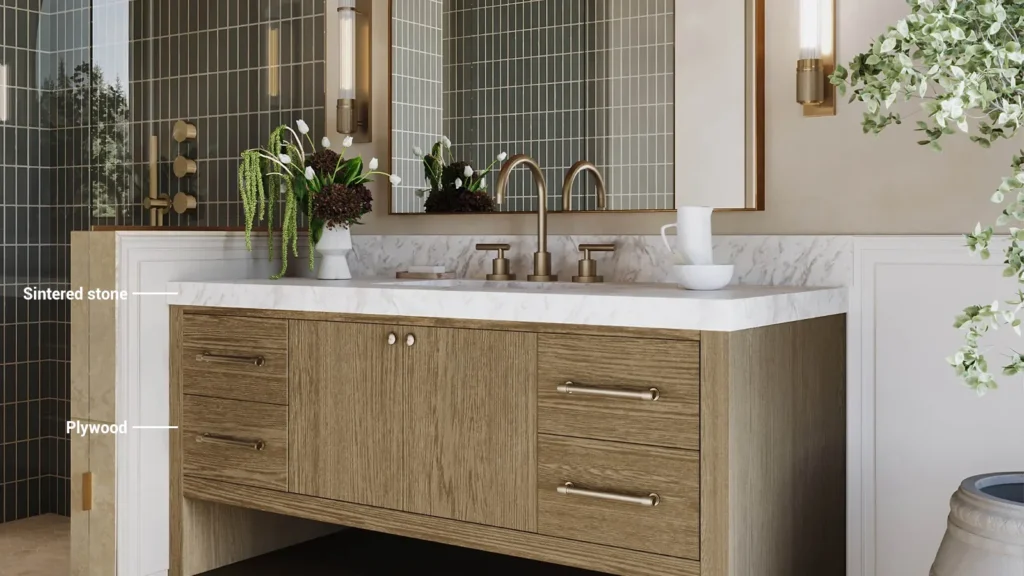
Cabinet material and countertop material together account for 40% to 60% of total vanity cost. Plywood costs more than particle board upfront but performs better long-term in wet environments. Sintered stone costs more than ceramic but requires less maintenance over time.
Cabinet Material Options
Plywood is the best choice for hotel, resort, and apartment projects. It resists moisture, holds screws well, and maintains its structure over time. MDF works in dry areas or painted finishes but needs proper moisture sealing in bathrooms. Particle board is the lowest cost option but is not suitable for long-term use in high-humidity environments. PVC and aluminum profiles work in very wet spaces but offer limited design flexibility.
Countertop Material Options
Quartz is the most common choice for hotel and apartment projects. It is durable, consistent in color, and easy to clean. Sintered stone is more premium and suits resort, villa, and high-end project needs. Artificial stone is reliable for standard project budgets. Custom Corian bathroom vanity tops offer design flexibility and seamless integration with under-mount sinks. Marble adds a luxury feel but requires sealing and more careful maintenance.
The Real Cost of Cheap Materials
The cheapest material may not be the lowest-cost choice if it increases maintenance, replacement, or water damage risk later. For Emma, who manages hotel properties over a multi-year lifecycle, material cost should be calculated over the full service life of the vanity, not just the purchase price.
I always ask project buyers one question before we discuss material price: how long do you need this vanity to last without maintenance issues? That answer drives the right material choice. A resort with a five-year renovation cycle needs a different material strategy than a budget apartment project.
Can Bulk Orders Lower Custom Vanity Cost?
Bulk orders do lower per-unit cost. But they also multiply risk. If something is wrong in the design, the wrong thing gets made at full scale. I have seen buyers save 15% per unit and lose 30% of the order value to errors that happened before production was reviewed.
Bulk orders reduce unit production cost, material cost, sample cost allocation, packaging cost, and container freight cost. But bulk orders also amplify drawing errors, color inconsistencies, countertop opening mistakes, packaging failures, and site labeling confusion if pre-production steps are not controlled.
Where Bulk Orders Save Money
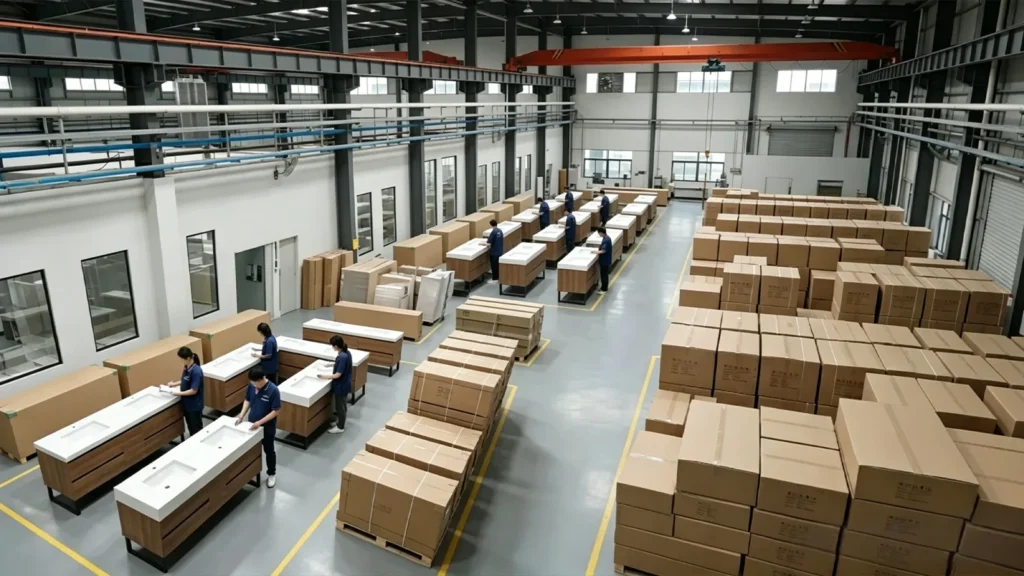
Higher production quantities allow factories to buy materials in bulk and reduce machine setup time per unit. When you order enough to fill a full container, freight cost per unit drops significantly. Sample and drawing costs are spread across more units. For large apartment and hotel projects, these savings are real and meaningful.
Where Bulk Orders Create Risk
An unreviewed drawing error becomes a full-batch error at production scale. A color that was never confirmed on a physical sample may arrive inconsistent across 200 rooms. Countertop openings that were not matched to the actual basin model will prevent installation on every single unit. Packaging that was not tested for sea freight may result in widespread arrival damage.
The Rule for Safe Bulk Ordering
Bulk order only reduces cost when drawings, samples, materials, QC, packaging, and delivery are all controlled before mass production begins. A supplier who rushes into production to meet your timeline is not saving you money. They are moving risk into your project.
For buyers like Emma, who manage multi-property procurement, bulk orders are a tool. The tool only works when the pre-production process is disciplined. I recommend full sample approval, countertop template confirmation, and packaging drop-test review before any bulk production order is released.
What Hidden Costs Should Project Buyers Watch Before Ordering?
Most buyers focus on the unit price and the freight quote. The hidden costs sit between those two numbers and after delivery. They are the costs that turn a good deal into a bad project. I want to name all of them clearly so you can build them into your budget before they surprise you.
Hidden costs in custom vanity procurement include sample cost, drawing revision, countertop opening mistakes, basin and faucet mismatch, plumbing adjustment, site storage, broken goods replacement, missing hardware, rework labor, delivery delay, color mismatch, and spare parts replacement.
Sample and Drawing Revision Cost
Getting the design right takes rounds of review. Each drawing revision and each sample remake carries a cost. Buyers who rush this stage to save time often pay more in corrections after production. Build sample approval time and cost into your project timeline from the start.
On-Site Mismatch and Rework Cost
A faucet hole that does not match the basin model, or a plumbing rough-in that does not align with the vanity drain position, requires on-site modification. This means labor, delay, and sometimes tile or wall damage. These costs are invisible in the quote but very visible on the site.
Replacement and Spare Parts Cost
Broken goods on arrival need replacement. Missing hardware delays installation. Without a spare parts plan, a 300-room project can stall because 15 sets of drawer handles are missing. Ask your supplier about replacement policy, spare part availability, and lead time before you place a bulk order.
I always tell project buyers: your hidden cost exposure is a direct reflection of how well your supplier manages pre-production. A supplier who reviews drawings carefully, confirms samples before production, tests packaging, and labels units clearly will reduce your hidden costs significantly. Choosing a supplier based on price alone skips all of that protection.
How Much Should Hotels, Resorts, and Apartments Budget for Custom Vanities?
There is no single answer to how much does a custom bathroom vanity cost for a project. The right budget depends on what type of project you are running, what quality your brand standard requires, and how long you need the product to perform without issues.
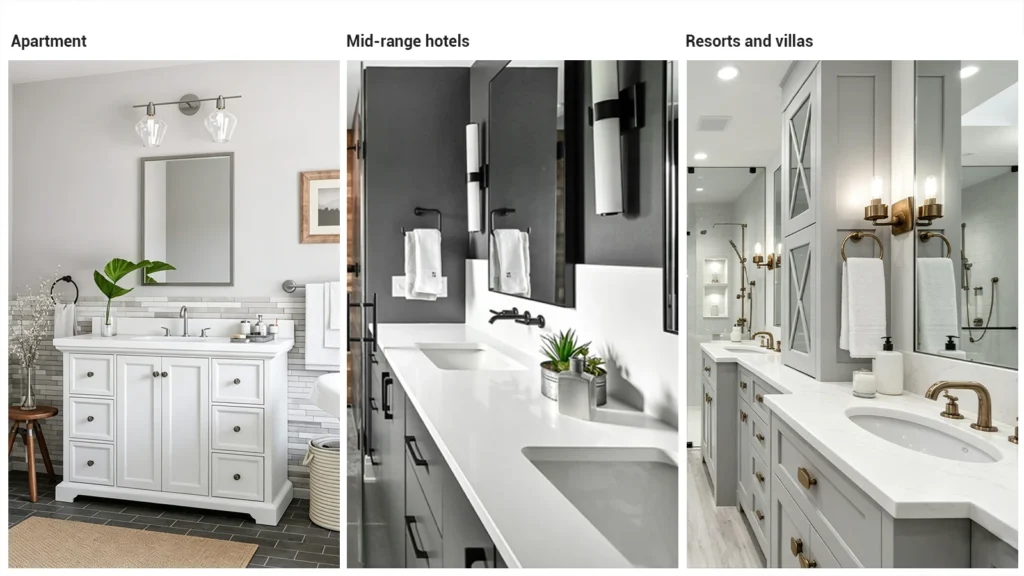
Budget guidance varies by project type. Budget apartment projects should plan for standardized sizes and simple finishes. Mid-range hotels need better plywood and quartz countertops. Resorts and villas require premium finishes and custom layouts. Show units need high visual impact. Large multi-unit projects need batch QC and spare part plans.
Budget Apartment Projects
Cost control and fast delivery are the priorities. Standardized custom bathroom vanity sizes, simple paint or foil finishes, and bulk production keep cost low. The risk here is cutting quality too far and creating early maintenance issues that cost more than the savings.
Mid-Range Hotel Projects
Durability and consistent style matter most. Better plywood cabinet bodies, quartz countertops, and stable drawer hardware are worth the additional cost per unit. These choices reduce in-service failures and maintenance calls, which directly affect guest experience and staff time.
Resort and Villa Projects
Design value and premium finish are expected. Sintered stone or marble countertops, special layout configurations, and higher-end surface treatments are standard. The custom corian bathroom vanity cost at this level reflects the design complexity, not just the material cost.
Large Multi-Unit Projects
Consistency and replacement ability are the core requirements. Standardized drawings, batch quality control, room-by-room labeling, and a confirmed spare parts plan are not optional for projects over 100 units. The budget should include all of these process costs, not just the product cost.
| Project Type | Buyer Priority | Suggested Cost Positioning |
|---|---|---|
| Budget apartment | Cost control, fast delivery | Standardized sizes, simple finish, bulk production |
| Mid-range hotel | Durability, consistent style | Plywood body, quartz top, stable hardware |
| Resort / villa | Design value, premium finish | Stone top, higher-end finish, custom layout |
| Real estate show unit | Visual impact, brand impression | Better surface finish and design detail |
| Large multi-unit project | Consistency, timeline, replacement | Standardized drawings, batch QC, spare parts plan |
The custom bathroom cost for a project is not a single number. It is a set of decisions made before the order is placed. A buyer who builds a complete cost model — product, customization, freight, installation, and risk — will stay in budget. A buyer who focuses only on the factory price will not.
Conclusion
Custom bathroom vanity cost is never just one number. For project buyers, total landed cost is the only number that matters. At georgebuildshop, we help hotel, resort, and apartment buyers build full cost models from the start. Contact us to discuss your project.
Ready to Build Your Project Cost Model?
Whether you are furnishing a 50-room boutique hotel or a 500-unit luxury resort, Georgebuildshop provides the complete one-stop bathroom package—from custom vanity manufacturing to exact hardware matching. Tell us about your project requirements below, and our experts will help you calculate your true landed cost.