
Many buyers search for a fixed price on a custom bathroom vanity top, then feel lost when every quote looks different. The cost is not random. It follows a clear logic once you know what drives it.
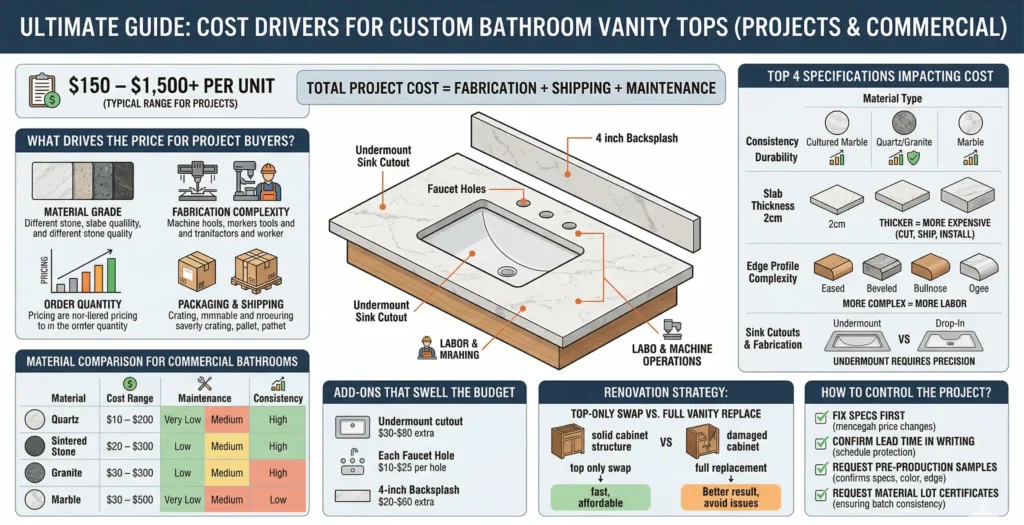
A custom bathroom vanity top typically costs between $150 and $1,500 or more per unit, depending on material, size, thickness, edge profile, sink cutouts, and order quantity. For hotel or apartment projects, the total cost also includes fabrication, shipping, and long-term maintenance.
I have worked with many project buyers who thought they found a great deal on bathroom vanity tops with sink, only to find hidden costs later. If you want real cost control, you need to understand every factor before you place an order.
Table of Contents
Why Is the Cost of a Custom Bathroom Vanity Top Different for Project Buyers?
Most buyers compare prices online and get confused fast. One supplier quotes $200, another quotes $800 for the same size. The difference is not always about quality — it is about what is included.
For project buyers, the price of a custom bathroom vanity top changes based on material grade, fabrication complexity, quantity per order, packaging requirements, and delivery terms. A single-room quote and a 200-room hotel order will never cost the same per unit.
Fabrication Is Not the Same as Material Cost
Material is only one part of the price. Cutting, polishing, drilling faucet holes, and finishing edges all add labor costs. A supplier quoting only material is not giving you the full picture.
Order Quantity Changes Unit Price
Most factories offer tiered pricing. Ordering 50 tops costs more per piece than ordering 300. For large hotel or apartment projects, batching orders in one go almost always reduces the unit price.
Packaging and Shipping Add Up
For international projects, packaging must protect tops during long transit. Custom crating, foam padding, and pallet wrapping all add to the final cost. I always ask suppliers to include this in the quote upfront.
| Cost Factor | Low-End Impact | High-End Impact |
|---|---|---|
| Material | $50–$200 | $400–$1,000+ |
| Fabrication | $30–$80 | $100–$300 |
| Packaging & Shipping | $20–$60 | $100–$400+ |
| Total Estimated | $100–$340 | $600–$1,700+ |
I always ask suppliers to include this in the quote upfront.Retail buyers pick standard sizes. Project buyers need custom size bathroom vanity tops to match exact room layouts. Custom sizing means more cutting waste and more machine time, which raises the unit cost even before quantity discounts apply.
What Specifications Change the Price of a Custom Vanity Top the Most?
I have seen two identical-looking tops priced $300 apart. Most buyers blame the supplier, but the real reason is usually in the specs sheet. A few small changes can push the price far higher.
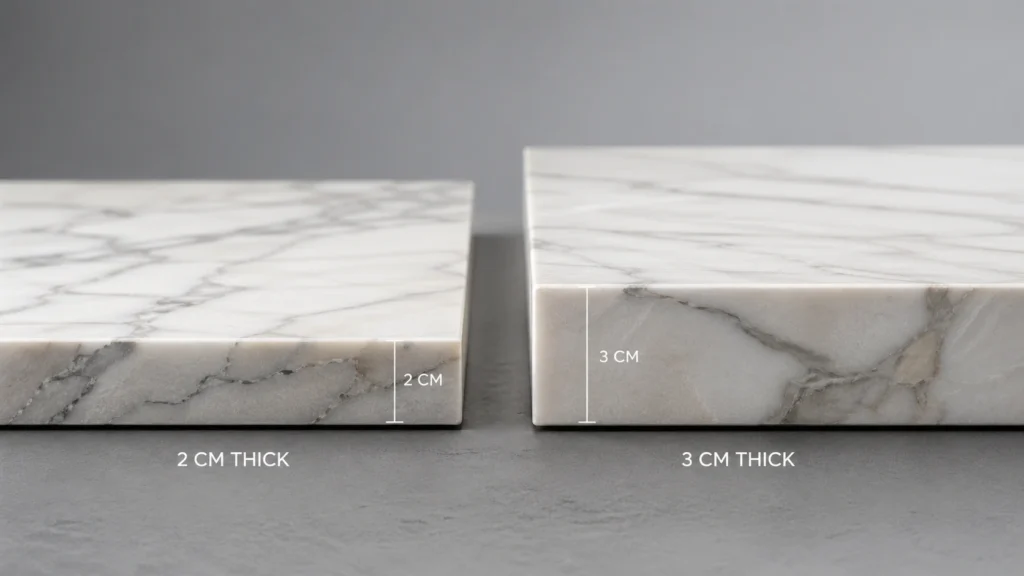
The specifications that raise cost the most are material type, slab thickness, edge profile complexity, number of sink cutouts, and surface finish. Choosing a 2cm slab over a 3cm slab, or a simple eased edge over an ogee profile, can change the price by 20–40%.
Material Type
Granite, marble, quartz, and sintered stone all sit in different price ranges. Custom granite bathroom vanity tops tend to cost less than marble but more than basic cultured marble. Quartz sits in the middle and offers more consistency.
Slab Thickness
Thicker slabs cost more to cut, transport, and install. A 3cm top looks more premium and is more durable, but adds weight and price. For high-use hotel bathrooms, I usually recommend 2cm with a laminated edge for a 3cm look.
Edge Profile
A flat eased edge is the cheapest to produce. Beveled, bullnose, and ogee profiles each add more machine time and finishing work. For a 200-room project, a complex edge profile can add thousands of dollars to the total order.
| Specification | Budget Option | Premium Option |
|---|---|---|
| Material | Cultured marble | Book-matched marble |
| Thickness | 2cm | 3cm |
| Edge Profile | Eased | Ogee |
| Surface Finish | Polished | Leathered |
Polished finishes are standard and the most affordable. Honed, leathered, or brushed finishes add processing steps and raise cost. For high-traffic hotel bathrooms, I prefer honed or matte finishes because they hide scratches better over time.
Which Materials Offer the Best Balance of Cost, Durability, and Maintenance for Commercial Bathrooms?
Choosing a material for 200 hotel bathrooms is not the same as choosing for your home. Guest traffic is heavy. Cleaning chemicals are strong. The material needs to survive years of daily use without looking worn.
For commercial bathrooms, quartz and sintered stone offer the best balance of cost, durability, and low maintenance. Both resist staining, scratching, and moisture better than natural stone. Porcelain slab is a growing option for projects that need a thin, lightweight top with strong chemical resistance.
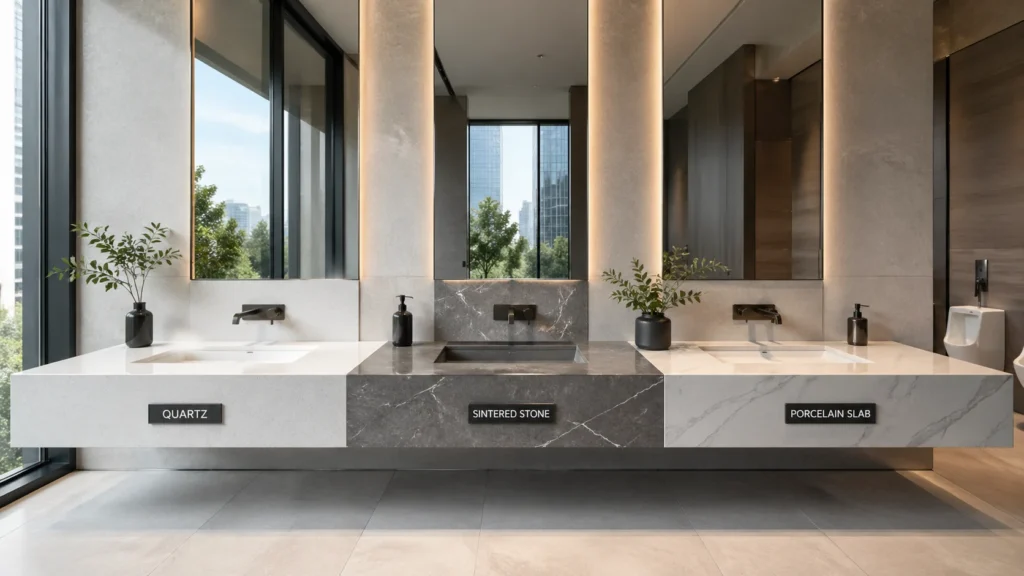
Quartz
Quartz is engineered, so it has no natural pores. It resists stains from soap, cosmetics, and cleaning products. Color and pattern are consistent across slabs, which matters a lot when you need 200 matching tops. I have recommended quartz for many hotel projects and rarely see complaints after installation.
Sintered Stone
Sintered stone is made under high heat and pressure. It is harder than quartz and almost completely non-porous. It handles strong disinfectants well, which hotels in the UAE often need. The cost is higher than quartz, but the maintenance cost over 10 years is lower.
Natural Granite
Custom granite bathroom vanity tops are a popular middle ground. Granite is durable and heat-resistant. It needs sealing once a year in heavy-use settings. The pattern varies between slabs, so matching across rooms can be harder than with engineered materials.
| Material | Cost Range | Maintenance | Consistency |
|---|---|---|---|
| Quartz | Medium | Low | High |
| Sintered Stone | Medium-High | Very Low | High |
| Granite | Medium | Medium | Low-Medium |
| Marble | High | High | Low |
I always ask buyers to think past the purchase price. A marble top may look beautiful in the showroom, but in a 200-room hotel, one etching from a cleaning product becomes a maintenance call. Quartz and sintered stone save money over time by needing fewer repairs and less resealing.
How Do Sink Type, Faucet Holes, and Backsplash Affect the Final Budget?
Many buyers focus on the top surface and forget everything attached to it. Sink type, faucet hole placement, and backsplash each add steps to fabrication. Each step adds cost. Missing these details in early planning causes budget surprises later.
Sink type, faucet hole count, and backsplash height each affect fabrication time and total price. An undermount sink cutout costs more than a drop-in. Each faucet hole adds a drilling charge. A full-height backsplash in the same material can add 15–30% to the top cost.
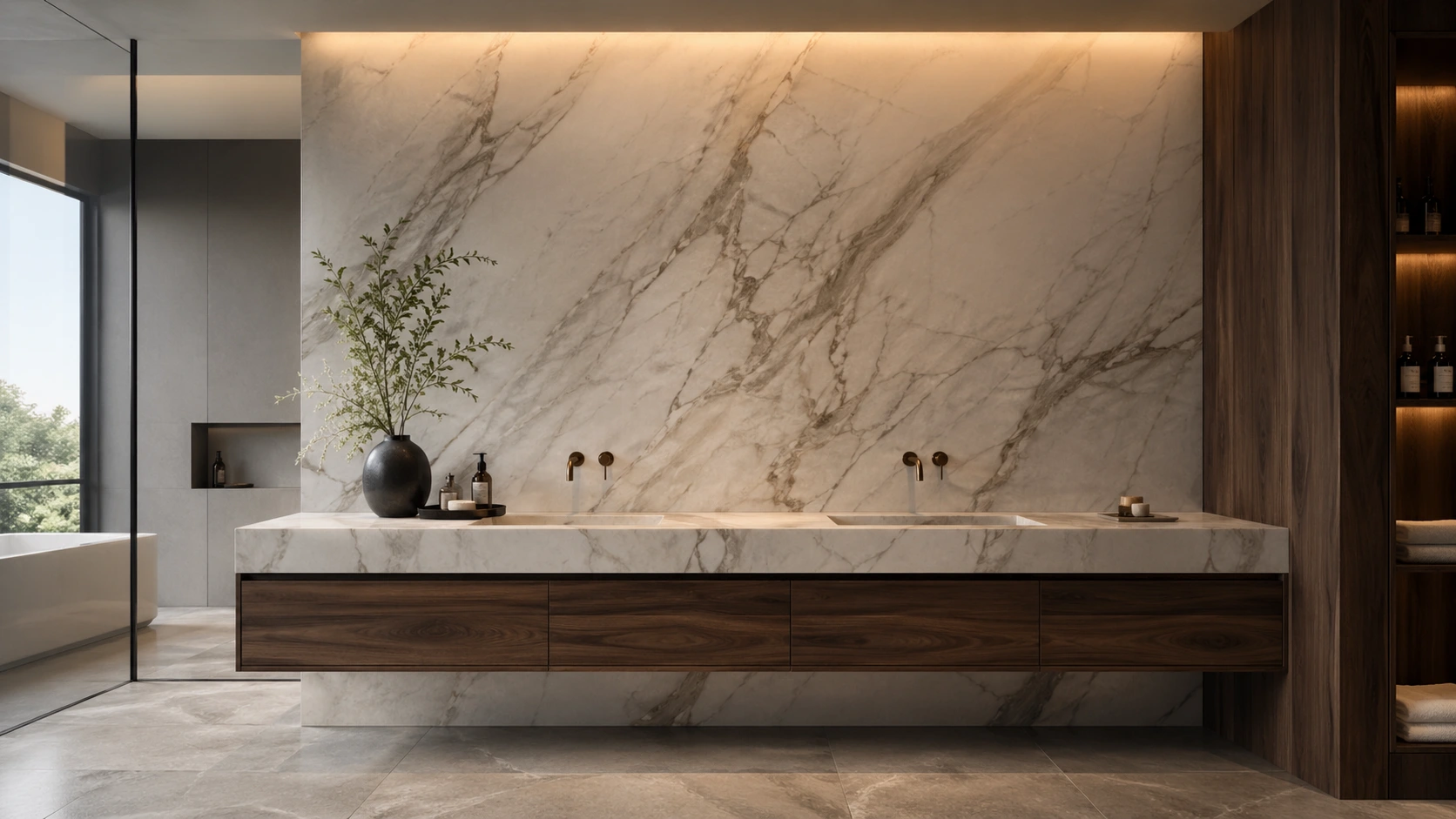
Undermount vs. Drop-In Sink
Bathroom vanity tops with sink can come in two main configurations. Drop-in sinks sit in a simple round or rectangular cutout. Undermount sinks need precise cutting, polished edges inside the cutout, and more fitting time. Undermount looks cleaner but costs more to fabricate.
Faucet Hole Drilling
Each faucet hole is a separate drilling operation. A single-hole top costs less than a three-hole top. For project orders, deciding on hole configuration early avoids rework charges. I always confirm the plumbing layout before the factory starts cutting.
Backsplash Options
A separate thin backsplash piece in the same material adds cost. The taller the backsplash, the more material and edge finishing it needs. Some buyers skip the matching backsplash to save cost and use tile instead. Both approaches work, but mixing materials needs careful planning to avoid visual gaps.
| Add-On | Typical Extra Cost | Notes |
|---|---|---|
| Undermount cutout | $30–$80 per top | vs. drop-in |
| Each faucet hole | $10–$25 per hole | depends on material |
| 4-inch backsplash | $20–$60 per top | same material |
| Full-height backsplash | $60–$200+ per top | depends on height |
Changes made after production starts cost far more than changes made during planning. In one project I worked on, a buyer changed the faucet hole count after 50 tops were already cut. The rework cost more than the original fabrication charge. Clear specs from the start protect your budget.
💡 Avoid costly rework with our 1-stop specs planning.
Should You Replace Only the Vanity Top or the Entire Vanity in a Project Renovation?
This is a question I get often from hotel renovation teams. The answer is not always obvious. Replacing only the top saves time and money upfront, but it is not always the right move.
In a project renovation, replacing only the vanity top makes sense when the existing cabinet structure is solid, the new top fits the same footprint, and the plumbing does not need major changes. Replacing the full vanity is better when the cabinet is damaged, outdated, or when the new layout changes the sink position.
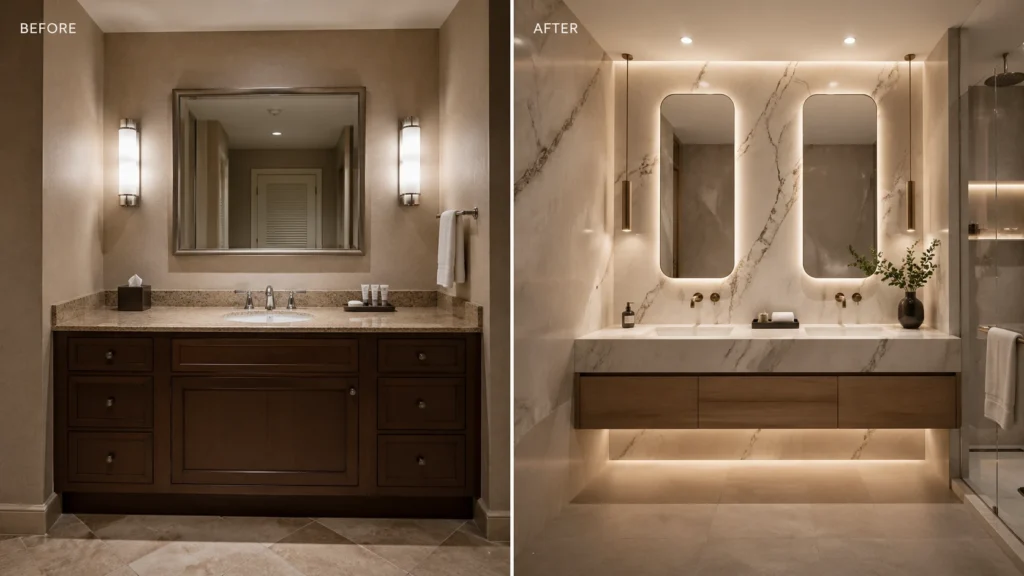
When Replacing Only the Top Works
If the cabinet box is in good shape and the plumbing stub-outs stay in the same place, a top swap is fast and affordable. I have seen hotels refresh 50 bathrooms in a week using this approach. The key is getting accurate measurements of the existing top before ordering the replacement custom size bathroom vanity top.
When Full Vanity Replacement Makes More Sense
Old cabinets with water damage, swollen panels, or outdated hardware will look wrong under a new premium top. In that case, replacing everything at once gives a better result and avoids a second round of work in two to three years.
Hidden Cost of Partial Replacement
Plumbing connections may not match the new top layout. Drain positions and faucet hole spacing must align exactly. If they do not, a plumber must adjust the supply lines and drain, adding labor cost. Always check this before deciding between a top-only swap and a full vanity replacement.
📊 Micro Case: 150-Room Resort Renovation
🔴 The Pain Point: The resort's old plumbing didn't align with standard new tops, threatening $12,000+ in local plumber adjustment fees.
🟢 The Solution: George Build Shop provided a one-stop full vanity space design, custom-building the vanity boxes and tops to fit the exact existing pipe layouts perfectly.
🏆 The Result: Zero plumbing rework. The resort saved over 2 weeks of delay and eliminated all hidden labor costs.
How Can Buyers Control Budget, Lead Time, and Batch Consistency Before Ordering?
Losing control of a large order mid-project is one of the most stressful things a procurement manager can face. I have seen it happen when buyers skip key steps at the start. Getting three things right early — budget, lead time, and consistency — protects the whole project.
Buyers can control budget by fixing specs before quoting, lead time by confirming production slots in writing, and batch consistency by requesting pre-production samples and material lot certificates. For large hotel orders, asking for a mock-up room installation before full production starts reduces the risk of expensive rework.
Fix Your Specs First
Every spec change after a quote restarts the pricing process. Write down the material, size, thickness, edge, sink type, faucet holes, and backsplash before contacting any supplier. A clear spec sheet gets you accurate quotes and avoids back-and-forth delays.
Confirm Lead Time in Writing
Verbal promises do not protect your renovation schedule. Ask for a production timeline in the contract. Include milestone dates — material arrival, production start, quality check, and ship date. This gives you a clear picture of when tops will arrive on site.
Request Pre-Production Samples
For a custom bathroom vanity top order of 50 units or more, I always ask for a physical sample before full production starts. A sample confirms color, finish, edge profile, and sink cutout position. It costs a little extra but prevents large-scale rework.
| Control Point | Action | Why It Matters |
|---|---|---|
| Specs | Write full spec sheet before quoting | Prevents price changes mid-order |
| Lead Time | Get production schedule in writing | Protects renovation window |
| Batch Consistency | Request material lot certificate | Ensures color match across all tops |
| Quality Check | Approve pre-production sample | Catches errors before mass production |
Natural stone slabs vary between quarry lots. Engineered materials like quartz are more consistent, but batch numbers still matter. Ask your supplier to confirm that all tops in one order come from the same production batch. This is the single most important step for keeping finishes uniform across all rooms.
Conclusion
There is no single price for a custom bathroom vanity top. The right choice balances material, specs, maintenance, and total project cost. If you need help planning your next project order, visit georgebuildshop.com and reach out to us directly.
Ready to Streamline Your Hotel Bathroom Renovation?
Stop juggling multiple suppliers and risking batch inconsistencies. Partner with George Build Shop for an end-to-end bathroom solution—from 3D space design to the mass production of custom vanities, toilets, shower enclosures, and hardware.
👇 Tell us about your project requirements in the form below, and our commercial project experts will provide a comprehensive solution within 24 hours.