
Quick Answer: This guide focuses specifically on ada toilet grab bar requirements within residential and real estate bathroom projects. True compliance requires an L-shaped support system combining side and rear wall grab bars. Key decision factors for developers include:
Centerline Alignment: 16–18 inch reference range ensuring precise transfer zone coordination.
Pre-installed Structural Blocking: Ensuring a ≥250 lb load transfer path integrated directly into framing drawings.
Certified Commercial Grab Bar Specification: Load-test verified and submittal-ready hardware suitable for high-volume delivery.
Most issues in toilet grab bar installations are caused by coordination gaps between layout, structure, and procurement.
Hi there! I’m Helen, and I’ve spent the last ten years navigating the complex world of bathroom fixtures with George Group. If there’s one thing I’ve learned from supplying thousands of high-end villa and commercial projects, it’s this: many projects fail inspections or require costly rework even when basic dimensions are technically correct.
This guide focuses specifically on toilet grab bar requirements within a broader ADA bathroom planning framework. We are diving straight into the toilet sub-system to help you manage risk and smooth out your procurement process.
In this guide, I’ll share actionable B2B perspectives on mastering your ada toilet grab bar layout, ensuring structural readiness, and specifying products that protect your luxury aesthetic and project timeline.
For a complete system-level overview of ADA bathroom standards, see our full guide on ADA grab bar requirements for residential bathroom projects (2026 update).
Table of Contents
Are ADA Toilet Grab Bars Required in Residential Projects?
If you are developing a multi-family apartment complex, a boutique hotel, or any space with public access, these standards are strictly non-negotiable. Missing these guidelines leads directly to inspection delays and liability risks.
For private single-family villas, strict compliance isn’t always legally enforced. However, integrating these elements properly from day one protects resale value and prepares high-end properties for aging-in-place demands. Therefore, proactive developers treat ada toilet grab bar dimensions and requirements as a system-level design input rather than a dimensional checklist.
How Should ADA Toilet Grab Bars Be Positioned Around a Toilet?
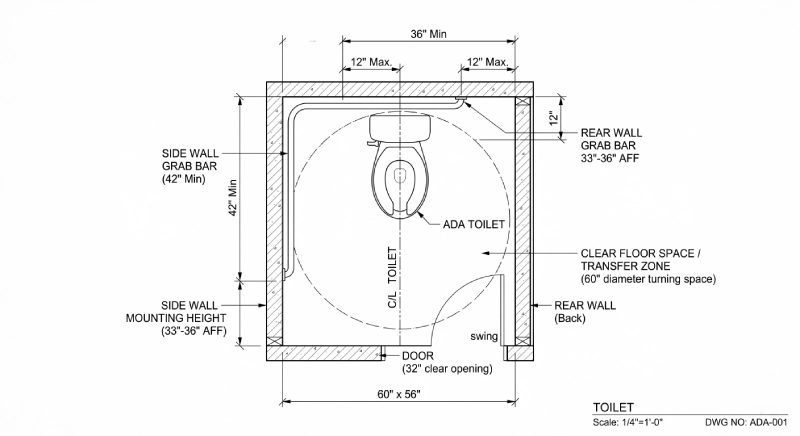
Toilet grab bars are specifically designed to support lateral transfer and seated balance. In most layouts, the side wall grab bar serves as the primary support element, while the rear wall bar provides secondary stabilization.
How Far Should ADA Toilet Grab Bars Be from the Toilet Centerline?
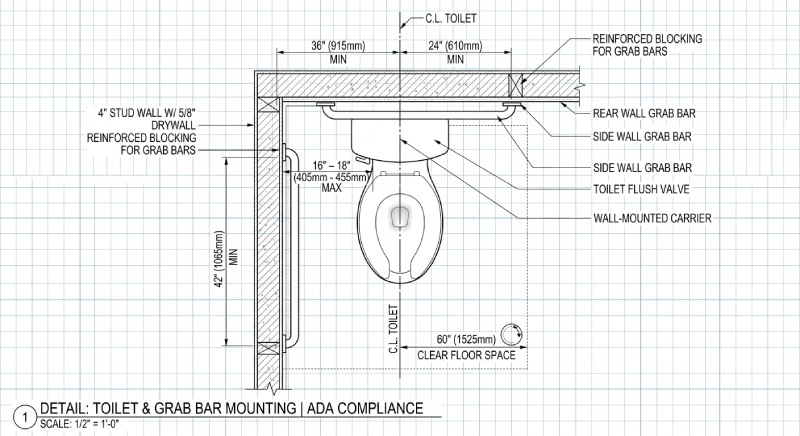
Placement is tightly tied to the toilet centerline and user reach zones. The side wall bar must be positioned precisely—typically 16–18 inches, depending on fixture clearance requirements, measured from the toilet centerline to the grab bar centerline. Deviations in horizontal positioning disrupt the user’s leverage, effectively rendering the installation unsafe.
What Length is Required for ADA Toilet Grab Bars in Toilet Areas?
You must account for exact ada toilet grab bar length requirements. Typically, this means a minimum 42-inch bar on the side wall and a 36-inch bar on the rear wall. There is also a mandatory 1.5-inch clearance gap between the bar and the wall to allow for a firm grip without trapping hands.
Layout Coordination vs. Vertical Measurements
While vertical placement is regulated, layout coordination dictates actual usability. (For a detailed breakdown of vertical measurements, see our guide on ada toilet grab bar height). We advise full CAD shop drawings before procurement because a bar that meets height codes but is blocked by a vanity is ultimately a project failure.
Layout Alignment
Risk: Transfer failure and non-compliant clearance zone
Structural Backing
Risk: Load failure under ADA testing force
Load Capacity
Risk: High-risk structural pull-out
Diameter
Risk: Reduced grip efficiency during transfer
How Do Different Bathroom Layouts Affect Positioning?
Toilet positioning within the room directly determines whether standard wall-mounted solutions are feasible.
Space Constraints and Wall Configurations
In a standard corner layout, the side wall anchors the primary bar. However, if the toilet is centered in an open-plan master suite, traditional side wall support isn’t available. In these scenarios, an ada toilet vertical grab bar or a floor-mounted swing-away solution must be engineered into the floor plan.
Left-Hand vs Right-Hand Installation Planning
Multi-family developments require a balanced mix of “Left-Hand” and “Right-Hand” accessible units. Failing to map out these ada toilet grab bar locations accurately during the tender stage leads to mismatched inventory and delayed site handovers.
Coordination with Other Bathroom Fixtures
Grab bars share tight real estate with toilet paper holders. Standard codes dictate the holder must sit within a specific reach zone (7-9 inches in front of the toilet) without obstructing the grab bar. Clash detection during the schematic design phase is crucial here.
What Wall Structure is Required for ADA Toilet Grab Bar Installation?
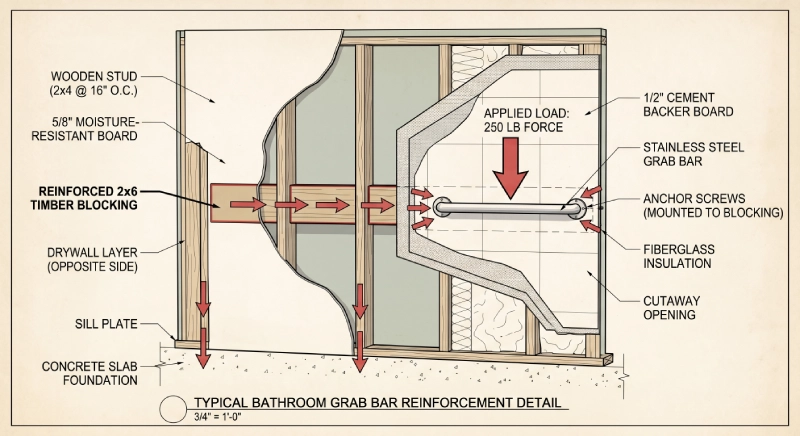
A grab bar is only as secure as the wall behind it. This is where spec-ready engineering evaluation becomes critical.
Suitable Wall Types and Structural Reinforcement
While concrete or solid masonry allows for straightforward anchoring, most modern residential and commercial builds utilize drywall with metal or wood studs. Standard drywall finishes cannot support the strict load requirements.
Implementing Blocking During Framing
To meet strict ADA toilet grab bar installation requirements, blocking (2×6 timber or steel backing plates) must be installed during framing. This ensures load transfer into structural studs under ≥250 lb force requirements. Structural reinforcement must be locked into architectural drawings before MEP and finishing coordination begins.
If your framing teams proceed with the installation using basic plastic wall anchors, the system will fail under load. Correcting this post-installation requires tearing out finished walls, destroying your margin and timeline.
Why Do ADA Toilet Grab Bar Installations Fail in Real Estate Projects?
These issues are rarely caused by incorrect specifications, but by gaps in coordination across design, construction, and procurement teams. Red flags include:
Late-Stage Procurement: Ordering hardware after walls are closed up, making structural load transfer impossible.
Siloed Communication: The architect issues the floor plan, the plumber sets the toilet, and the finishing carpenter mounts the bars without verifying the centerline alignment together.
Incompatible Hardware: Specifying standard residential bars that lack the required commercial load testing certifications.
How Can You Integrate Commercial ADA Toilet Grab Bars into Luxury Design?

In premium real estate, grab bars must be treated as integrated architectural hardware rather than secondary accessories. Standard off-the-shelf commercial ada toilet grab bars clash with high-end expectations.
Design Strategies for Aesthetic Balance
At George Group, we engineer ada compliant toilet grab bars that feature:
Concealed Flanges: Eliminating visible mounting screws for a clean look.
Knurled Textures: Providing superior grip through precision machining rather than bulky rubber grips.
Slim Profiles: Retaining the compliant diameter while elevating the silhouette.
Visual Integration in Real-World Scenarios
This challenge is common in high-end villa developments. For the Ethiopia Villa Complex Project, a luxury estate of 55 independent villas, standard institutional bars would have ruined the natural stone and brushed brass aesthetic. We supplied custom-finished, commercial-grade bars that flawlessly matched their solid brass basin mixers, satisfying both building inspectors and luxury buyers.
How Do You Select Project-Ready ADA Toilet Grab Bars for Large Developments?

Selecting the right system ensures smooth project delivery. Developers need solutions that are project-ready, complete with engineering data.
Required Certifications and Load Testing Standards
Navigating ADA toilet grab bar specifications for residential projects means ensuring your procurement team requests SGS or Intertek test reports. Documented proof of load capacity is your primary defense against future liability.
The Role of Supplier Engineering Support
A reliable supplier provides comprehensive submittal packages. This includes detailed specification sheets, SS304/SS316 material certifications, and installation guides. Delivering this technical documentation upfront reduces coordination errors between design drawings and on-site installation.
Where Can You Find Project-Ready ADA Toilet Grab Bar Solutions?
At George Group, we supply comprehensive, project-ready hardware solutions backed by a decade of B2B manufacturing expertise.
Before procurement approval, developers typically require:
Layout validation against floor plans
Structural compatibility verification
Specification sheet for engineering approval
Reach out to me, Helen, or our engineering team to streamline your tender and secure your project’s compliance.
Frequently Asked Questions (FAQ) for Developers & Project Managers
1. What is the most common ADA toilet grab bar inspection failure?
The most common failure is incorrect toilet centerline alignment. Even if the bars meet exact length and height codes, failing to lock in the 16–18 inch distance during early floor plan reviews renders the entire installation non-compliant and unusable.
2. When should ADA toilet grab bar requirements be applied during construction planning?
Requirements must be integrated during the Schematic Design (SD) phase. This ensures framing teams know exactly where to install structural blocking before drywall is closed.
3. What happens if ADA toilet grab bars are installed without structural reinforcement?
Without proper blocking installed during the framing stage, the grab bar cannot transfer loads into the structural studs. It will easily rip out of the drywall under the mandated 250 lb force, causing severe safety liability and expensive wall damage.
4. How do ADA toilet grab bar requirements affect project procurement and installation sequencing?
Grab bar requirements demand early-stage coordination. Procurement must finalize specifications early so framing teams know exactly where to position backing plates long before the hardware arrives.
5. What is the difference between ADA-compliant and project-ready grab bars?
ADA-compliant products simply meet regulatory dimensions. Project-ready solutions include load-test certifications, technical submittal packages, layout support, and reliable supply chains built for large-scale B2B delivery.
6. Can we customize ADA grab bar dimensions to fit specific luxury villa layouts?
Yes. While codes mandate minimum lengths, custom extended lengths can be manufactured. George Group produces custom lengths to prevent standard bars from disrupting custom tile grout lines or vanity placements.
7. How do toilet grab bar requirements relate to overall ADA bathroom design?
They are one specific subsystem. Effective planning requires ensuring that the grab bar layout does not conflict with clear floor space requirements or other fixture placements within the specific toilet zone.
Conclusion
Mastering ada toilet grab bar requirements is about risk management and smooth project execution. By focusing on exact layout alignment, verifying structural blocking early, and specifying certified, aesthetically integrated hardware, you turn a regulatory hurdle into a property asset.
Remember, compliance is achieved through coordinated decisions across design, structure, and procurement—not just isolated measurements. The critical decision point happens during the Schematic Design phase: lock in your layouts and structural backing early. To fully implement these standards and protect your investment, always align your grab bar procurement directly with your framing and layout timelines.
References
U.S. Department of Justice (DOJ). 2010 ADA Standards for Accessible Design (Chapter 6: Plumbing Elements and Facilities). Official regulatory guidelines for grab bar dimensions, structural strength, and clearances. Link: https://www.ada.gov/law-and-regs/design-standards/2010-stds/
George Group. Ethiopia Villa Complex Project. Case study demonstrating the successful integration of custom-finished, commercial-grade ADA grab bars in a 55-unit luxury residential development. Link: https://georgebuildshop.com/ethiopia-villa-complex-project/
National Association of Home Builders (NAHB). What is Universal Design? Industry insights on integrating universal design, barrier-free living, and structural readiness into modern homes. Link: https://www.nahb.org/other/consumer-resources/what-is-universal-design
We provide integrated one-stop bathroom solutions covering tubs, sanitaryware, fittings, and system coordination for hotel and commercial projects.
▼ Submit the form below to connect with our team and explore project-based collaboration. ▼