PVD (Physical Vapor Deposition) is the most reliable finish for commercial hotel bathtub faucets, typically offering a lifecycle of 8–15+ years. In contrast, traditional electroplated finishes frequently show visible degradation within 3–7 years in high-traffic suites. This performance gap is supported both by ASTM B117 salt spray testing and long-term performance data from hospitality field observations.
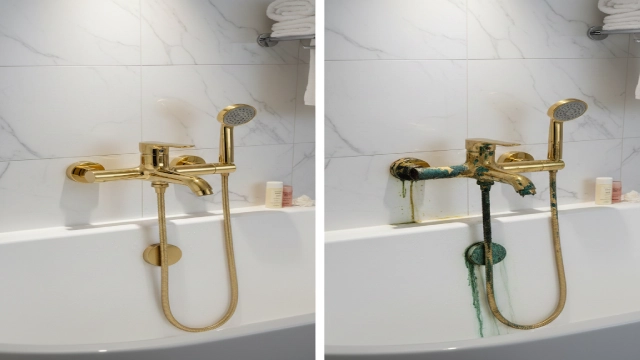
For hotel owners, developers, and brand standards teams, the bathtub is more than a utility—it is the focal point of the guest’s relaxation experience. I often describe the bathtub faucet as the “jewelry of the suite”; it is the hardware that signals quality and attention to detail. However, when that jewelry begins to tarnish, the impact on guest perception and maintenance budgets is immediate.
At George Buildshop, we have observed projects across multiple regions where the wrong finish specification led to early hardware failure, operational disruption, and ultimately, guest complaints. In the high-volume environment of a commercial bathroom, the “jewelry” must do more than shine—it must survive.
Executive Summary: The Strategic Value of PVD
For project managers and procurement leads, selecting a finish is a decision of risk management rather than just aesthetics.
The Verdict: PVD coating is the industry standard for low-risk, high-durability hospitality applications.
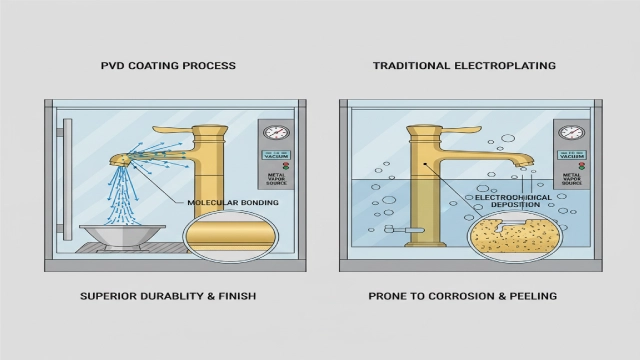
The Mechanism: PVD creates a molecular-level bond that fuses the finish into the metal. Electroplating creates a layered “skin” that is more susceptible to the stressors of a commercial environment.
The Operating Reality: Bathtub hardware must withstand frequent thermal shock (rapid hot/cold cycles) and high-frequency cleaning protocols that can degrade surface-level coatings.
The Lifecycle Choice: While electroplating often shows signs of pitting or peeling within the first few years of heavy use, PVD maintains its integrity throughout the typical hotel renovation cycle.
Table of Contents
What Are the Technical Differences Between PVD and Electroplating?
Understanding the engineering behind the finish explains why one fails where the other thrives.
What is PVD Coating?
PVD (Physical Vapor Deposition) involves vaporizing solid metals into a plasma state within a vacuum chamber. These ions are then embedded into the faucet’s surface.
Why this matters in hotels: Because the finish is fused at a molecular level, it is virtually impossible to peel or flake, even when subjected to the high humidity of a hotel bathroom.
What is Electroplating?
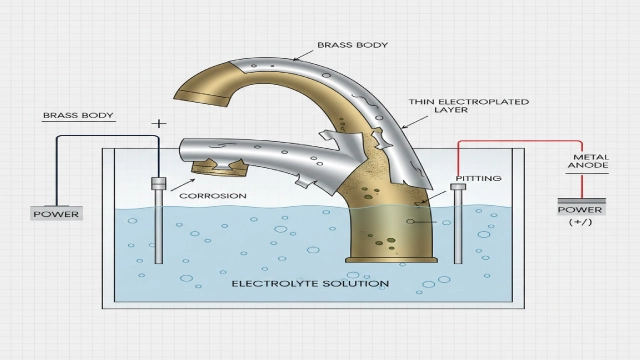
Electroplating is an electrochemical process where a layer of metal (like chrome or nickel) is deposited onto the brass body.
Why this matters in hotels: While cost-effective, electroplating remains a surface-level “skin.” Over time, the bond can weaken due to heat and chemical exposure, leading to the “bubbling” or pitting often seen in older hotel hardware.
How Do PVD and Electroplating Perform Differently?
Note: Ratings reflect typical hospitality project observations and field performance rather than lab-only results.
PVD Coating vs Electroplating: Key Performance Factors
Corrosion Resistance
Scratch Resistance
Salt Spray (ASTM B117)
Thermal Shock Resistance
Typical Hotel Lifespan
What Environmental Stressors Affect Faucet Finishes in Hotels?
1. High-Humidity and Steam
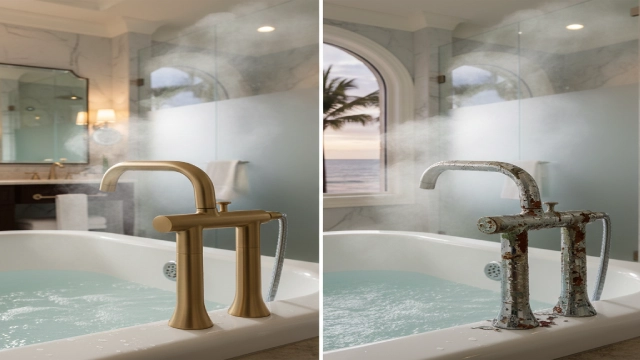
A hotel bathtub is a localized tropical environment. PVD coating is non-porous, meaning steam cannot penetrate the finish to cause the subsurface oxidation that ruins electroplated fixtures.
2. Coastal & Resort Locations
Salt air accelerates oxidation exponentially. For beachfront properties, PVD is among the best-performing finishes available, significantly reducing the “pitting” effect that often appears on electroplated gold or bronze within 18 months.
3. Cleaning Chemicals & Hard Water
Housekeeping operates under strict time constraints, often using standard commercial cleaners that can be abrasive. PVD is chemically inert and highly scratch-resistant, making it essentially “housekeeping-proof.” It also resists mineral buildup, making it an excellent finish for regions with hard water.
How Does Faucet Finish Impact ROI and Total Cost of Ownership?
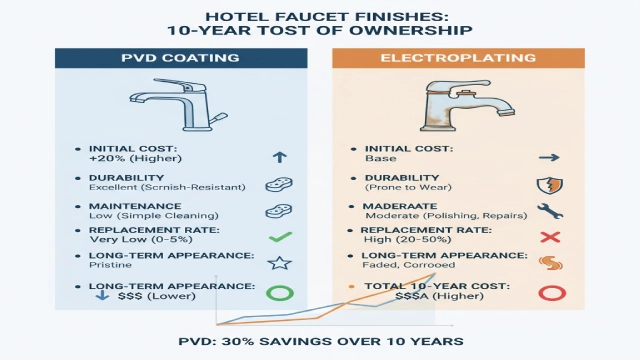
For a property owner, the true cost of a faucet includes the purchase price, the labor to replace it, and the lost revenue of a “down” room.
TCO Assumption: Based on average room rates, typical labor costs for plumbing replacement, and the observation that electroplated finishes often require at least one replacement cycle during a 10-year period.
Bathtub Faucet TCO Calculator
Enter your project data to see the full lifecycle cost of your bathtub faucet, including purchase, installation, maintenance, replacement, and downtime costs.
Total Project TCO:
Per Room:
Per Year:
This includes purchase, installation, maintenance, replacement, and downtime costs over the expected service life.
10-Year Faucet Cost Comparison: Electroplating vs PVD
Business Hotel
Boutique Hotel
Beachfront Resort
The Decision Summary: For hotel owners planning an 8–12 year asset lifecycle, PVD is no longer just a luxury—it is a financially inevitable choice to protect the bottom line.
FAQ: Procurement & Lifecycle
1. Does PVD coating affect lead time?
Yes, slightly. Because PVD requires specialized vacuum chambers, lead times are typically 2–3 weeks longer than standard electroplating. We recommend finalizing finish specifications early in the procurement phase.
2. Which faucet finish is best for hard water?
Brushed PVD finishes (such as Brushed Nickel or Gold) are superior. They resist mineral accumulation and hide water spots significantly better than polished finishes.
3. Is PVD suitable for budget or mid-scale hotels?
While the upfront cost is higher, PVD is highly recommended for mid-scale properties to eliminate the need for a dedicated plumbing maintenance budget for finish repairs.
4. How does PVD coating affect the product warranty?
Due to its durability, many manufacturers offer extended finish warranties (often 10–15 years) for PVD, compared to the 1–3 year limited warranties typical of electroplating.
5. Can PVD finishes be matched to existing hardware?
Yes. PVD allows for highly consistent color matching across batches, which is often a struggle with traditional electroplating.
Why Is PVD the Recommended Choice for Long-Term Durability?
The most expensive piece of hardware is the one you have to buy twice. When planning your next hotel project, the goal is to ensure the hardware remains as stunning on Day 3,000 as it was on Day 1. Choosing PVD coating is a lifecycle durability decision that protects your brand reputation from the “peeling fixture” complaint.
Ultimately, finish durability issues like these are rarely isolated material problems—they are part of a broader specification logic that explains why bathtub faucet decisions fail in hotel projects.
Would you like me to prepare a custom ROI analysis and sample comparison tailored to your specific property’s location and room count? If you’re planning a hotel bathroom project and want to avoid costly finish failures, partner with George Buildshop to access proven PVD specifications, lifecycle cost analysis, and finish solutions tailored to your property’s environment and brand standards.
Reference
PVD vs Electroplating: Corrosion and Wear Comparison (Keenhai) — PVD vs Electroplating: Corrosion and Wear Comparison (Keenhai)
Benefits of PVD vs Electroplating Finish (BathSelect guide) — PVD vs Electroplating Benefits Guide (BathSelect)
Hotel Bathroom Faucet Finish Trends: PVD vs Electroplating Corrosion Data (Watersino) — Hotel Faucet Finish Trends & Salt Spray Test Data (Watersino)
PVD Faucet Finish Benefits and Durability (WOWOW Faucets) — How PVD Technology Improves Faucet Durability (WOWOW)
Why PVD Coating is Preferred Over Electroplating (Blackrock Evolution) — Why Manufacturers Prefer PVD Coating Over Electroplating (Blackrock)
We support hotel and commercial projects with integrated solutions that reduce specification gaps and coordination risks.
▼ Contact us via the form below to evaluate your project and collaborate. ▼