
Many hotel buyers order vanities before checking the actual bathroom layout. The result? Pieces that don’t fit, delayed installs, and wasted budget on bulk orders.
Choosing custom bathroom vanity sizes for hotel projects means matching each vanity to the room’s layout, plumbing positions, and guest needs. Start by measuring the wall width, floor space, and pipe locations. Then set a few standard sizes by room type to keep the project consistent and easy to manage.
I have seen many procurement teams focus only on style and finish during the early stage. They skip the size checks. That choice often causes problems during installation—and those problems are expensive to fix when you are ordering hundreds of units. The sections below will walk through each sizing decision step by step.
Table of Contents
Why Do Hotel Projects Need Custom Vanity Sizes Instead of Standard Sizes?
Standard sizes look simple on paper. But hotel bathrooms are not built to match catalog dimensions, and that gap creates real problems on site.
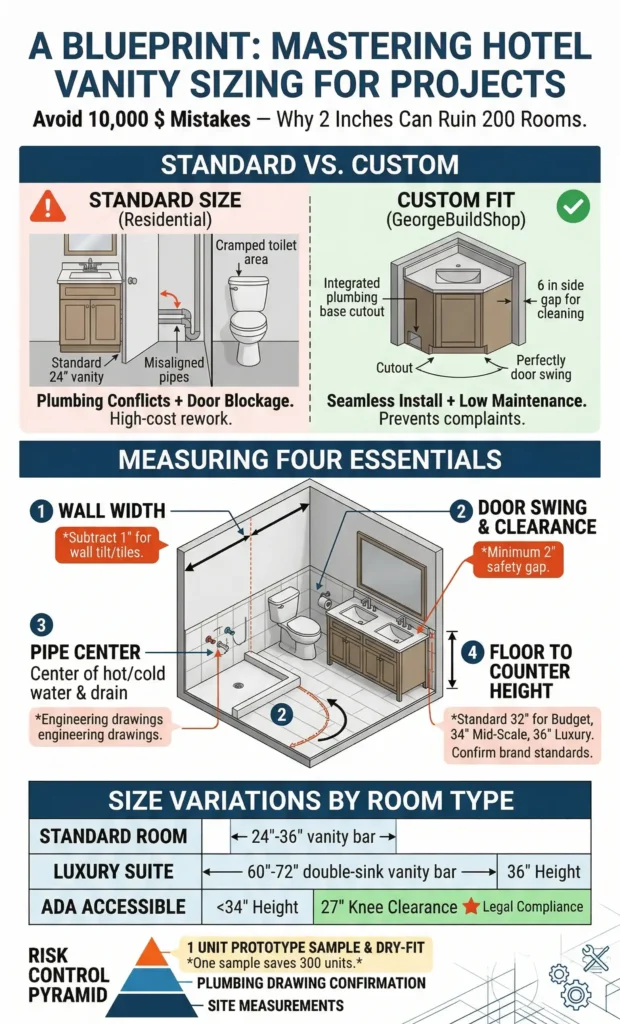
Standard bathroom vanity cabinet sizes—typically 24, 30, 36, or 48 inches wide—are made for residential use. Hotel bathrooms vary in layout, plumbing position, and wall configuration. Custom sizes let you fit the vanity to the actual room instead of forcing the room to fit the vanity.
Standard Sizes Miss Hotel-Specific Layouts
Hotel rooms are built to maximize floor space. A standard 21-inch-deep vanity may block the door swing or crowd the toilet area. I have seen this happen in compact rooms where every inch matters.
Bulk Orders Need Consistent Sizing Across Rooms
When you order 200 units, small differences in wall width or pipe placement across floors can make one standard size wrong for 30% of the rooms. Custom sizing by room type solves this problem before production starts.
Brand Standards Require Specific Dimensions
Most hotel brands set their own bathroom layout rules. Those rules often require a vanity width, height, or countertop depth that no standard catalog size matches exactly.
| Room Type | Why Standard Sizes Often Fail |
|---|---|
| Compact standard room | Door clearance and toilet spacing conflicts |
| Suite bathroom | Longer double-sink runs need non-standard widths |
| Accessible room | ADA height and knee clearance rules don't match stock sizes |
The problem with using standard sizes in hotel projects is not just a fit issue. It creates a chain reaction. A vanity that is 2 inches too wide means the plumber has to move a pipe. Moving a pipe adds labor cost. Labor delays push back the room handover date. In a renovation with tight windows—like the ones Emma manages across multiple properties—one size mistake can affect the whole schedule. Custom sizing adds a small step at the start. It removes a large risk at the end.
What Should Buyers Measure Before Finalizing a Custom Vanity Size?
Most size mistakes I see in hotel projects start with the same cause: buyers approve drawings before anyone measures the actual site.
Before finalizing any custom size bathroom vanity top or cabinet, measure the usable wall width, the distance from the wall to the door or toilet, the floor-to-ceiling height, and the exact position of the water supply and drain pipes. These four measurements decide what will actually fit.
Usable Wall Width
Measure the clear wall space where the vanity will sit. Subtract any trim, baseboard, or tile edge. The vanity width should be at least 1 to 2 inches narrower than this space to allow for installation.
Door Swing and Clearance
Check how far the bathroom door swings. A vanity that is too deep will block the door or create a tight squeeze for guests. Standard hotel bathroom dimensions often allow only 21 to 22 inches of vanity depth for this reason.
Pipe Positions
Mark where the drain and supply pipes come out of the wall or floor. The vanity cabinet must be cut or positioned to clear these pipes. Skipping this step is the most common cause of costly rework.
Floor-to-Counter Height
Standard counter height is 32 to 34 inches. Some hotel brands prefer 36 inches for a more upscale feel. Confirm the brand standard before production.
| Measurement | What to Check | Common Range |
|---|---|---|
| Wall width | Clear space minus trim | 24–72 inches |
| Vanity depth | Door clearance and toilet gap | 18–22 inches |
| Counter height | Brand standard and ADA rules | 32–36 inches |
| Pipe location | Distance from wall corner or floor | Site-specific |
In my experience, buyers focus on width and height but forget about pipes. On a project with 150 rooms, if the drain pipe sits 2 inches off-center from room to room, that variation can affect how the cabinet base is cut on every single unit. I always recommend that buyers get a dimensioned plumbing drawing from the site engineer before they approve the vanity drawing. That one document can save weeks of back-and-forth during production.
How Do Vanity Width, Depth, and Height Affect Hotel Bathroom Efficiency?
Width, depth, and height each affect a different part of the guest experience. Getting one wrong makes the whole bathroom feel off.
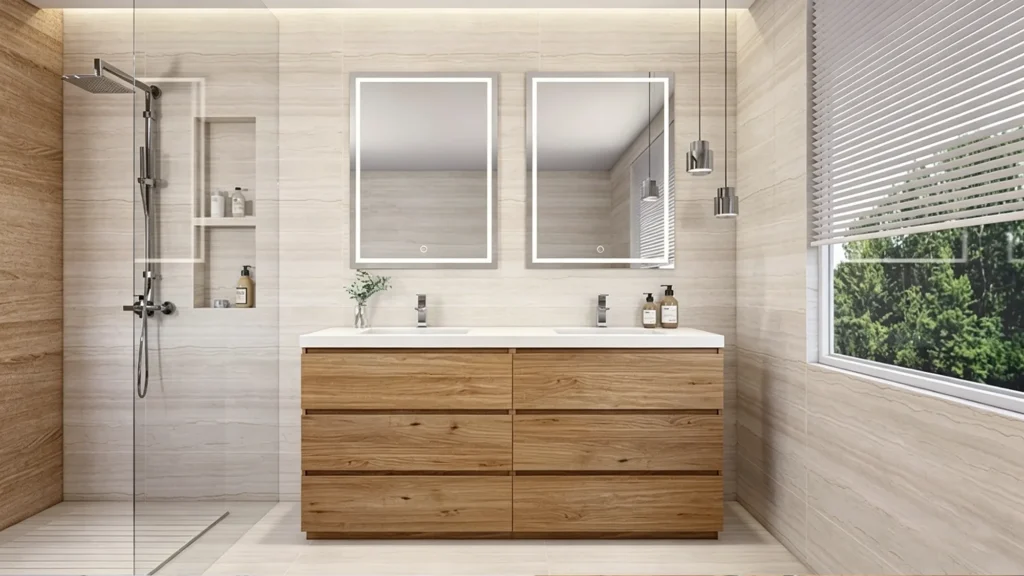
Vanity width determines storage and counter space. Depth affects how much floor room is left for movement. Height impacts guest comfort at the sink. For hotel bathrooms, the right balance across all three dimensions makes the space feel open and easy to use—even in compact layouts.
Width and Counter Usability
A vanity that is too narrow gives guests no place to set toiletries. I recommend at least 24 inches of counter width per sink. For double-sink layouts in suites, 60 to 72 inches total width is a practical starting point.
Depth and Floor Space
A deep vanity eats into the open floor area. Most hotel bathrooms work best with a vanity depth of 18 to 21 inches. This keeps enough floor space for guests to move freely and for housekeeping to clean around the unit.
Height and Guest Comfort
A counter set at 34 to 36 inches suits most adult guests. Lower counters at 32 inches work well for budget hotels where the bathroom is compact. Taller counters at 36 inches feel more premium and suit suite-level rooms.
| Dimension | Budget Hotel | Mid-Scale Hotel | Suite / Luxury |
|---|---|---|---|
| Width | 24–30 inches | 36–48 inches | 60–72 inches |
| Depth | 18–20 inches | 20–21 inches | 21–22 inches |
| Height | 32–34 inches | 34–35 inches | 35–36 inches |
Most buyers think about depth in terms of guest comfort. I think about it in terms of maintenance. A vanity that sits too close to the toilet or wall is hard for housekeeping to clean around. It also makes it harder for a technician to access the drain or supply valves without removing the cabinet. When I advise on bulk hotel orders, I always suggest leaving at least 6 inches of clear space between the side of the vanity and the nearest wall or fixture. That gap makes a real difference over years of daily use.
How Should Vanity Sizes Change by Room Type in Hotel and Apartment Projects?
Not every room in a hotel needs the same vanity. Using one size for all room types wastes space in some rooms and creates a cramped feel in others.
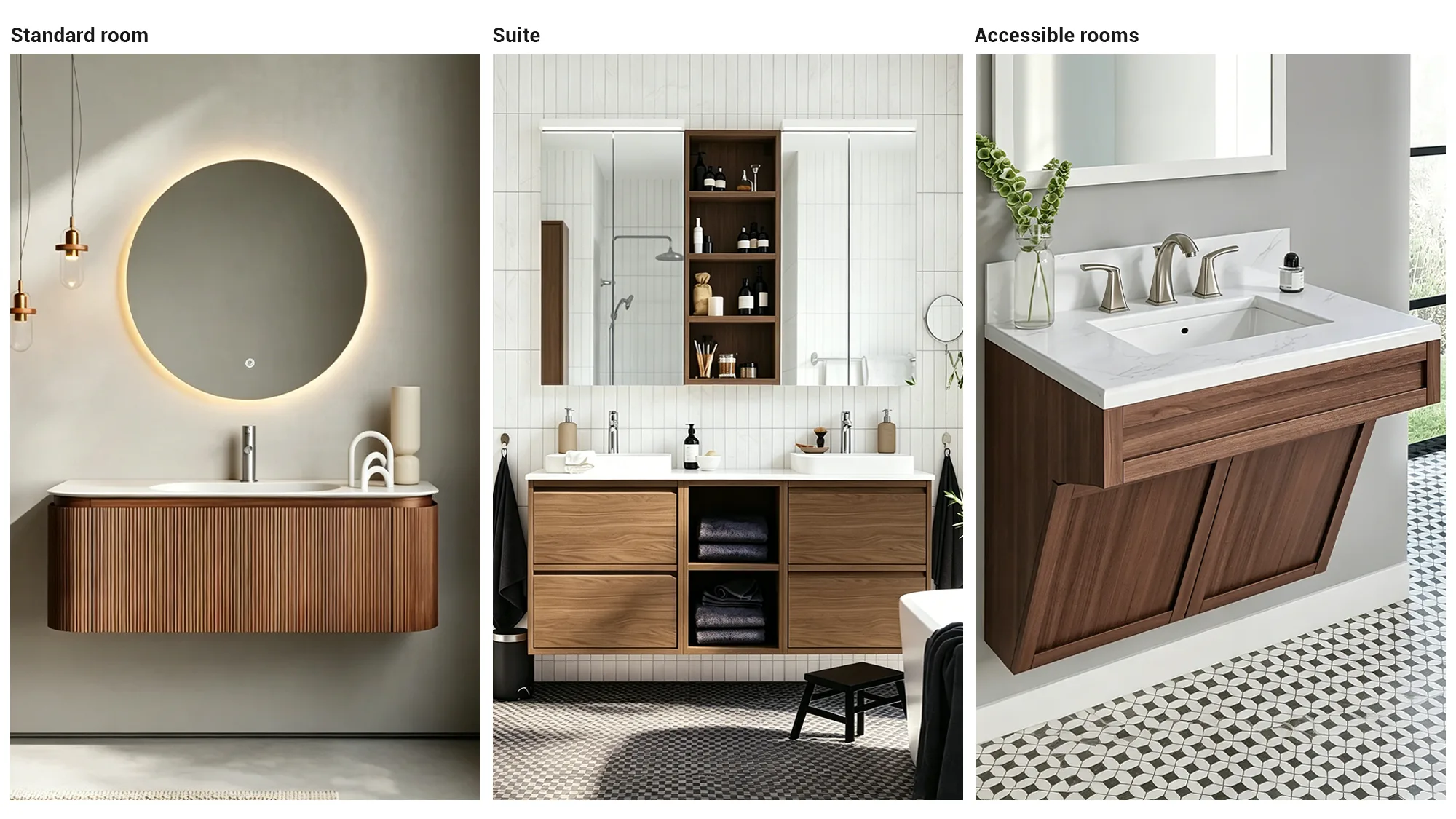
Vanity sizes should be set by room type. Standard rooms need compact, efficient layouts. Suites need wider counters and double sinks. Accessible rooms need lower counters and open knee space. Setting two or three defined sizes across your project keeps production consistent and installation faster.
Standard Rooms
In most standard hotel rooms, the bathroom is small. A single-sink vanity between 24 and 36 inches wide works well. Keep the depth at 18 to 20 inches to protect floor space.
Suite Bathrooms
Suites have more floor space and higher guest expectations. A double-sink vanity from 60 to 72 inches wide is common. Depth can go up to 22 inches. Counter height at 35 to 36 inches adds a premium feel.
Apartment and Extended-Stay Units
These rooms need more storage than a typical hotel room. A 36- to 48-inch vanity with deep drawers or under-sink cabinets works well. Guests in long-stay rooms use the bathroom like a home bathroom.
| Room Type | Suggested Width | Depth | Height |
|---|---|---|---|
| Standard room | 24–36 inches | 18–20 inches | 32–34 inches |
| Junior suite | 48–60 inches | 20–21 inches | 34–35 inches |
| Full suite | 60–72 inches | 21–22 inches | 35–36 inches |
| Extended stay | 36–48 inches | 20–22 inches | 34–36 inches |
It might seem like giving every room type its own exact size is the most precise approach. In practice, too many custom sizes create problems. Each new size needs its own production run, its own hardware set, and its own installation guide. On a 300-room project, I recommend no more than three vanity size variants. Pick sizes that cover standard rooms, suites, and accessible rooms. That range handles 95% of the project. It also makes reorders, replacements, and spare parts much simpler to manage over the hotel’s lifetime.
What ADA and Accessibility Dimensions Should Buyers Check Before Approving Vanity Drawings?
ADA compliance is not optional in most markets. Getting the dimensions wrong on accessible rooms creates legal risk and requires costly rework after installation.
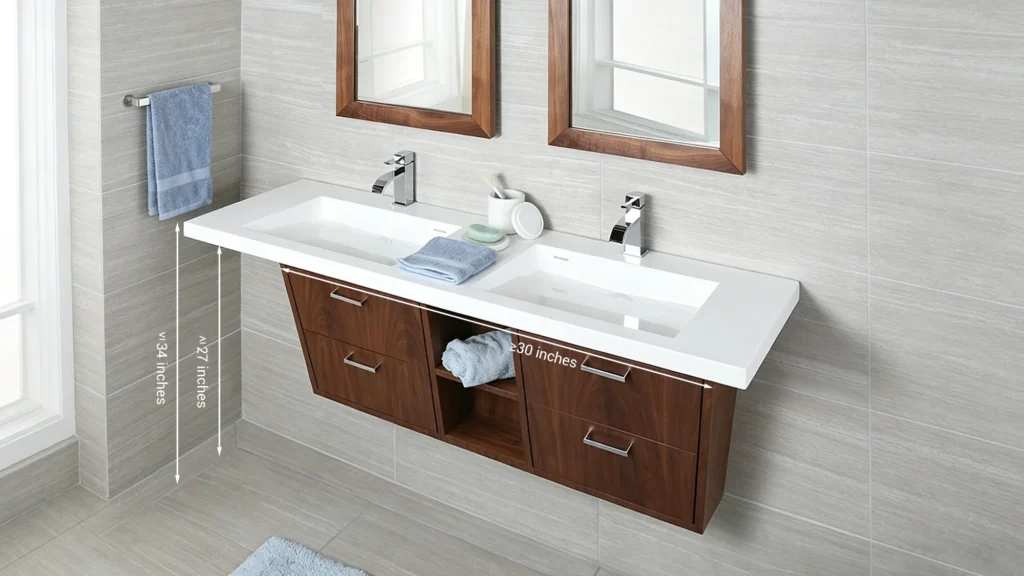
ADA-compliant bathroom vanities must have a counter height no higher than 34 inches, a knee clearance of at least 27 inches high and 30 inches wide under the counter, and no sharp edges on the front face. These standard bathroom vanity sizes apply to all accessible rooms in hotel and apartment projects.
Counter Height for Wheelchair Users
The ADA standard sets the maximum counter height at 34 inches. Many accessible hotel rooms now use 32 to 33 inches to give seated guests more comfortable access to the sink.
Knee Clearance Below the Cabinet
The space under the vanity must be open for wheelchair access. That means no cabinet base in the knee clearance zone. The open area must be at least 27 inches tall, 30 inches wide, and 19 inches deep.
Pipe Insulation Requirements
When the drain and supply pipes are exposed under an open-base accessible vanity, they must be insulated or covered. Bare pipes can burn or injure a seated user who cannot feel heat or pressure.
| ADA Requirement | Minimum Dimension |
|---|---|
| Counter height | ≤ 34 inches |
| Knee clearance height | ≥ 27 inches |
| Knee clearance width | ≥ 30 inches |
| Knee clearance depth | ≥ 19 inches |
| Pipe insulation | Required on exposed pipes |
The ADA is a US standard. If you are managing hotel projects in the UAE, Europe, or Southeast Asia, the local accessibility code may use different numbers. I always advise buyers to request the local accessibility standard from their architect before approving any accessible vanity drawing. The general principles—low counter, open knee space, insulated pipes—are similar across most codes. But the exact numbers can differ by 1 to 2 inches. In a bulk order, that difference matters.
How Can Buyers Avoid Plumbing Conflicts and Costly Size Mistakes in Bulk Hotel Orders?
Plumbing conflicts are the most expensive size mistake in hotel projects. They are also the most preventable with the right checks at the right time.
To avoid plumbing conflicts in bulk hotel vanity orders, get a dimensioned plumbing drawing before approving any custom size. Confirm pipe positions room by room if layouts vary across floors. Build a 1-inch tolerance into your vanity width and depth. Order one sample unit and do a dry-fit before approving the full production run.
Get a Dimensioned Plumbing Drawing First
This drawing shows where every supply and drain pipe exits the wall or floor. It is the most useful document for sizing decisions. Without it, the vanity size is just a guess.
Order a Sample Before Full Production
A sample unit lets you test the fit on site before committing to 200 or 300 pieces. I always recommend this step for any hotel order above 50 units. It takes two to three weeks but saves months of rework.
Build Tolerance Into the Size
Give the vanity width a 0.5- to 1-inch gap on each side. Give the depth a 1-inch buffer from the door swing or toilet edge. These small buffers protect against minor variations in wall and pipe positions across rooms.
| Risk | Prevention Step | When to Do It |
|---|---|---|
| Pipe conflict | Get plumbing drawing | Before approving size |
| Wrong fit at site | Dry-fit sample unit | Before full production |
| Size varies by floor | Measure 3–5 rooms per floor | Before finalizing drawing |
| Reorder mismatch | Lock size specs in writing | Before placing bulk order |
I understand why buyers skip the sample step. It adds time. It adds shipping cost. But in my years of working on hotel furniture orders, the sample step has saved more money than any other single action. A sample reveals problems you cannot see on a drawing—how the door clears the vanity corner, whether the drain cutout lines up, how the finish looks under the bathroom lighting. For a project with 300 rooms, finding one problem on a sample unit costs almost nothing. Finding that same problem after full delivery can cost tens of thousands of dollars to fix.
CASE SNAPSHOT: The 200-Unit Renovation Rescue
The Pain: A coastal resort ordered 200 standard vanities, only to find floor-drain offsets varied by 2 inches in 40% of rooms, halting installation.
The Fix: Our team redesign the cabinet base with a custom plumbing cavity and provided a pre-production dry-fit sample.
The Result: Zero on-site rework, installation time cut by 15 days, and 100% brand compliance.
Conclusion
Choosing the right custom bathroom vanity sizes for hotel projects takes early measurement, clear size standards by room type, and a sample check before bulk production. Get the dimensions right at the start, and everything else gets easier. If you need help sizing vanities for your next hotel project, visit georgebuildshop.com and reach out to our team.
Ready to Secure the Right Fit for Your Project?
Stop gambling with guest experience and installation deadlines. Whether you need ADA-compliant vanity layouts or a complete, one-stop luxury bathroom package, our factory-direct engineering team is ready to assist. Drop your project details, floor plans, or plumbing drawings below, and our commercial project specialists will review your specifications within 24 hours.