
Choosing between frosted shower doors vs clear panels frustrates project buyers. Wrong clear shower doors expose guests, while poor frosted glass ruins bathroom lighting and increases maintenance complaints across high-traffic properties.
Clear glass maximizes natural light, visibility, and interior space for open layouts. Frosted glass diffuses illumination and reduces visibility for privacy. The best choice depends on guest room lighting, water conditions, housekeeping schedules, and specific floor plans rather than surface appearance alone.
I spent years managing glass production in cabinet and bathroom factories, and I learned that glass looks different on site than in sample boxes. Project buyers must look past simple catalog pictures to protect their budgets and long-term guest satisfaction.
What Is the Difference Between Frosted and Clear Shower Doors?
Selecting bathroom glazing without comparing functional features creates costly operational headaches. Obscure textures can darken enclosures, while transparent panels trigger guest privacy complaints when floor plans feature open room layouts.
Clear shower glass delivers full light transmission and open sightlines, which expands compact bathrooms visually. Frosted shower glass scatters direct light to conceal bathers, but it alters color contrast and requires careful artificial lighting design to avoid casting sharp body shadows at night.
When I evaluate frosted vs clear glass shower doors for procurement teams, I separate performance into three technical areas. You must review user privacy, spatial lighting effects, and specific surface manufacturing methods before making bulk purchasing commitments.
Privacy and Visibility
Clear glass offers zero visual barrier between the shower enclosure and the vanity area. Frosted glass reduces visibility, but it does not create absolute privacy. Light angle and bather distance change everything. If the shower light stays on while the bedroom is dark, backlighting reveals sharp body silhouettes through frosted panels.
Online guest reviews frequently highlight this exact flaw in hotel layouts where bathroom lights wake sleeping partners. Never assume obscure glass guarantees modesty without testing local fixtures. Privacy should be verified under real room lighting, not assumed from a small glass sample on a sales desk.
Light, Space and Visual Continuity
Clear shower doors allow eyes to travel straight through to the back wall. This visual flow makes small guest bathrooms feel spacious and lets expensive feature tiles shine. Modern frosted glass shower doors diffuse illumination softly, but the opaque surface creates a visual boundary that can make tight bathrooms feel confined.
Architects often face a conflict between open design and guest comfort in compact urban rooms. If you want spatial depth without exposing the entire enclosure, partial frosted shower glass provides a balanced compromise. A center frosted privacy band keeps sightlines open at eye level while covering the mid-body zone.
Appearance, Surface Finish and Cost
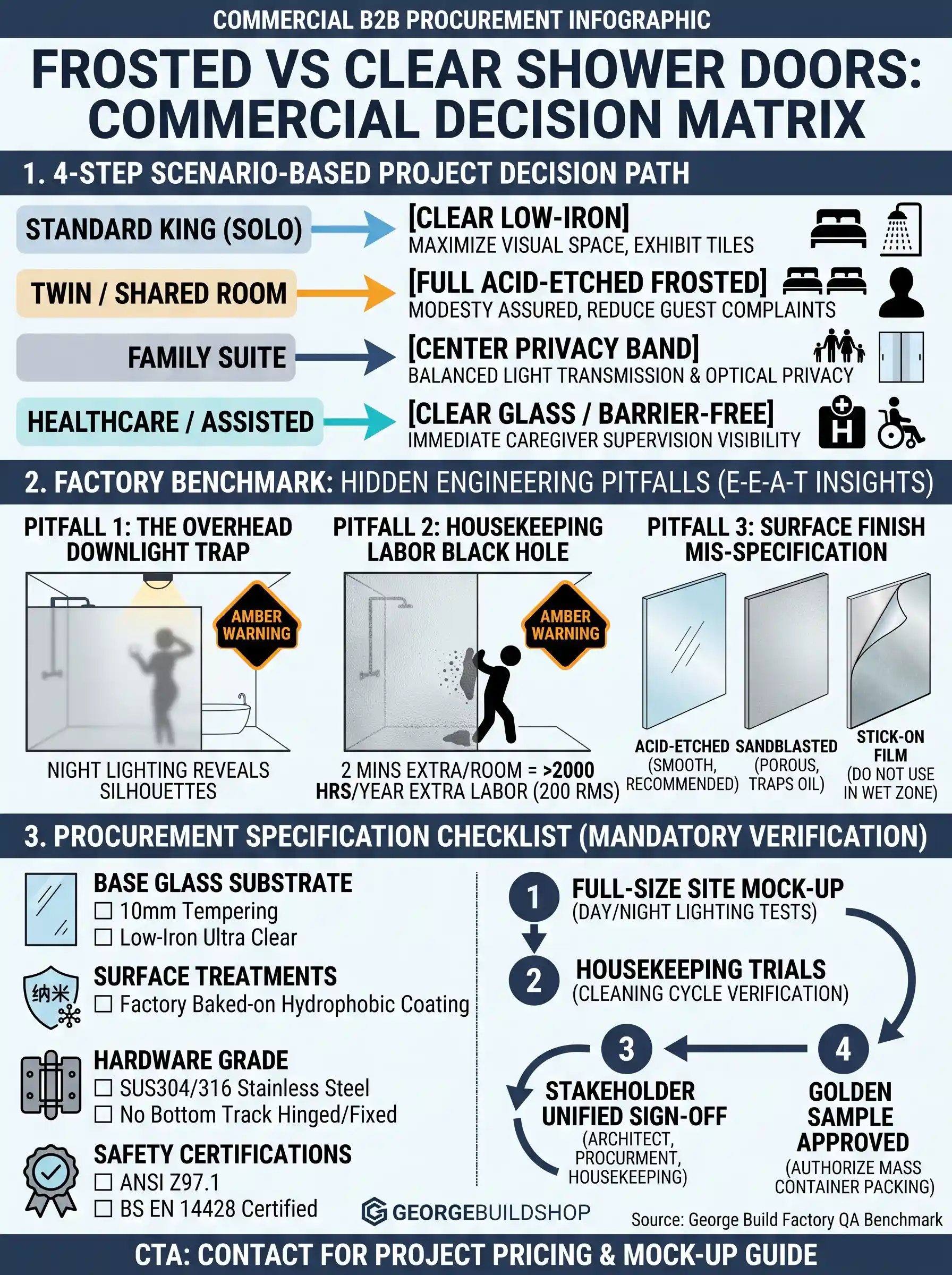
Frosted glass is not a single product. Acid-etched glass offers a smooth, fingerprint-resistant surface that withstands daily commercial cleaning. Sandblasted glass provides deep opacity, but its porous surface catches oils easily. Applied decorative films cost less initially, but they can peel or scratch under continuous humid conditions.
Base glass quality also changes your final project budget. Standard clear glass carries a subtle green iron tint along the polished edges. Low-iron ultra clear shower glass removes this green cast for clean luxury styling. Acid-etching processes add manufacturing costs, so clarify specific glass finishes early during supplier pricing reviews.
In my factory days, buyers often ordered frosted panels expecting total opacity, only to discover guest complaints after installation. You cannot evaluate glass performance in isolation from your electrical plan. Overhead downlights placed directly inside the shower turn obscure glass into a projection screen, destroying privacy despite expensive chemical etching.
Which Is Better for Hotels, Apartments, and Healthcare Projects?
Standardizing one shower door across different commercial developments invites severe operational failures. Commercial guests demand privacy, residential tenants neglect maintenance, and healthcare residents require immediate caregiver access during medical emergencies.
No single glass finish suits every building type. Hotels balance guest modesty with rapid housekeeping across varied room layouts. Apartment developments prioritize durable surfaces, hard water resistance, and low unit costs. Healthcare facilities prioritize accessible door openings, caregiver visibility, and strict safety regulations over decorative privacy glass.
Procurement managers must align glass specifications with exact end-user routines and operational demands. We must evaluate guest room occupancy dynamics, multifamily property maintenance realities, clinical safety requirements, and emerging smart glass technologies before issuing project orders.
Hotel Guest Rooms
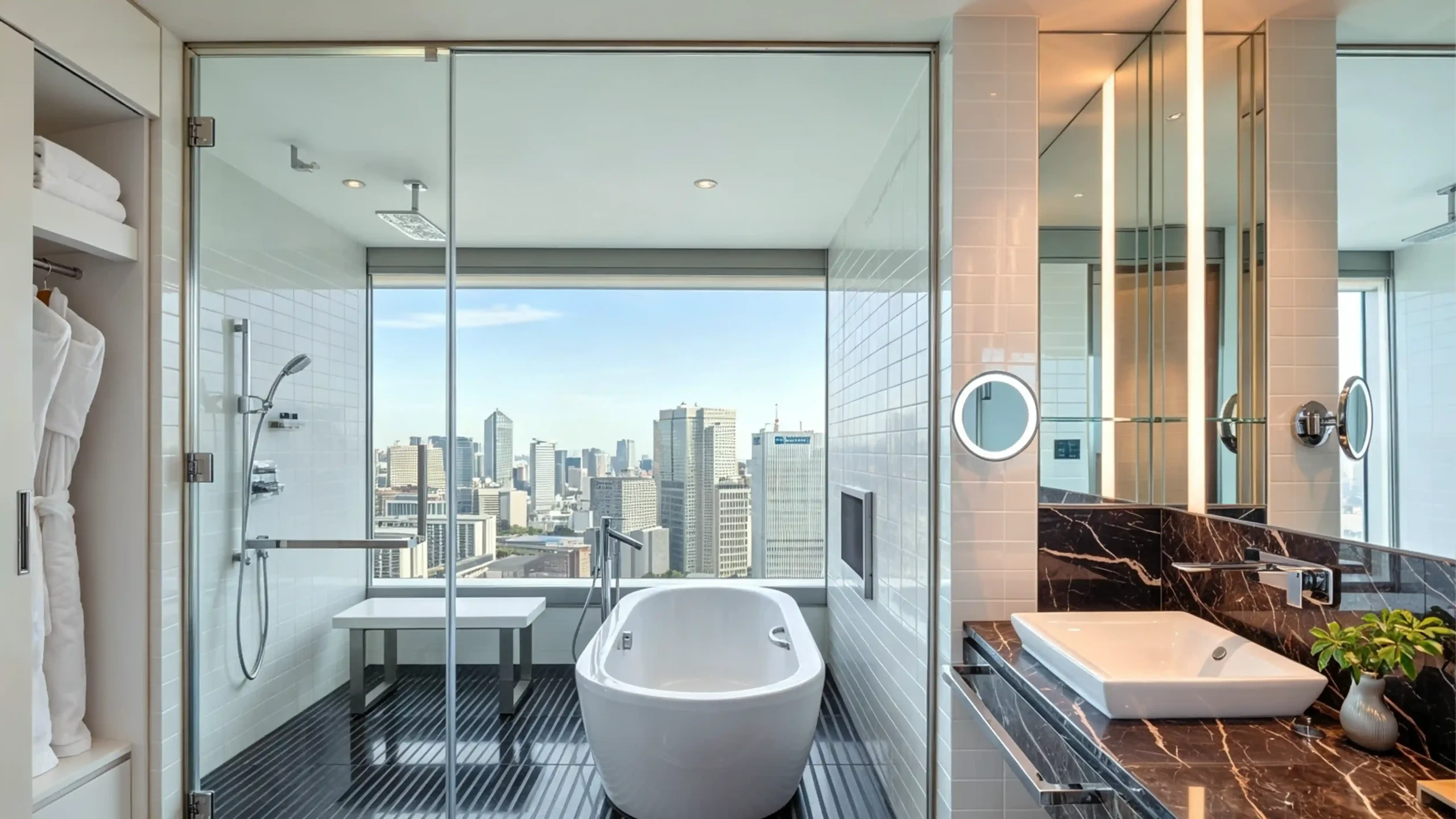
Hotel shower doors must accommodate diverse traveler demographics. A standard king room housing a solo business traveler benefits from clear glass doors that maximize perceived room volume. Twin rooms, family suites, and conference rooms require heavy privacy protection because guests often share bathrooms with coworkers, siblings, or friends.
| Room Type | Privacy Priority | Light Priority | Recommended Starting Point | Mock-Up Required? |
|---|---|---|---|---|
| Standard King | Medium | High | Clear Glass | Yes |
| Twin / Shared | High | Medium | Frosted Glass | Yes |
| Family Suite | High | Medium | Partial Frosted Glass | Yes |
| Luxury Suite | Medium | High | Switchable Privacy Glass | Yes |
Apartment and Multifamily Projects
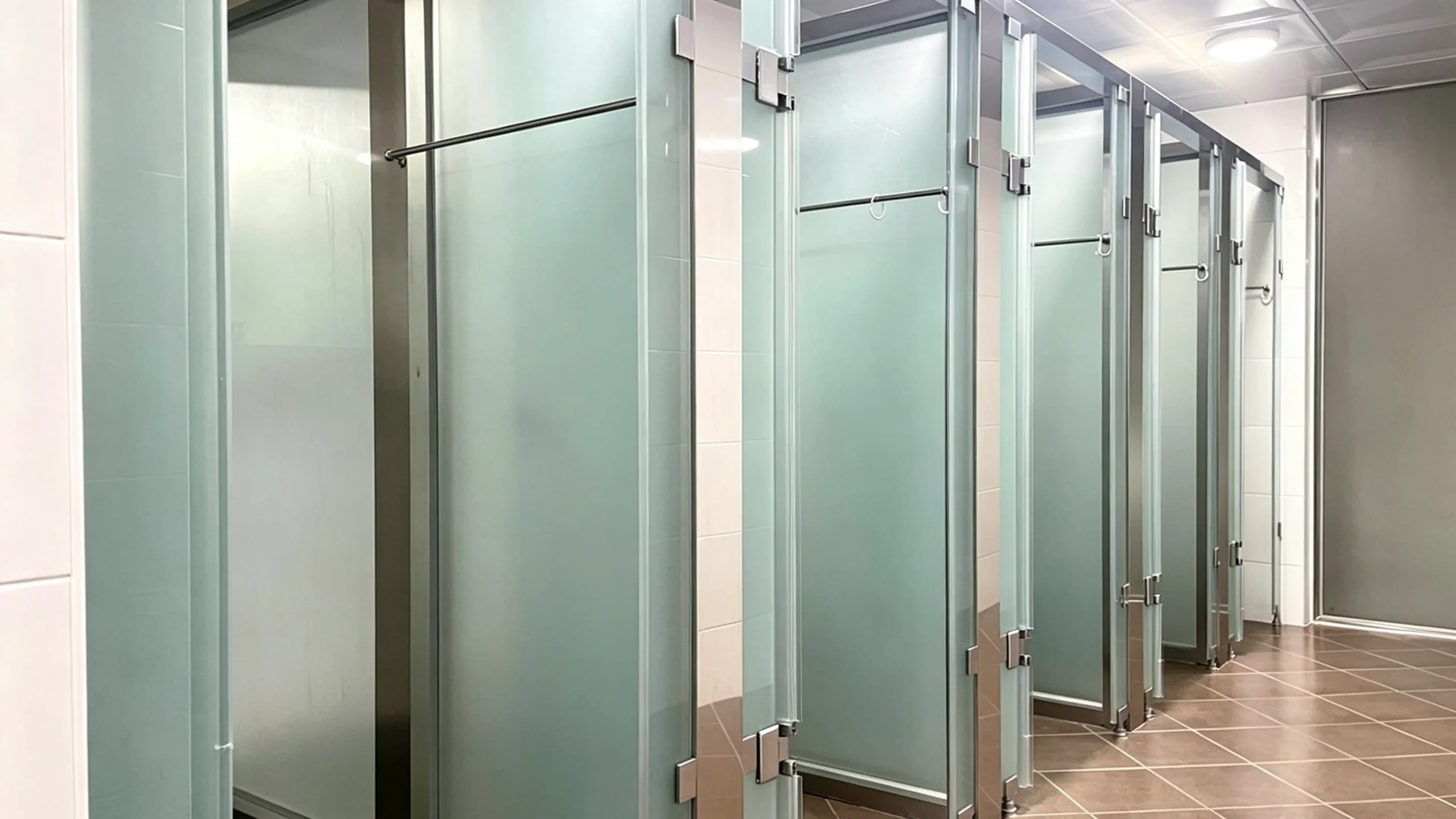
Multifamily developers focus on tenant turnover, hard water resistance, and standardization across hundreds of units. While clear shower doors help compact studio apartments feel larger, tenants rarely squeegee glass after bathing. Mineral deposits build up quickly, forcing property managers to spend extra time scrubbing between leases.
Frosted glass shower doors for apartments hide minor soap residue between tenant visits. But for student housing and co-living units, shared bathrooms make obscure glass an absolute operational necessity. When ordering for one hundred identical bathrooms, choose reliable hardware and standard glass panels that maintenance crews can replace quickly.
Healthcare and Assisted-Use Bathrooms
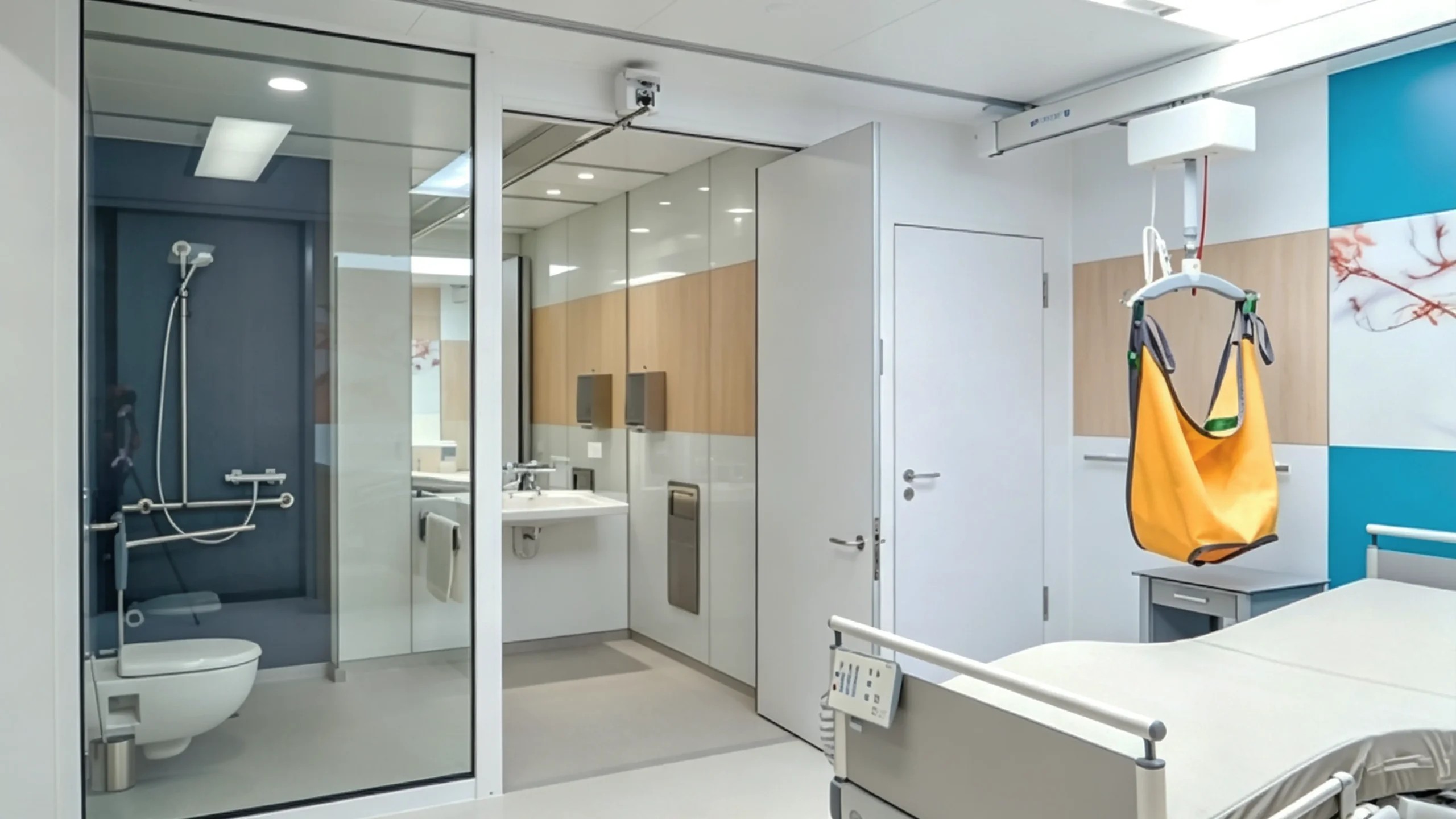
Healthcare shower enclosures require a careful balance between patient dignity and caregiver supervision. Complete frosted glass prevents medical staff from seeing a fallen patient quickly. Clear glass provides immediate safety monitoring, but it leaves vulnerable patients feeling exposed during personal bathing routines.
Glass finish is only one detail in healthcare design. Facilities must check grab-bar clearances, zero-threshold floor transitions, and wide emergency door swings. Standards like BS EN 14428 cover general domestic enclosures, but clinical facilities require strict adherence to local medical guidelines and accessibility building codes.
Partial Frosting and Switchable Privacy Glass
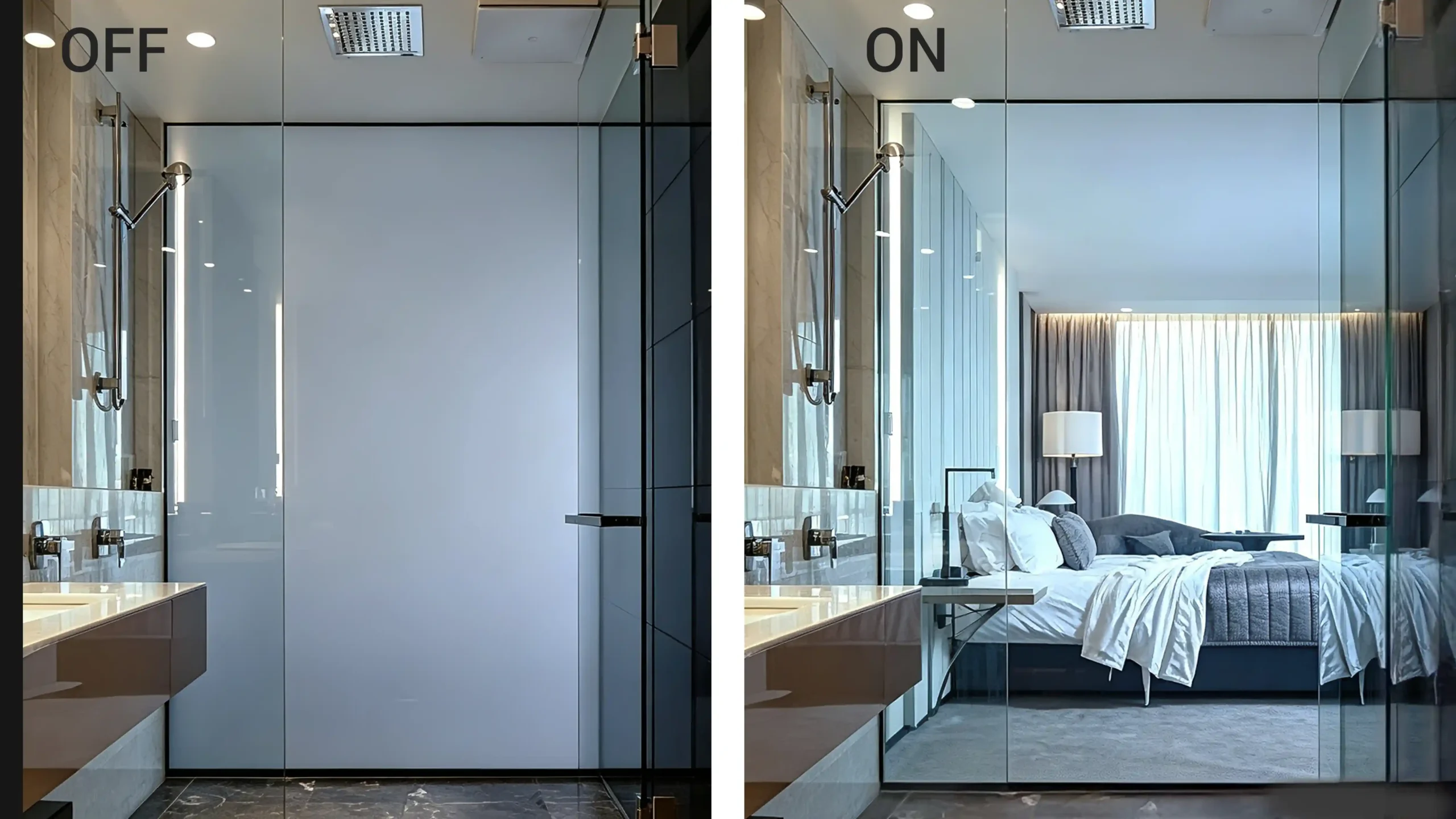
Modern projects often explore shower doors that change from clear to frosted to solve the privacy debate. Polymer dispersed liquid crystal glass switches from clear when powered to opaque when turned off. This smart privacy glass shower technology lets guests enjoy sweeping views while bathing with instant push-button privacy.
Commercial buyers must handle switchable glass with care in wet zones. You cannot apply standard dry-area privacy film inside showers. High-humidity installations require sealed laminated glass panels, safe low-voltage wiring pathways, and moisture-proof silicone seals. Project teams must also confirm fail-safe opaque states during electrical outages.
When I worked with hotel procurement teams on resort projects, we learned that room occupancy drives glass success. Single business travelers loved open clear glass bathrooms overlooking city skylines. But when conference delegates shared those same rooms, front desks faced endless complaints. Specifying glass by room category prevents operational disasters.
Which Is Easier to Clean and Costs Less to Maintain?
Housekeeping delays destroy hospitality profit margins and damage customer review scores. Mineral stains turn clear panels cloudy, while rough frosted textures trap grime that standard cleaning chemicals fail to remove.
Frosted shower glass hides water marks better than transparent panels, but it is not inherently easier to clean. Smooth clear glass allows faster squeegee wiping and easier visual inspection. Textured frosted surfaces trap mineral buildup more readily, demanding specialized cleaning chemicals and longer labor time over time.
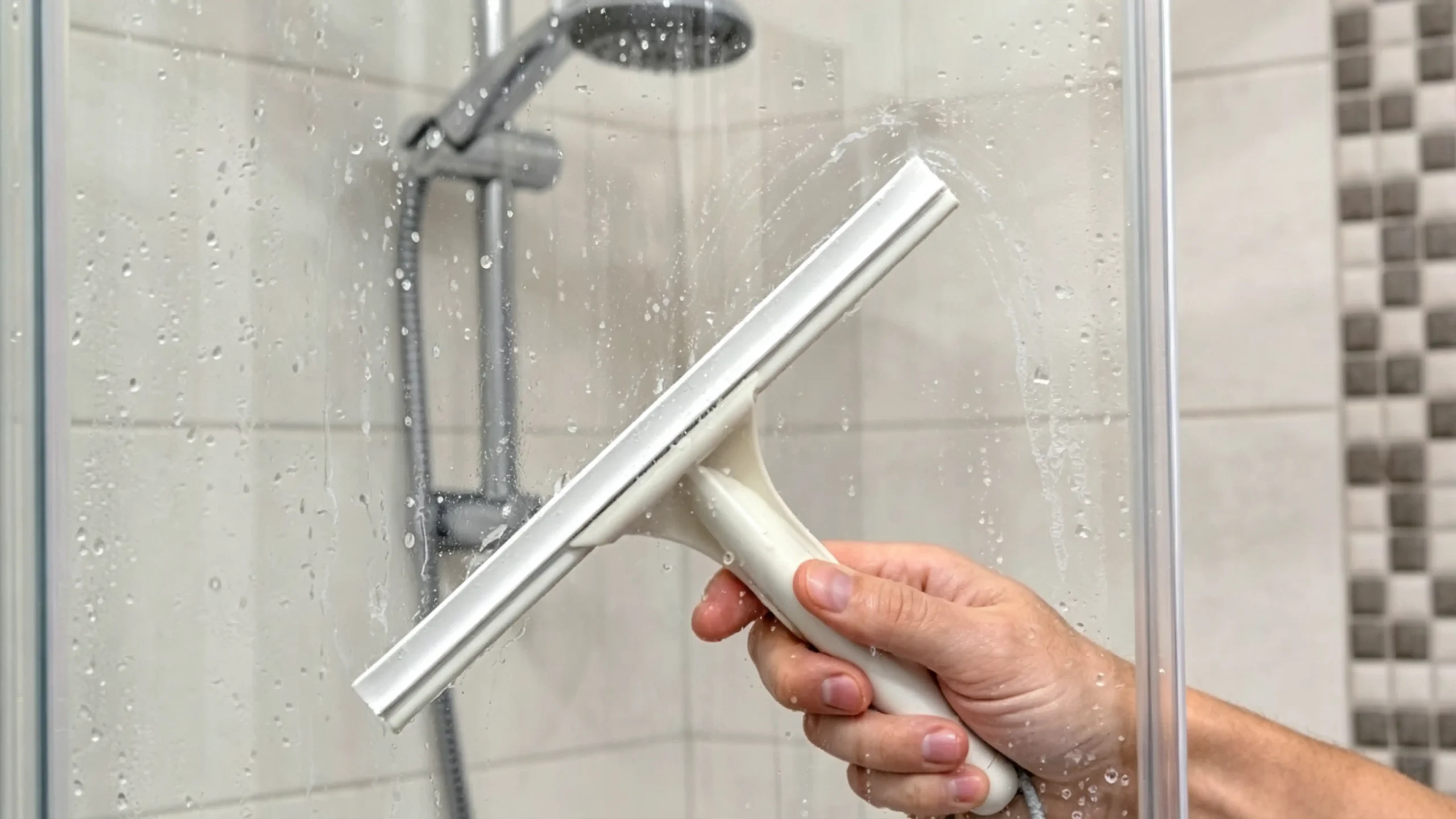
Calculating true operating costs requires looking past surface appearance to analyze daily housekeeping routines. We must examine visual cleanliness versus actual hygiene, local water mineral hardness, door hardware friction, and long-term housekeeping payroll before choosing a system.
Visible Cleanliness vs Actual Cleanability
Clear glass reveals every water drop, fingerprint, and soap streak instantly. Housekeeping supervisors can inspect clear panels across the room in two seconds. Frosted glass masks minor limescale spots effectively, but hiding water spots and being easier to clean are not the same thing in commercial operations.
When guests leave body wash oils on obscure glass, maids often overlook the invisible film. Over months, organic grime bakes into microscopic surface pits under hot shower steam. Clear doors show soil immediately, prompting daily squeegee cleaning that stops permanent limescale etching before expensive glass restoration becomes necessary.
Hard Water and Surface Texture
Hard water contains calcium and magnesium that bond with hot glass silica. On smooth clear glass, factory-applied hydrophobic coatings repel droplets, making them the easiest shower doors to keep clean. On sandblasted panels, coarse surface textures hold water droplets, creating permanent white chalk stains that standard vinegar cannot lift.
Before approving bulk glass orders, project buyers must ask suppliers vital technical questions. Which glass side faces the wet shower interior? Is the water-repellent coating baked on at the factory or wiped on manually? Can staff use alkaline cleaners without stripping the protective seal?
Door Design and Housekeeping Workload
Glass opacity is only one part of the maintenance equation. Heavy sliding door systems with deep floor channels, bottom rollers, and overlapping glass panels trap soap scum and standing water. Housekeeping staff spend five extra minutes digging hair and mold out of aluminum floor tracks every morning.
A simple frameless clear hinged door or fixed walk-in glass screen requires far less cleaning effort than a complex frosted sliding unit. By eliminating bottom tracks and magnetic door seals, your cleaning staff can wipe the smooth surface in seconds without dealing with moldy rubber gaskets.
Housekeeping Cost Over the Project Lifecycle
Procurement managers must calculate glass maintenance costs across the entire property lifecycle. Labor drives bathroom operating expenses far more than initial glass fabrication costs. You can calculate project cleaning overhead using this simple planning formula: Annual Glass Cleaning Cost = Rooms × Daily Cleaning Frequency × Extra Cleaning Minutes × Labor Rate.
Consider an illustrative example of a two-hundred-room hotel. Adding just two extra minutes per room to scrub textured frosted doors costs hundreds of additional labor hours annually. Factor in specialized cleaners and periodic coating reapplication, and minor glass finish choices create massive long-term operational budget differences.
In my factory testing, we placed clear glass and acid-etched glass under identical hard water spray cycles for thirty days. Uncoated frosted glass held mineral scales tightly inside its etched valleys. Clear glass showed water droplets earlier, but maids wiped it clean in one smooth squeegee stroke, proving visibility does not equal cleaning difficulty.
What Should Project Buyers Specify Before Bulk Ordering?
Submitting vague shower glass specifications leads to disastrous site delays and costly rejected containers. Unverified glass thicknesses rattle, non-compliant hardware corrodes, and mismatched frosted patterns destroy brand standards across wings.
A complete commercial shower door specification requires more than selecting clear or frosted glass. Buyers must define regional safety codes, glass thickness, surface treatments, hardware grades, dimensional tolerances, and batch packaging standards. Detailed tender documents prevent fabrication mistakes and guarantee smooth on-site installation across hundreds of hotel rooms.

Through my manufacturing background, I guide procurement managers through every phase of the commercial supply chain. We review certified safety standards, complete hardware assemblies, factory mock-up signoffs, and post-installation replacement tracking before cutting raw glass sheets.
Safety Glazing and Market Requirements
Glass finish is an aesthetic choice, but safety glazing is a strict legal requirement. In the United States, commercial shower doors must comply with CPSC 16 CFR Part 1201 and ANSI Z97.1-2026 safety standards. European and Middle Eastern projects typically mandate certified testing under BS EN 14428:2015+A1:2018 standards.
Never confuse general plumbing approvals with structural glass compliance. While certifications like cUPC or WaterMark apply to specific plumbing fixtures, shower enclosures require separate impact testing and certified factory stamps. Always verify the applicable building code, glazing standard, and project specification for the destination market before approval.
Glass Finish Is Only Part of the System
A tender line requesting two hundred frosted doors is completely unbuildable. A complete specification must define glass thickness, exact edge polishing, precision hinge cutouts, structural wall profiles, and magnetic water-seal gaskets. It must also stipulate stainless steel hardware grades to resist corrosion in high-steam environments.
Roller mechanisms, floor guides, anti-jump stoppers, and water-retention sills determine how doors operate under heavy daily use. Specifying ten-millimeter tempered glass without matching heavy-duty brass hinges causes door sagging within months. Clear engineering drawings must integrate structural hardware with your selected glass panels into a cohesive unit.
Approved Sample and Batch Consistency
Mass production requires strict quality control to ensure uniform appearance across multiple manufacturing batches. Variations in acid-etching immersion times create visible differences in opacity and color tint. When two adjoining hotel rooms feature different frosted finishes, the resulting guest impression looks cheap and uncoordinated.
We enforce a rigorous project workflow: drawing schedule review, glass finish coupon signoff, hardware finish matching, full-size mock-up room testing, and inbound quality checks. Technicians inspect dimensional tolerances, edge smoothness, hole alignments, and acid-etched haze levels under standardized factory lighting before authorizing mass container packing.
Replacement and Traceability
Hotel maintenance teams face major headaches when a shower door shatters three years after opening. Without clear production tracking records, finding an exact match for glass thickness, hole spacing, and frosted opacity becomes an expensive guessing game that keeps revenue-generating suites closed.
We solve this maintenance challenge by assigning permanent project codes to each production batch. Each shipping crate includes room-number markings, engineering drawing references, and hardware component codes. This detailed traceability ensures that hotel engineers can reorder an identical replacement panel for Room 812 without on-site modifications.
During a large resort renovation, our factory received an urgent call because custom frosted panels did not align with pre-drilled wall studs. That experience proved that procurement managers must tie glass orders directly to plumbing rough-in drawings. Rigorous factory quality control means nothing if your team fails to verify site tolerances before shipment.
How Should You Choose Between Frosted and Clear Shower Doors?
Rushing glass selection decisions causes costly guest complaints and premature bathroom renovations. Misjudging privacy creates uncomfortable guest stays, while choosing wrong finishes darkens compact rooms and inflates ongoing maintenance budgets.
Choose clear glass shower doors when maximizing natural light, architectural tile display, and spacious visual depth are your priorities. Choose frosted glass shower doors when bather modesty is essential. For multi-use projects, build a full-size lighting mock-up room to verify sightlines before approving mass factory fabrication.
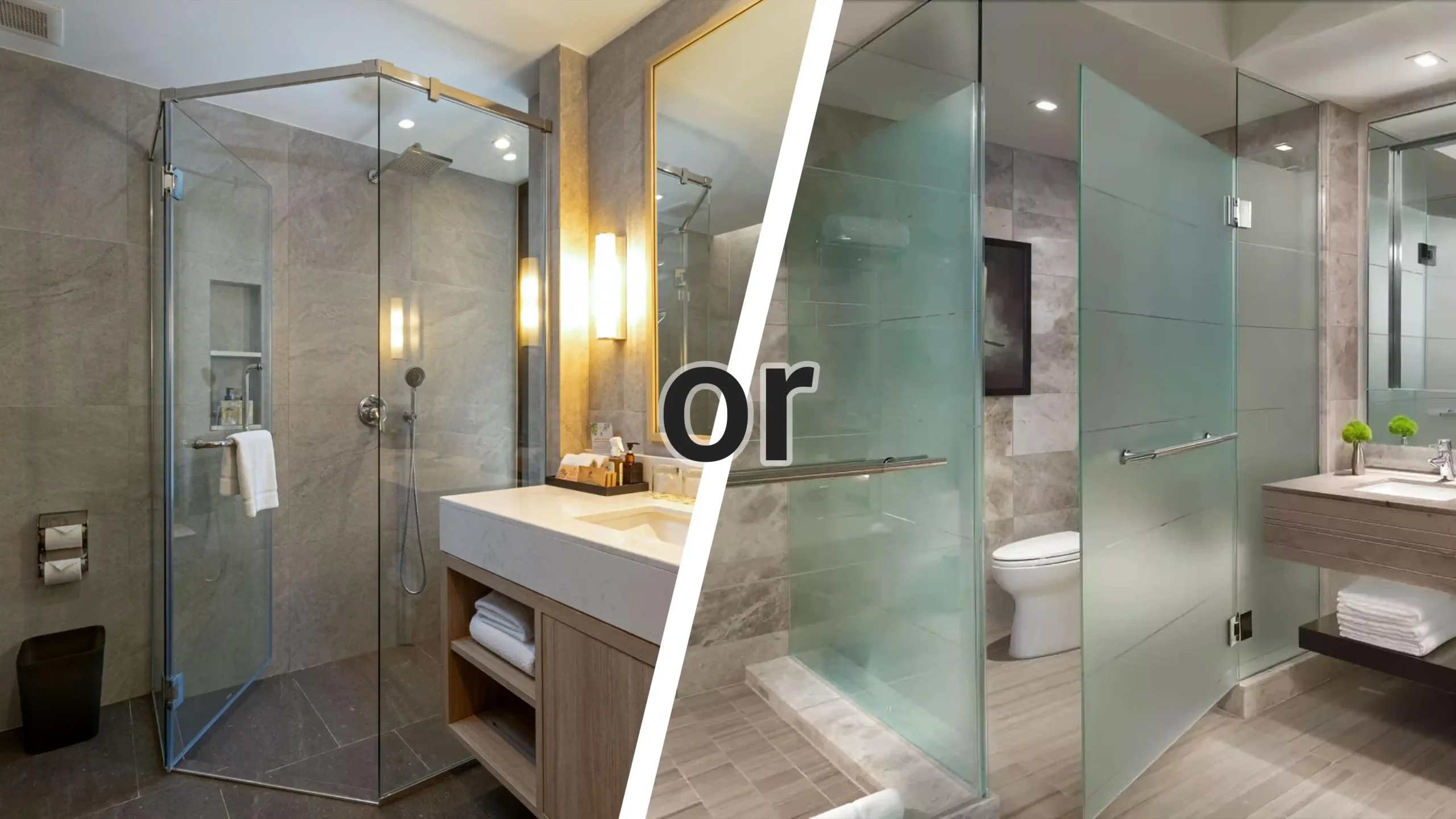
Selecting the correct glass specification requires a balanced decision framework. We structure this selection by evaluating key performance parameters across glass types, following a hands-on mock-up evaluation protocol, and executing a comprehensive pre-order procurement checklist.
Project Decision Matrix
| Performance Factor | Clear Glass | Frosted Glass | Partial Frost | Switchable Glass |
|---|---|---|---|---|
| Privacy Level | Low | High | Medium | Dynamic (High/Low) |
| Light Transmission | High | Medium | High | High |
| Perceived Space | Maximum | Constrained | Balanced | Maximum |
| Visible Water Spots | High | Low | Low (Mid-Band) | Medium |
| Cleaning Inspection | Easy | Moderate | Moderate | Moderate |
| Upfront Cost | Economical | Moderate | Moderate | Premium |
| Technical Complexity | Low | Low | Low | High |
| Recommended Project | Solo Hotel / Studios | Shared Hotel / Units | Family / Suites | Luxury Penthouse |
Full-Size Privacy and Cleaning Mock-Up
Never approve commercial glass orders based on desktop material swatches. Set up a full-size mock-up room on site. First, test day and night conditions with bathroom lights switched on while guest rooms remain dark. Second, check viewing angles directly from the bed, entrance corridor, and vanity mirror.
Third, spray the glass with soapy water and let housekeeping test their regular cleaning chemicals and squeegees. Fourth, invite your interior designer, project procurement manager, and executive housekeeper to inspect the installation together. Require unified sign-off from all department heads before placing your mass production factory deposit.
Final Procurement Checklist
Before approving mass manufacturing contracts, confirm these technical parameters: room occupancy type, required safety glazing certificates, glass thickness, surface etching method, hardware stainless steel grades, water-resistant coatings, batch opacity tolerances, crate labeling marks, and long-term replacement spare parts coding.
Always secure physical golden samples signed by your project architect and factory manager. Cross-check your delivery timeline with on-site plumbing milestones to prevent crowded job-site storage. Completing these validation steps ensures your glass packages arrive on schedule, match brand standards, and perform reliably for years.
In my factory experience, procurement managers who run comprehensive mock-up tests avoid ninety percent of post-handover warranty claims. A mock-up room transforms abstract drawings into real customer experiences. It exposes night lighting silhouettes, verifies cleaning cycle times, and prevents expensive architectural redesigns before glass containers cross the ocean.
FAQ About Frosted vs Clear Shower Doors?
Conclusion
Choosing between frosted and clear shower doors balances privacy, lighting, and maintenance costs. Contact georgebuildshop to discuss custom project specifications, order verified glass samples, and receive factory-direct manufacturing support today.
Ready to Engineer the Perfect Bathroom for Your Commercial Development?
Sourcing bathroom fixtures for hundreds of rooms requires more than just picking products from a catalog. As your dedicated one-stop sanitary ware partner, George Build simplifies your entire procurement process. From custom bathroom vanities to premium shower hardware and globally certified toilets, we supply everything your project needs to succeed.
Our factory-direct team will help you build full-size mock-ups, ensure strict safety code compliance, and establish permanent replacement batch codes for effortless long-term property maintenance. Submit your project details, floor plans, or BOQ (Bill of Quantities) below, and let our experts design a customized, cost-effective sanitary ware solution for your property.