Author: helenxu1995

  • Why does your cleaning team always complain about the difficulty of cleaning the bathroom? The secret of easy-to-clean design

    Why does your cleaning team always complain about the difficulty of cleaning the bathroom? The secret of easy-to-clean design

    The Ultimate Guide to Commercial Toilets: Silence Janitor Complaints & Boost Your Bottom Line

    The Ultimate Guide to Commercial Toilets: Silence Janitor Complaints & Boost Your Bottom Line

    Discover how the right toilet selection can transform your operational costs and guest satisfaction. This guide reveals the secrets to eliminating your cleaning team’s biggest headaches and turning your restrooms into a strategic asset.

    Let’s be direct. Have you ever truly considered what your cleaning crew faces every day? Their complaints about hard-to-clean restrooms aren’t just operational noise; they are the most valuable, unfiltered data you will ever receive about a critical—and costly—part of your facility.

    When your team talks about a “bad bathroom day,” they aren’t talking about a few stray paper towels. They’re talking about confronting what they grimly call a “Poo-casso”—feces intentionally smeared on walls, sinks, and mirrors[1]. They’re battling a persistent urine smell that never goes away, because porous tile grout acts like a sponge, trapping waste and becoming a permanent breeding ground for odor-causing bacteria[2][3]. They’re on their hands and knees scrubbing the impossible-to-reach grime that collects around the base of every single floor-mounted toilet[4].

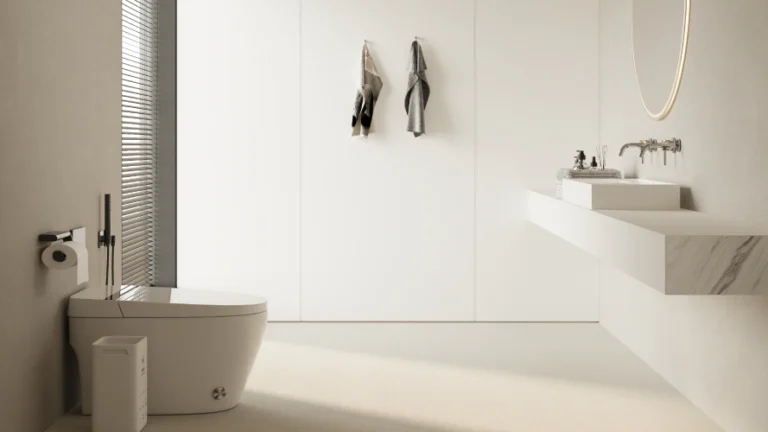
    A modern, clean, and easy-to-maintain commercial restroom with wall-hung fixtures.
    This isn’t just unpleasant; it’s a financial drain.

    This brutal work environment is a primary driver of burnout and turnover in the janitorial industry, which suffers from an astonishing average turnover rate of 200% to 400%[5][6]. Every time a good employee quits, you absorb the cost—either through your own HR department or through the inflated price of your cleaning contract.

    And the impact doesn’t stop there. An incredible 84% of customers say a dirty restroom damages a business’s image, and 75% will think twice before returning after just one bad experience[7]. For restaurants, the connection is even more devastating: customers assume a dirty restroom means a dirty kitchen[8].

    This guide is built on a simple but powerful premise: the secret to a better bottom line, happier guests, and a more stable workforce lies in solving your cleaning team’s biggest problems. Their complaints are your roadmap. By understanding their pain, you can make smarter procurement decisions that design these problems out of existence. Let’s begin.

    Table of Contents Module
    Table of Contents

    Here’s what we’ll cover:

    • The Janitor’s Veto: Uncover the real stories behind your cleaning team’s complaints—from the dreaded “Poo-casso” to the unwinnable war against odors—and why they are your most valuable design feedback.
    • The Architect’s Ghost: I’ll connect the dots between poor design choices and your bottom line, revealing the hidden costs of high staff turnover, wasted labor, and a damaged brand reputation.
    • The “Easy-to-Clean” Secret: Debunk the myth that all commercial toilets are the same. I’ll reveal the core principles of “Easy-to-Clean Design” that systematically eliminate your biggest maintenance headaches.
    • Your ROI Blueprint: Stop guessing. Get a simple, powerful framework and interactive calculator to see the real Return on Investment (ROI) of a toilet upgrade, turning a major expense into one of the smartest investments you can make.

    Why Are Your Janitors So Frustrated? – The Ultimate Guide to Commercial Toilets

    Why Are Your Janitors So Frustrated? (Decoding the Daily Battlefield)

    Before we talk about toilets, we need to talk about the people who clean them. Their daily complaints aren’t just the cost of doing business; they are the most accurate, real-time feedback you will ever get on the design failures within your facility. Let’s step onto their battlefield and see the problems through their eyes.

    The Daily Biohazard: More Than Just a Mess

    The most soul-crushing part of a janitor’s job isn’t the routine dirt. It’s the deliberate, almost hostile, acts of vandalism that turn a restroom into a recurring biohazard zone. Staff have a grim internal slang for the most common offense: the “Poo-casso”[1]. This is when a user decides to engage in what can only be described as “finger painting” with their own feces, smearing it on walls, sinks, mirrors, and even inside toilet paper dispensers[2][3].

    This isn’t a rare occurrence. Custodians regularly report cleaning stalls “drenched in… vomit,” dealing with used sanitary products stuck to ceilings, and finding toilets intentionally clogged with everything from beverage bottles to vape pens, leading to overflows that flood the very floors they have to clean[1][4]. Add to this the constant threat of finding needles in trash cans, and you have a job that is not just disgusting, but genuinely dangerous[5].

    Helen’s Insight:

    When you see this level of malice, you have to accept a hard truth: you aren’t designing for “users.” You are designing against “abusers.” Your material choices for partitions, walls, and fixtures can’t just be “durable”; they must be defensible. They need to be non-porous, graffiti-resistant, and able to withstand a level of hostility that most designers simply can’t imagine.

    The Unwinnable War: Odors, Grout, and Flawed Fixtures

    Here’s the complaint that truly breaks a custodian’s spirit: the restroom still smells bad right after it’s been cleaned. This isn’t a failure of their effort; it’s a catastrophic failure of the materials they were given to clean.

    Close-up of a dirty floor-mounted toilet base with stained grout, illustrating a major cleaning pain point.

    The main culprit? Tile grout. I’ve heard it described perfectly by cleaning pros: grout lines act “like a squeegee”[6]. When you mop a tiled floor, the porous grout actively scrapes filth, urine, and bacteria *off* the mop and locks it deep inside its own structure. The mop isn’t cleaning the floor; it’s feeding the grout. That grout then becomes a permanent food source for odor-causing bacteria, releasing a foul ammonia-like smell as the uric acid crystals reactivate with humidity[7][8].

    This problem is made worse by the “impossible-to-clean” zone: the grimy, unreachable area around the base of a floor-mounted toilet. Custodians describe having to get on their hands and knees with stiff brushes to attack the “stuck on dust, hair and grime” that collects there, a task that is both demeaning and inefficient[9][10]. Add in the nooks and crannies of an exposed trapway and the hidden underside of a toilet rim, and you’ve designed a perfect habitat for filth[11].

    Helen’s Insight:

    The complaint “the floor still stinks” is the single most compelling argument for investing in seamless, non-porous flooring. It is not a cleaning failure; it is a material specification failure. Any architect or designer who specifies porous tile and grout in a high-traffic commercial restroom today is committing long-term maintenance malpractice. Period.

    The Human Cost: Burnout, Turnover, and the “Turnover Tax”

    This daily battle against filth and flawed design takes a severe psychological toll. It’s the frustration of blocking off a restroom for cleaning, only to have customers push past the signs and walk all over a wet floor[12]. It’s the feeling of being invisible, of your hard work being undone in minutes by people who think messes just magically disappear[13].

    This isn’t just about feelings; it’s about burnout, and it has a staggering financial cost. The janitorial industry suffers from an average annual employee turnover rate between 200% and 400%[14][15]. This isn’t just your cleaning contractor’s problem. The costs of recruiting, hiring, training, and lost productivity for that revolving door of new employees are passed directly on to you in the form of higher contract prices and lower quality service[16].

    Helen’s Insight:

    Think of it as a “turnover tax.” You are paying a premium on your cleaning contract because your restrooms are so difficult and demoralizing to clean that they burn through staff. This is a hidden, recurring expense baked into your operational budget, all stemming from initial design choices. Solving your janitors’ frustrations isn’t just good management; it’s a direct path to cutting that hidden tax.

    How Cleaning Complaints Cost You Money – The Ultimate Guide to Commercial Toilets

    How Do Cleaning Complaints Actually Cost You Money? (The Hidden Financial Drain)

    We’ve walked through the daily battlefield your cleaning crew faces. Now, let’s translate that frustration into the language every property owner, manager, and investor understands: dollars and cents. The truth is, every complaint about a hard-to-clean restroom is a symptom of a deeper financial issue. Ignoring them is like ignoring a slow leak; eventually, the damage becomes impossible to miss.

    The “Time Tax”: Paying for Inefficient Design Every Single Day

    Think of poor restroom design as a “time tax” on your operations. Every feature that’s difficult to clean adds minutes to each cleaning cycle. According to ISSA, the worldwide cleaning industry association, cleaning a standard restroom fixture takes about 3 minutes[1]. But that’s for a well-designed fixture. What about the extra time spent on hands and knees scrubbing the grimy base of a floor-mounted toilet[2]? Or fighting the endless battle against urine-soaked grout[3]?

    These extra minutes add up. A design that’s easier to clean, like a wall-hung toilet, can reduce cleaning time by up to 30%[4]. For a 150-room hotel, saving just one minute per toilet per cleaning cycle, four times a day, adds up to over 3,600 hours of saved labor per year. At an average janitorial wage of $17.27/hour, that’s over $62,000 in direct labor savings annually[5].

    Helen’s Insight:

    I call this the “Architect’s Ghost.” It’s the lingering financial consequence of a decision made years ago, likely to save a few hundred dollars on the initial purchase. That “cheaper” floor-mounted toilet haunts your operating budget every single day. The initial price tag is a one-time event, but the labor cost is a recurring bill you pay for the next 20 years.

    The Revolving Door: How Bad Bathrooms Fuel the $60,000 “Turnover Tax”

    The janitorial industry has a staggering employee turnover rate, averaging between 200% and 400% annually[6][7]. This isn’t just an HR problem; it’s a massive, hidden cost passed directly on to you. Every time an employee quits due to burnout from a demoralizing work environment, it costs thousands to replace them.

    Research from Cornell University estimates the cost of replacing a single hospitality worker is $5,864, factoring in recruitment, training, and lost productivity[8]. If a difficult work environment causes just ten employees to leave per year, that’s nearly $60,000 in turnover costs. This is the “Turnover Tax” you pay for maintaining a workspace that frustrates and devalues your staff.

    A frustrated hotel manager looking at a spreadsheet, representing the hidden financial costs of poor restroom maintenance.

    The Brand Reputation Balance Sheet: Where a Dirty Toilet Becomes Lost Revenue

    This is where the cost becomes most visible—and most damaging. In today’s digital world, your restroom is a silent, brutally honest ambassador for your brand. And customers are listening.

    The numbers are unforgiving. A landmark survey by Bradley Corp. found that 84% of customers say a dirty restroom damages a business’s image, and a shocking 75% will think twice before returning after just one bad experience[9]. For restaurants, it’s even more direct. A Harris Interactive poll revealed that 88% of people believe a dirty restroom reflects the cleanliness of the kitchen[10].

    This isn’t just about perception; it’s about revenue. A Cornell University study quantified the impact of online reputation, finding that a 1-point increase on a 5-point rating scale allows a hotel to raise its price by 11.2% while maintaining the same market share[11]. Every negative review that mentions your “disgusting restroom” isn’t just a complaint—it’s a direct downward pressure on your pricing power and your property’s value.

    Helen’s Insight:

    Think of your restroom as the ultimate litmus test. A customer might forgive slow service, but a dirty bathroom feels like a personal insult. It sends a clear message: “We don’t care about your comfort or your health.” In an era where a single photo on Google Maps can reach thousands, that’s a message no business can afford to send.

    The “Easy-to-Clean” Secret – The Ultimate Guide to Commercial Toilets

    What Is the Secret to an “Easy-to-Clean” Restroom? (A Solutions-Based Blueprint)

    After years in this industry, I can tell you the secret to a low-maintenance restroom isn’t a magic cleaning product. It’s about making smart, proactive design choices that eliminate cleaning headaches before they ever begin. “Easy-to-Clean Design” isn’t an aesthetic; it’s an operational strategy. It’s about systematically designing away the very things your cleaning crew complains about. Here’s the blueprint.

    Pillar 1: The Wall-Hung Revolution (Get Everything Off the Floor)

    Remember the “impossible-to-clean” zone we talked about? That grimy, disgusting area around the base of a floor-mounted toilet? The single most effective way to eliminate it is to get the toilet off the floor entirely. Wall-hung toilets are a game-changer for maintenance staff. By suspending the bowl from the wall, you create a completely open, obstruction-free floor that can be mopped quickly and thoroughly[1]. No more kneeling, no more special brushes, no more permanent ring of filth.

    This isn’t just about looks; it’s about labor. Eliminating the need to navigate around a toilet pedestal can cut cleaning time by up to 30%[2]. When you multiply that by every toilet, every day, the savings are enormous. The tank and plumbing are concealed within the wall, which not only saves 8-12 inches of precious floor space but also eliminates multiple surfaces that would otherwise collect dust and grime[3].

    Helen’s Insight:

    I’ve heard every concern about wall-hung toilets, especially about maintenance. “What if something breaks inside the wall?” Modern in-wall carrier systems are engineered for this. All the working parts—the fill and flush valves—are accessible through the flush plate opening, without ever touching a tile[4]. It’s a myth that you have to break open the wall for routine service. The higher initial cost is an investment in decades of lower labor costs.

    Pillar 2: The War on Grout (Choose Seamless, Non-Porous Surfaces)

    The second unwinnable war for janitors is against the persistent smell of urine, which is almost always caused by one thing: porous tile grout[5]. Grout acts like a sponge, absorbing urine and other contaminants, creating a permanent food source for odor-causing bacteria. No amount of surface mopping will ever fix it.

    The solution is to eliminate grout. For floors, materials like epoxy terrazzo or polished concrete create a seamless, non-porous surface. There are no joints for filth to hide in, making cleaning incredibly simple and effective[6]. For walls, especially in shower areas, solid surface panels offer a grout-free, waterproof, and antimicrobial alternative to tile, resisting mold and mildew growth from the start[7].

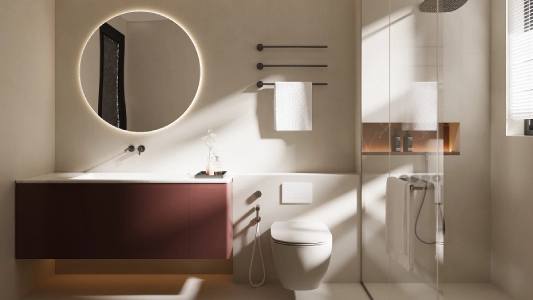
    A modern, easy-to-clean restroom featuring seamless surfaces and wall-hung fixtures.

    Pillar 3: Engineered Cleanliness (Specify Smarter Toilets)

    Not all toilets are created equal. Modern toilet design has evolved specifically to combat the biggest cleaning pain points. When specifying, look for these three features:

    1. Skirted Trapway: This design conceals the S-shaped pipe at the base of the toilet with a smooth, continuous surface. It eliminates all the awkward curves and bolt caps that are so difficult to clean on a standard toilet[8].
    2. Rimless Bowl: Traditional toilets have a rim around the inside of the bowl where water flows during a flush. This area is impossible to see and nearly impossible to clean, making it a “breeding ground for unwanted bacteria”[9]. Rimless toilets eliminate this channel, allowing for a more powerful, direct flush that cleans the entire bowl and leaves no place for germs to hide[10].
    3. Advanced Glaze: Leading manufacturers have developed nano-technology glazes, like TOTO’s CEFIONTECT, that create an ultra-smooth, ionized barrier on the porcelain. This super-slippery surface prevents waste from sticking in the first place, reducing the need for frequent scrubbing and harsh chemicals[11].

    Helen’s Insight:

    Combining these three features—a wall-hung toilet with a skirted design and a rimless bowl with an advanced glaze—is the ultimate hat-trick. You’ve just designed away the three biggest toilet-related complaints from your cleaning staff: the dirty floor, the grimy exterior, and the filthy interior rim. This is how you move from reactive cleaning to proactive design.

    ROI Blueprint Calculator

    Your ROI Blueprint (The Interactive Calculator)

    Alright, we’ve talked about the problems and the hidden costs. But what does this all mean for your specific property? It’s easy for me to throw around big numbers, but the real power comes when you can see your own potential savings in black and white.

    That’s why I built this tool. Think of it as a simple way to translate the “soft costs” we’ve discussed—like wasted time and staff turnover—into a hard number. This isn’t about complex accounting; it’s about giving you a realistic estimate you can use to justify an upgrade. It’s the blueprint that turns a restroom renovation from an “expense” into one of the smartest “investments” you can make.

    Helen’s Insight:

    Don’t be intimidated by the term “ROI.” All it really means is, “For every dollar I spend, how many dollars do I get back?” This calculator helps you answer that question. Use it to see the money that’s currently leaking out of your budget through inefficiency. This is the number you can take to your finance team to show them not just how much a renovation will cost, but how much it will save.

    How to Use the Calculator

    Just fill in the details about your property below. I’ve pre-filled some fields with industry averages to make it easier, but feel free to adjust them to match your reality. The more accurate your numbers, the more powerful the result.

    How to Interpret Your Results

    The numbers you see above are a powerful story. The Total Annual Savings is the estimated amount of money you could reclaim each year by reducing wasted labor and lowering staff turnover. The Payback Period tells you how quickly the project pays for itself[1]. And the 5-Year ROI (Return on Investment) shows the total return as a percentage of your initial cost over five years, a metric that financial decision-makers love to see[2]. This isn’t just about a cleaner bathroom; it’s about a healthier bottom line.

    Your Action Plan – The Ultimate Guide to Commercial Toilets

    What’s Your Action Plan to Turn a Cost Center into a Profit Center?

    We’ve gone through the ‘why.’ We’ve seen the battlefield through your janitors’ eyes and translated their frustrations into real financial costs. Now, let’s talk about the ‘how.’ Knowledge is only powerful when you use it. This is your action plan—a simple, step-by-step guide to start making smarter decisions today.

    Step 1: Conduct a “Pain Point Audit”

    Your first and most important step doesn’t cost a dime. Go talk to your cleaning crew. They are your frontline intelligence officers. Ask them simple, direct questions:

    1. What is the single most frustrating part of cleaning our restrooms?
    2. Which fixtures or areas take the most time to clean?
    3. If you could wave a magic wand and change one thing about the design, what would it be?

    Their answers are not just complaints; they are a diagnostic report of your facility’s design flaws. Document them. This is the foundation of your business case.

    Helen’s Insight:

    I can’t stress this enough. The unfiltered feedback from your janitorial staff is more valuable than any consultant’s report you could ever pay for. They know where the bodies are buried—or in this case, where the grime is permanently trapped. Listening to them shows respect and gives you the exact data you need to justify an upgrade.

    Step 2: Shift Your Mindset from “Price Tag” to “Total Cost”

    The biggest mistake I see property managers make is choosing the cheapest option on the invoice. This is a classic trap. You must start thinking in terms of Total Cost of Ownership (TCO)[1]. TCO is the simple idea that the true cost of an item isn’t just what you pay for it today, but what you pay to maintain, repair, and eventually replace it over its entire life.

    A cheap, floor-mounted toilet might save you $500 upfront, but if it costs you an extra $200 a year in cleaning labor and contributes to staff turnover, it’s actually the more expensive choice in the long run.

    Helen’s Insight:

    Think of it like buying a car. A cheap used car might seem like a great deal, but if it has terrible gas mileage and needs constant repairs, it will drain your wallet. A slightly more expensive, reliable car with great fuel efficiency costs you far less over five years. Your toilets are no different. You’re not just buying a fixture; you’re buying 20 years of maintenance costs.

    Step 3: Build Your Business Case with the ROI Blueprint

    Now it’s time to put numbers to your plan. Use the ROI Calculator from the previous section. Plug in the real numbers from your facility—your janitor’s wages, the number of toilets, and a conservative estimate of time saved. The result is a powerful document that shows:

    1. The thousands of dollars you’re currently losing to inefficient labor.
    2. The thousands more you’re losing to the “Turnover Tax.”
    3. A clear payback period that shows how quickly a smart investment pays for itself.

    This isn’t a request for a “nicer bathroom” anymore. It’s a data-driven proposal to reduce operational costs and mitigate risk.

    Step 4: Specify for the Future, Not the Past

    Armed with your data and a new mindset, you can now make procurement decisions that solve problems instead of creating new ones. For any future renovation or new build, make these “Easy-to-Clean” features non-negotiable:

    1. Wall-Hung Fixtures: Demand them. The labor savings are too significant to ignore.
    2. Seamless Surfaces: Prioritize non-porous materials for floors and walls. Declare a war on grout.
    3. Engineered Cleanliness: Specify toilets with skirted trapways, rimless bowls, and advanced glazes.

    By following this plan, you’re not just remodeling a restroom. You’re upgrading your entire operational model. You’re turning a constant source of complaints and costs into a silent, efficient, and valuable asset.

    Conclusion – The Ultimate Guide to Commercial Toilets

    Your Restroom Is Your Brand’s Loudest Ambassador

    So, where does this leave us? We started this journey by listening to the most honest feedback you can get: the daily complaints of your cleaning crew. We followed that thread from the “Poo-casso” on the wall and the impossible-to-clean toilet base all the way to your balance sheet, where it shows up as wasted labor, high staff turnover, and negative online reviews that damage your brand.

    If there’s one thing I hope you take away from all this, it’s that a commercial restroom is never just a restroom. It’s a silent, brutally honest reflection of your business. It tells your customers, your guests, and even your own employees exactly how much you care about the details. A cheap, poorly designed toilet doesn’t say “we saved money.” It says, loud and clear, “we don’t care about your experience here.”

    Helen’s Insight:

    For years, I’ve seen smart managers make the same mistake: they treat the restroom as a line-item expense to be minimized. But the smartest leaders I know treat it as a strategic asset to be optimized. They know that an investment in a clean, modern, and efficient restroom isn’t a cost—it’s one of the highest-returning investments they can make in their brand’s reputation and long-term profitability.

    We’ve spent this guide diagnosing the problem and uncovering the “why” behind the costs. Now, it’s time to move from analysis to action. It’s time to explore the cure.

    That’s exactly what our main pillar page is for. It’s the next step. It takes the principles we’ve discussed here and turns them into a detailed, practical guide for selecting the right fixtures that will save you money, impress your guests, and finally give your cleaning team a break. This is where you find the specific solutions.

    Ready to make a change? Continue to our complete Commercial Toilet Procurement Guide now and start building a better restroom—and a stronger business.

    References – The Ultimate Guide to Commercial Toilets

    A Note on Our Research

    To provide you with the most accurate and actionable insights, this guide was built on a foundation of extensive research. We believe in transparency and want you to see the work that went into it. Below is a comprehensive list of the external articles, studies, and real-world forum discussions that informed our analysis and Helen’s insights. This isn’t just opinion; it’s data-driven strategy.

    1. Stathakis – What No One Tells You About Janitorial Turnover
    2. Spotless Cleaning Chicago – The Damaging Impact of High Janitorial Turnover Rates
    3. CleanLink – Survey: Dirty Restrooms Hurt a Business’s Image
    4. The Facilities Group – How Dirty Restrooms Negatively Impact Your Business
    5. Reddit – r/Custodians – Worst single situation you have ever had to clean up after
    6. Newsweek – Custodian’s Photo Showing School Bathroom’s Mess Sparks Outrage
    7. Reddit – r/AskReddit – People who work as janitors, what’s the most…
    8. Reddit – r/AskReddit – Janitors/cleaning staff of reddit, what is the…
    9. Reddit – r/HomeDepot – Anybody else’s bathrooms absolutely disgusting…
    10. Kaivac – The Definitive Guide to Restroom Cleaning
    11. Imperial Dade – Products to Avoid Grout Odor
    12. Zerorez – How to Get Urine Out of Grout Around Toilet
    13. Reddit – r/Custodians – Floor behind the toilets
    14. Archipro – Wall-hung vs floor-mounted toilets: pros and cons
    15. Wholesale Domestic – What is a Rimless Toilet?
    16. Reddit – r/retailhell – Why do customers come into the restrooms while I am cleaning?
    17. Reddit – r/Custodians – Do you guys re-clean restrooms after a staff use it?
    18. ISSA – How To Calculate Cleaning Times
    19. Satellite Industries – Wall-Hung Wonders: The Benefits of Elevating Your Toilet
    20. U.S. Bureau of Labor Statistics – Janitors and Building Cleaners
    21. EB3.work – The Real Cost of Hospitality Turnover
    22. Opiniator – Restaurant Restroom Quality: Dirty Bathrooms Are Damaging Profits
    23. Travel Weekly – Cornell study links hotel reviews and room revenue
    24. Houzz – Which is Better: Wall-Mounted or Floor-Mounted WC?
    25. Horow – Wall Hung Toilets Pros and Cons
    26. Geberit – Reference Projects
    27. Terrazzco – Low Maintenance Flooring
    28. Tower Surfaces – Solid Surface Wall Panels
    29. Angi – Skirted Toilet vs. Regular
    30. Robertson – What is a rimless toilet and which are the best?
    31. TOTO USA – What is CEFIONTECT Technology?
    32. iGroup Design – Four Steps for Calculating the ROI of Your Hotel Renovation
    33. NetSuite – Hotel ROI
    34. Ferguson – Total Cost of Ownership for Facilities
  • How to Save Tens of Thousands on Your Hotel’s Water Bill Just by Replacing Your Toilets

    How to Save Tens of Thousands on Your Hotel’s Water Bill Just by Replacing Your Toilets

    Hotel Water Bill Savings

    How to Save Tens of Thousands on Your Hotel’s Water Bill Just by Replacing Your Toilets

    Hi everyone, I’m Helen.

    I was on an online forum for property owners the other day and saw a post from a manager who had just received a record-breaking water bill. His word for it?

    “Pure insanity.”

    As a 10+ year veteran in the sanitary ware industry—who started on the factory floor—and as a new mom who now scrutinizes every household expense, I completely understand that feeling of helplessness when you see costs spiraling out of control. That ever-increasing water bill is silently eating away at your hotel’s profits.

    And more often than not, the biggest leak in your budget is coming from the one place you might not be looking: your hotel’s outdated, inefficient toilets.

    A modern, water-saving toilet in a clean bathroom setting.

    But this article isn’t about vague promises. It’s about the numbers. I’m going to give you a simple framework to calculate the real Return on Investment (ROI) of a toilet upgrade. Together, we’re going to turn this “expense” into one of the smartest “investments” you can make for your property.

    Collapsible Table of Contents
    Table of Contents ^

    Here’s what we’ll cover:

    • The “Ghost Leaks”: Uncover the hidden leaks silently draining your profits, backed by real stories of financial and legal risks.
    • The Real ROI: Stop guessing. Get a simple, powerful ROI framework and see real case studies of hotels saving thousands.
    • Debunking the Myth: I’ll debunk the myth that new toilets cause more problems, using my “insider” factory-floor experience.
    • Your Action Plan: A practical, step-by-step checklist to audit your current system and start turning water waste into profit.

    Table of Contents

    1. Why Is Your Water Bill “Pure Insanity”? The Hidden Costs You’re Ignoring.
    2. How Do You Calculate the Real ROI of a Toilet Upgrade? (A Simple Framework)
    3. Aren’t Modern Water-Saving Toilets Just More Trouble? (Debunking the Myth)
    4. What’s Your Action Plan to Turn Water Waste into Profit?
    Chapter 1: The Hidden Costs of Water Leaks

    1. Why Is Your Water Bill “Pure Insanity”? The Hidden Costs You’re Ignoring.

    That phrase, “pure insanity,” isn’t mine. It’s from a property manager on a Reddit forum after he received a record-breaking water bill for 11,000 gallons used in just 15 days. It’s a feeling of helplessness I see all the time, and it’s a pain point that hits the bottom line hard.

    The culprit is often something you can’t even see and might not even hear: a silent, persistent leak often called a “ghost leak.” How bad can it be?

    The Shocking Cost of a “Ghost Leak”

    • 2 Gallons/Minute: Waste from a single running toilet.
    • 3,000 Gallons/Day: Potential daily water loss per toilet.
    • 100,000 Gallons/Month: Documented waste from one faulty toilet.

    And the cause for this massive financial drain? More often than not, it’s a simple, perishable part that costs just a few dollars: an old, deteriorated toilet flapper.

    A detailed view of a modern toilet's internal flushing mechanism.

    But the damage goes far beyond the water bill. It’s a business risk. In one documented case on Reddit, a running toilet led to a $2,000 water bill and a nasty dispute with a tenant that was heading towards small claims court. Imagine that scenario with a hotel guest—the negative review, the potential chargebacks, the damage to your reputation. It’s a headache you simply don’t need.

    As someone who started on the factory floor, I can tell you this: the quality of those small, internal parts is everything. A manufacturer can save a few cents on a cheaper flapper, but that decision can cost you, the hotel owner, thousands of dollars a year later. That’s why when my team and I evaluate products, we obsess over these unseen details. Because reliability isn’t a feature; it’s the foundation of a smart investment.

    Section 2: ROI Calculation Framework (Corrected)

    2. How Do You Calculate the Real ROI of a Toilet Upgrade? (A Simple Framework)

    Alright, let's get down to business. Talking about "insane" water bills is one thing, but making a case for a capital expenditure requires cold, hard numbers. As a business owner myself, I know that any investment has to justify itself on the balance sheet.

    This is the exact framework I use to show my clients how this "expense" becomes a powerful investment that makes their CFOs nod in approval. It might look like a lot of math, but I'll break it down for you step-by-step.

    Step 1: Calculate Your Annual Water Savings (in Gallons)

    First, let's play detective and find out exactly how much water you stand to save. The key metric here is GPF (Gallons Per Flush). Your current, older toilets likely use anywhere from 3.5 to as much as 7.0 GPF. Modern high-efficiency toilets (HETs) that carry the EPA's WaterSense® label use a maximum of 1.28 GPF.

    Here’s the simple formula:(Old GPF - New GPF) x Flushes/Day x Occupancy Rate x Rooms x 365 = Annual Gallons Saved

    Step 2: Turn Gallons into Dollars (The Important Part)

    Now, let's turn that saved water into actual dollars. And here’s where I want you to make this personal, because this is where the real power lies.

    A quick note: Water and sewer rates vary significantly by city and state. For this example, I'll use a conservative national average of around $0.015 per gallon for a combined water/sewer rate. But for the most accurate and powerful calculation, I highly recommend you grab your latest utility bill right now. Find your exact combined rate—that’s the number that will unlock your true potential savings.

    Here’s the formula:Gallons Saved x (Your Combined Water + Sewer Rate) = Annual Dollars Saved

    Step 3: Determine Your Payback Period

    This is the number your CFO or owner will want to see. How long until this investment pays for itself and starts generating pure profit?

    Total Project Cost / Annual Dollars Saved = Payback Period (in Years)

    A financial chart overlaid on a picture of a modern bathroom, illustrating ROI.

    Calculate Your Hotel's Savings

    (Tip: Check your utility bill for the most accurate local rate.)

    Annual Water Savings--
    Annual Financial Savings--
    Project Payback Period--

    And This Isn't Just Theory: Proof from the Real World

    These aren't just spreadsheet fantasies; we're seeing these kinds of results in the real world.

    • The U.S. Environmental Protection Agency (EPA) reported on a 397-room hotel in San Antonio, Texas, that upgraded its fixtures. The result? An annual saving of $35,000 in water and sewer bills, plus fewer maintenance calls.
    • Another detailed cost analysis for a 200-unit hotel found that upgrading from 3.5 GPF toilets to 1.28 GPF models resulted in $7,042 in annual savings, with a payback period of just 5.2 years and a solid 19.4% ROI.
    Chapter 3: Debunking the Myth

    3. Aren't Modern Water-Saving Toilets Just More Trouble? (Debunking the Myth)

    Let's be honest. I know what many of you are probably thinking because I've heard it for years from seasoned managers and plumbers: "Helen, the last thing I need is a 'low-flow' toilet that I have to flush twice."

    And you know what? You're not wrong to be skeptical. Many early-generation water-saving toilets were a disaster. They gave the entire category a bad name by causing more clogs and requiring multiple flushes, which defeated the whole purpose. I've seen firsthand how a poorly designed "eco-friendly" product can create more headaches than it solves.

    But here's the truth I can share from inside the industry: the technology of today is a completely different world. Modern high-efficiency toilets (HETs) are engineered to outperform their water-guzzling predecessors. The difference lies in the flushing technology. Instead of relying solely on gravity, today's best commercial toilets use systems like:

    A close-up of a powerful toilet flush, showing water efficiently clearing the bowl.

    Pressure-Assisted Technology

    These toilets use a special vessel within the tank to compress air. When you flush, this trapped air forces water into the bowl at a much higher velocity. The result is a powerful flush that clears the bowl effectively on the first try and is far less likely to clog, though it can be a bit noisier.

    Flushometer Systems

    There's a reason these tankless toilets are the standard in airports and stadiums. They are connected directly to a building's water supply line and deliver a powerful, high-pressure flush every single time. As one plumbing professional on a forum put it, there's a reason they're used in public restrooms:

    "they're extremely hard to clog. I'd kill to have one in my home".

    The "Midnight Phone Call ROI"

    A sales spreadsheet can tell you how many dollars you'll save on water. But what's the cost of a phone call at 2 AM from a guest on their honeymoon because their toilet overflowed? What's the cost of that one-star TripAdvisor review that mentions a clogged toilet, deterring future bookings? And what's the cost of an emergency plumber visit on a holiday weekend?

    Those are the real, painful costs that eat away at your reputation and peace of mind. I've read the horror stories on forums—from front desk staff in tears having to plunge toilets to guests facing legitimate safety risks from broken, leaking fixtures.

    Choosing a modern, powerful, and reliable water-saving toilet isn't just about reducing your utility bill. It's an investment in operational stability. It's about reducing the number of those dreaded "midnight phone calls" and ensuring your team can focus on hospitality, not plumbing emergencies. As a new mom, I can tell you that nothing is more valuable than a quiet night. I'm sure you feel the same way about your hotel.

    Chapter 4: Your Action Plan (Corrected)

    4. What's Your Action Plan to Turn Water Waste into Profit?

    Alright, we've talked about the problems, the myths, and the numbers. Now, let's turn this knowledge into action. As someone who has spent years on the factory floor, I believe in practical steps, not just theory. Here's a simple, four-step plan you can start implementing this week to begin turning water waste into profit.

    A person performing a dye test on a toilet tank to check for leaks.

    Conduct a Quick Internal Audit

    Before you can plan for the future, you need a clear picture of the present. Grab a notepad and walk through ten of your rooms. You're looking for one number: the GPF (Gallons Per Flush). You can usually find it stamped on the ceramic between the seat hinges or printed inside the tank. Is it 3.5? 5.0? This simple piece of data is the starting point for your entire ROI calculation.

    Hunt for "Ghost Leaks" with the Dye Test

    This is a classic plumber's trick, but it's incredibly effective for spotting those silent profit-drainers we talked about in Chapter 1. Here's how you do it:

    1. Remove the tank lid from a toilet.
    2. Add a few drops of dark food coloring into the tank water.
    3. Do not flush. Wait for 15-20 minutes.
    4. Check the water in the toilet bowl.
    5. If you see any color has seeped into the bowl, you've found a ghost leak. This is almost always caused by a faulty or deteriorated toilet flapper.

    Research Local Rebates and Incentives

    This is a step most managers miss, and it can save you a significant amount of money. Many local governments and water utility companies offer cash rebates to commercial properties for upgrading to high-efficiency fixtures.

    Before you even talk to a supplier, do a quick search for "[Your City] + commercial water rebate program" or visit the EPA's WaterSense Rebate Finder. You might be surprised to find programs that can significantly reduce your upfront costs, making your ROI even more attractive.

    Talk to Suppliers Like an Expert

    When you're ready to talk to suppliers, you're now armed with data and insights. Don't just ask for the price. Ask the questions that reveal the true quality and long-term value of their products:

    • "What is the MaP score for this model?" For a high-traffic hotel, you should be looking for a score of 800-1-000 grams.
    • "What is the warranty on the internal components, specifically the flush valve and the flapper?" A strong warranty is a direct signal of the manufacturer's confidence in their quality.
    • "How readily available are replacement parts?" The last thing you want is a room out of commission for weeks because you're waiting on a special-order part.

    By following these steps, you're no longer just buying a toilet. You're making a strategic, data-driven investment in your property's efficiency and profitability.

    In summary, you've now mastered how to transform a toilet from a simple fixed asset into an "operational tool" that continuously saves you budget. At your next finance meeting, you can confidently present a bathroom upgrade plan based on precise ROI calculations.

    When you start viewing your restroom systems from an operational and financial perspective, a much broader scope for optimization opens up. Beyond water bills, have you considered how to reduce cleaning costs through optimized design? Or how to cut down on emergency maintenance expenses by eliminating clogs?

    The answers to these questions, along with a complete supplier review checklist, are all included in our ultimate procurement manual. To become a true expert in commercial restroom procurement, read our flagship guide now: The Ultimate Guide to Commercial Toilet Procurement: Balancing Cost, Durability, and Guest Experience.

    References with Image
    A collage of official documents and technical manuals related to commercial toilets.

    References and Sources

    To ensure the professionalism, accuracy, and authenticity of our content, this article was written based on the following public information, technical specifications, and real-world industry discussions. We believe that evidence-based insights provide the most value.

    1. Technical Specifications & Official Guides

    1. U.S. Americans with Disabilities Act (ADA) Standards: Source: Official design standards published by the U.S. Access Board (access-board.gov). These standards detail the requirements for toilet installation height, spacing, and grab bars in public restrooms, serving as a core basis for compliance review.
    2. U.S. EPA WaterSense® Certification: Source: Official program documentation from the U.S. Environmental Protection Agency (EPA). This certification is the gold standard for identifying high-efficiency, water-saving toilets, and its performance data was referenced for our Return on Investment (ROI) calculations.

    2. Technical Materials from Industry Leaders

    1. Kohler Commercial Products Page: Source: The commercial toilets category page on Kohler's official website, where technical specifications for various models can be reviewed.
    2. Sloan Commercial Products Page: Source: The commercial water closets page on Sloan's official website, a company specializing in commercial restroom solutions.

    3. Real User & Expert Discussions

    1. Reddit - Hotel Management Forum: Source: A community for hotel operators and managers to discuss daily operational challenges, providing a valuable source for identifying real-world pain points.
    2. Reddit - Plumbing Forum: Source: A community for professional plumbers and DIY enthusiasts to discuss plumbing issues, offering expert insights on equipment durability and installation best practices.
  • ceshi

    hahoxdsjxcguisxuiasxbuiwqhgsd12wsihndxuiegwdcsyh1290e87378fyderycbdshcbkjsacjhiuqw

    xwqygdygeuiwhdcbiwefyctgscukxbhaskjxnioe78932r687ctfdyhsucb uiasxhnqw

    xasiuyhdc97e8wydfewubhcvuirtfgvciwdhu2i3ye789

Canton Fair 2026 Invitation

Your One-Stop Premium Building Partner in China!

Why Choose George Group for Your Projects?

Complete Product Range: From high-performance windows and doors to custom cabinetry and premium bathroom fixtures, we offer a complete one-stop integrated supply solution.

Proven Reliability: Supported by a 100,000㎡ production base, we have successfully delivered projects for top global hotels such as Hilton and Westin.

Maximum Efficiency: One supplier to meet all your home needs, saving you over 30% in communication and logistics costs.

We invite you to step into our factory. Don’t just view us online—come to China and witness our manufacturing power firsthand. We provide VIP shuttle service from Canton Fair directly to our facility.

Get Your Design & Supply Proposal

Upload your floor plan to unlock a tailored design quote and material solution.

🔒We respect your privacy. Your number is used strictly to discuss your project and share your quote or proposal via WhatsApp. No spam, no cold calls.

Add Your Heading Text Here

Lorem ipsum dolor sit amet, consectetur adipiscing elit. Ut elit tellus, luctus nec ullamcorper mattis, pulvinar dapibus leo.

bathroom
New Client Special Offer

15% Off

Get Your Free Project Quote

Tell us about your project. Our team will review your drawings, product scope and timeline, then send pricing and recommendations within 24 hours.