
In commercial hotel projects, the standard bathtub faucet flow rate typically ranges from 2.0 to 2.5 GPM (Gallons Per Minute) in North America, governed by CUPC and ASME standards. However, based on a decade of hands-on experience supporting international hotel projects at George Group, I have found that this “standard” is often a regulatory minimum—not a performance guarantee. In our project audits, flow-rate mismatches are one of the most common early-stage specification issues that later surface as post-opening guest complaints. In hotel projects, bathtub faucet flow rate is not a number to comply with—it is a decision that directly determines guest satisfaction, thermal loss, and operational longevity. This article explores why treating code-compliant figures as operationally sufficient is a risk your project cannot afford, especially when navigating high-rise dynamics and large-volume tubs.
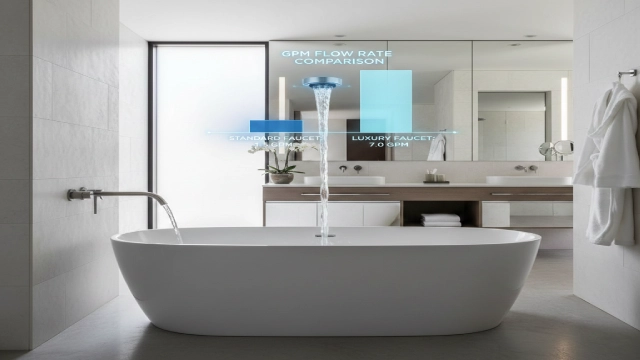
Short Answer: The standard flow rate for hotel bathtub faucets is typically 2.0–2.5 GPM in the U.S., lower under UK WRAS regulations, and varies across the EU and Asia depending on local water-efficiency codes. However, “code-compliant” flow rates may still be inadequate for large soaking tubs or high-rise hotel projects where pressure loss occurs.
Table of Contents
What Is the Difference Between Standard and Operationally Recommended Flow Rates in Hotel Projects?
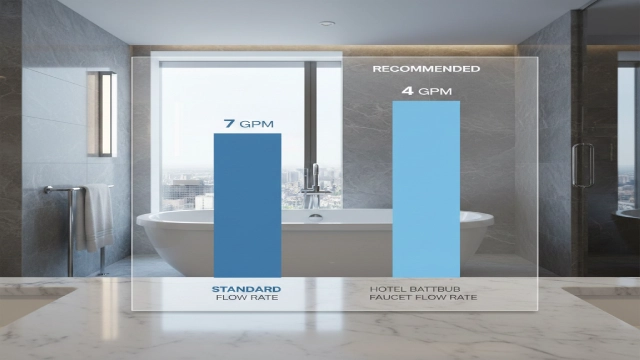
To clarify the gap between regulatory compliance and hotel performance, we use the following benchmark:
Standard (Code-Compliant): The legal minimum flow rate required to pass building inspection.
Operationally Recommended: The project-specific GPM calculated based on tub volume, fill-time targets (10–12 min), and building height—often requiring a high flow tub faucet in luxury or high-rise settings to ensure guest satisfaction.
What Does “Standard Flow Rate” Actually Mean in Commercial Projects?
When you are sitting in a project meeting discussing the average faucet flow rate, it is easy to get bogged down in regulatory numbers. In hotel projects, “standard” usually reflects regulatory minimums, not operational suitability.
Consider this: if you’ve specified a large hotel soaking tub, often exceeding 80–120 gallons (300–450 liters)—which is common in many modern luxury suites—your guest may be waiting 30–40 minutes for a bath at a “standard” flow rate. In a high-turnover hospitality environment, this delay is impractically slow.
Standard ≠ Recommended: A 2.0 GPM faucet might pass inspection, but it often fails the “luxury experience” test.
Standard ≠ Universal: What works for a mid-scale boutique in London will fail a high-rise resort in Dubai due to differing pressure standards.
Standard ≠ Fixed: In hotel projects, flow rate is not just a fixture specification—it is a system performance outcome.
How Do Standard Bathtub Faucet Flow Rates Vary Across Different Markets?
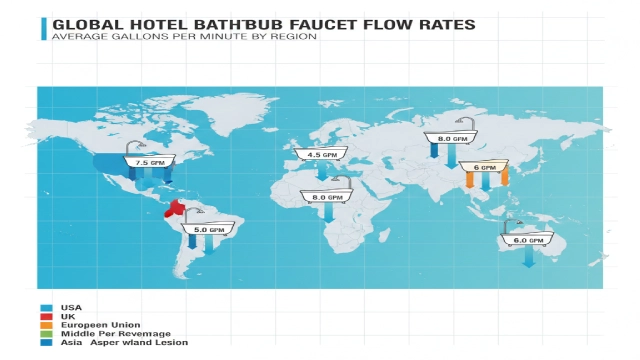
In my experience at George Buildshop, we find that the most successful projects specify flow rates that balance local laws with the physical realities of the guest experience.
Table: Global Bathtub Faucet Flow Rate Benchmarks
Hotel Bathtub Faucet Flow Rates by Market
United States
United Kingdom
European Union
Middle East
Asia / Africa
*Note: Recommended GPM assumes a standard luxury soaking tub volume (80+ gallons). For suites with oversized or infinity-edge tubs, higher flow rates and specialized high-capacity valves are required.
Specification Note: This table should be used as a regulatory and performance reference—not a final specification. The “Recommended” column reflects the flow rate needed to achieve a 10–15 minute fill time, which is the industry gold standard for hospitality.
Why Do Luxury Hotels Often Require Higher Bathtub Faucet Flow Rates?

In the luxury sector, time is the ultimate currency. Many modern hotel soaking tubs hold 80 to 120 gallons or more. At a 2.0 GPM average faucet flow rate, you are looking at an impractically slow fill time for a hotel environment.
The Wait Threshold: Most guests lose patience after 10–12 minutes.
Thermal Efficiency: The longer it takes to fill, the more heat the water loses to the tub surface and the air. By the time a 100-gallon tub is full via a low flow faucet, the water is often lukewarm.
The “Waterfall” Experience: A high flow tub faucet provides the visual and auditory abundance that guests associate with a premium stay.
Does a Higher GPM Increase the Risk of Faucet Failure?
A higher flow rate puts more stress on internal components. If you are using a high flow tub faucet, the ceramic cartridge size and valve body design must be robust enough to handle the increased friction and volume.
Project Insight: Once a valve is undersized and buried behind finished walls, correcting a flow-rate mistake becomes both disruptive and expensive. Always validate valve capacity against your tub volume before the plumbing is roughed in.
Can You Exceed Local Flow Rate Limits in Hotel Projects?
Many project leads feel trapped by “Code,” but it is rarely an immovable number—it is a system-level requirement. By properly sizing mixing valves and using pressure-compensating components, projects can often achieve better perceived performance while remaining compliant.
At George Buildshop, we are often brought in during the specification or value-engineering stage to validate whether the selected flow rate will still perform once the building goes vertical. This allows project teams to balance strict LEED/WaterSense compliance with actual guest usability by optimizing the internal engineering of the faucet to the specific pressure constraints of the site.
How High-Rise Hotels Change Bathtub Faucet Flow Performance?
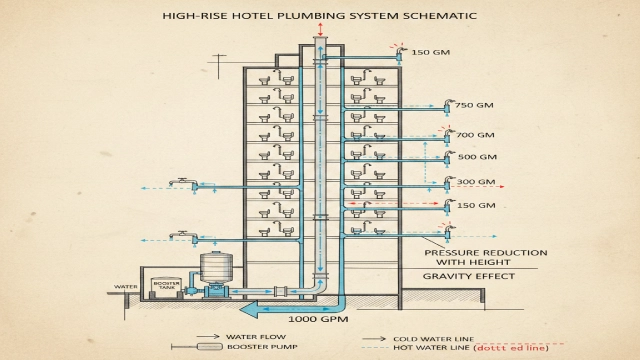
This is where experience from real high-rise hotel projects becomes critical. In a 40-story hotel, gravity is a variable that cannot be ignored.
Static vs. Dynamic Pressure A faucet that produces 2.5 GPM in a factory test lab might only produce 1.5 GPM on the 30th floor if the booster pumps aren’t calibrated correctly or if the vertical loss hasn’t been compensated for.
In high-rise hotels, bathtub faucet flow rate is not a static number. A spec that is perfect for the 3rd floor might be abysmal for the Penthouse. We often recommend specific high-capacity valve configurations for upper floors to ensure the average faucet flow rate remains consistent throughout the entire vertical stack.
What are Common Flow Rate Mistakes in Hotel Bathtub Specifications?
Through hundreds of project audits, I’ve seen these mistakes repeat across global markets:
Residential Overlap: Applying low flow faucet residential specs to a commercial faucet environment without considering the hotel’s higher duty cycle.
Rough-in Bottlenecks: Selecting a high-design trim but pairing it with a low-capacity rough-in valve that limits GPM at the source.
The “Pump Fix” Fallacy: Trying to “crank up the pressure” later to fix a slow fill. This leads to water hammer, noisy pipes, and premature valve fatigue.
Design–MEP Disconnect: Faucet flow rates approved in design meetings are often not revalidated once plumbing riser layouts are finalized. This disconnect is the primary cause of post-opening guest complaints regarding water temperature and fill time.
How to Specify the Right Bathtub Faucet Flow Rate for Your Project?
To move beyond a “standard” spec and toward a high-performance outcome, use this judgment framework:
True Tub Volume: Calculate the actual volume to the overflow, not just the “nominal” size.
Target Fill Time: For luxury projects, aim for a fill time of under 12 minutes.
Building Height & Zoning: Account for vertical pressure loss per floor and pump zone transitions.
Local Code Ceiling: Cross-reference your high flow tub faucet requirements with local water-efficiency caps.
Valve & Cartridge Capacity: Ensure the “engine” of the faucet (the valve) is rated for the flow rate the tub requires.
Conclusion
In commercial hotel projects, faucet flow rate should never be specified in isolation—it must be evaluated alongside tub selection, valve systems, and long-term maintenance realities.
Finally, mismatches between specified flow rates and real guest usage are rarely isolated issues—they are part of the broader decision-making context that explains why bathtub faucet decisions fail in hotel projects.
If you’re reviewing bathtub specifications for an upcoming hotel project, validating flow rates against tub volume and building height early can prevent costly revisions later. With a decade of international project experience at George Group, my team and I are here to ensure your project performs as reliably as it was designed to.
Would you like to discuss the specific pressure requirements for your next high-rise project?
References
Wikipedia. (n.d.). EPA WaterSense. Retrieved January 26, 2026
Kingston Brass. (2025). Understanding Flow Rates: A Comprehensive Guide. Retrieved January 26, 2026,
- CommercialBathFaucets.com. (2025). Understanding Flow Rate Regulations for Architects: Meeting Code and Sustainability Goals. Retrieved January 26, 2026
We support hotel and commercial projects with integrated solutions that reduce specification gaps and coordination risks.
▼ Contact us via the form below to evaluate your project and collaborate. ▼