
Hotel renovations often stall when compliance inspections fail unexpectedly. You worry about potential violations and guest complaints, but knowing the exact specifications beforehand prevents these costly mistakes.
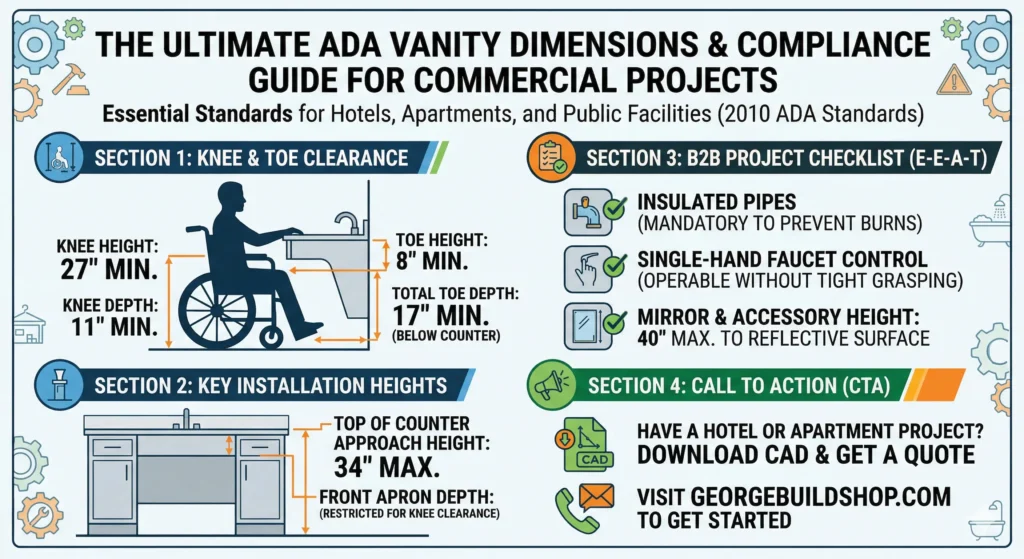
The standard ada vanity dimensions require a maximum height of 34 inches from the floor to the counter surface. You also need a minimum knee clearance of 27 inches high, 30 inches wide, and 11-25 inches deep for a truly wheelchair accessible bathroom vanity.
I remember my early days in the cabinet factory, seeing entire batches of cabinets rejected for being just half an inch too tall. It taught me that precision is everything in this industry. Let’s look at the specific requirements for commercial spaces to help you avoid these pitfalls.
Table of Contents
What are the Standard ADA Vanity Dimensions for Commercial Bathrooms?
Large hotel projects cannot afford costly ADA violations during the final walkthrough. One small error in a single room design multiplies across hundreds of units, ruining your renovation budget.
Commercial standards strictly enforce specific handicap vanity dimensions for safety. The sink must be installed with the rim or counter no higher than 34 inches from the finished floor. This measurement ensures guests using wheelchairs can reach the basin comfortably without struggle.
Height Restrictions
I always ensure the counter sits at exactly 34 inches maximum. This is the critical limit for compliance in commercial zones. Any higher placement prevents easy access for seated users. You must measure from the floor to the highest point of the vanity surface.
Clear Floor Space
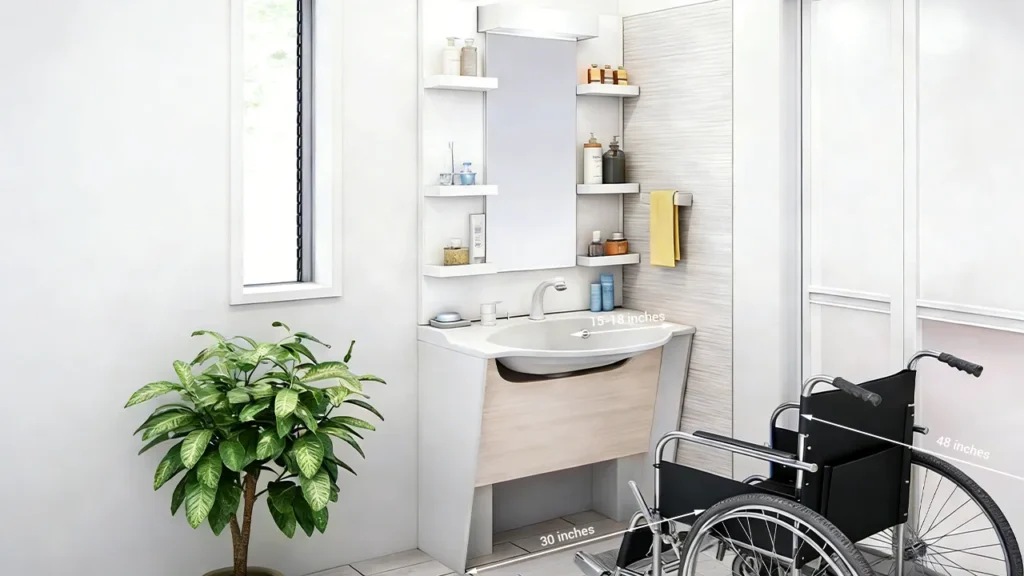
You must provide a clear floor space of at least 30 inches by 48 inches. This area allows a wheelchair to approach the vanity from the front without obstruction. The space can be positioned for a forward or parallel approach depending on the layout.
Forward Reach
ADA faucet compliance is not only about mounting height. In hotel, apartment, and commercial vanity projects, the real risk often comes from the reach depth created by the countertop, sink bowl, apron design, and mirror cabinet layout. Under the 2010 ADA Standards, operable parts must fall within the required reach ranges. For a forward reach at a lavatory, the maximum high reach is 48 inches only when the reach depth over the counter is 20 inches maximum. When the reach depth goes beyond 20 inches, the maximum high reach drops to 44 inches, and the reach depth cannot exceed 25 inches.
This is why an ADA vanity can still fail in practice even if the overall vanity height is under 34 inches. A deeper top, thicker front edge, or poorly positioned faucet can push the controls out of compliant reach. For project orders, it is safer to review the faucet position together with the bowl location, countertop depth, knee clearance, and user approach path before production begins.
| Dimension | Requirement |
|---|---|
| Max Height | 34 inches |
| Floor Space | 30" x 48" |
| Reach Range | 15" - 48" |
In my experience supplying hotels, architects often forget the apron height when designing the cabinet face. If the apron is too thick, it cuts directly into the required knee space. I suggest using a shallow basin or an offset drain to solve this. This design choice maintains the sleek look you want while strictly following the ada vanity dimensions. It saves you from having to modify cabinets on-site later.
What is the minimum clearance for an ADA sink?
Cramped bathrooms frustrate guests and frequently fail safety inspections. You need to know exactly how much space is required around the sink area to ensure full accessibility.
ADA lavatory compliance should not be judged by a generic side-wall distance alone. In hotel, apartment, and commercial bathroom projects, the more important checks are whether the vanity provides the required 30-inch by 48-inch clear floor space, whether the forward approach is workable, whether knee and toe clearance is maintained below the unit, and whether exposed pipes are protected. A vanity can appear correctly positioned on plan but still become non-compliant if the bowl, drain, apron, or countertop depth reduces usable clearance or creates an improper reach condition.
Approach Width
The sink area needs a minimum clearance width of 30 inches. This width accommodates standard wheelchairs and ensures the user fits comfortably under the unit. It essentially creates a dedicated zone for the user to park their chair while washing up.
Depth Requirements
A clear depth of at least 17 inches beneath the sink is standard. This depth allows the user’s legs to extend fully under the vanity bowl. Without this depth, the user cannot get close enough to the faucet to wash their hands.
Overlap Allowance
The required clear floor space can overlap the knee clearance by up to 19 inches. This rule helps save space in smaller hotel bathroom layouts. It allows you to design compact rooms without violating the strict accessibility codes.
| Clearance Type | Min Dimension |
|---|---|
| Width | 30 inches |
| Depth | 17 inches |
| Max Overlap | 19 inches |
I often see plans where the plumbing trap blocks the required clearance area. You must insulate pipes to prevent burns and sharp edges touching the user. I recommend installing a trap cover or a full shroud. This small addition protects the guest’s legs and makes the wheelchair accessible bathroom vanity look much cleaner. It hides the messy plumbing while ensuring the space remains safe and compliant for everyone.
What are the Specific Knee and Toe Clearance Requirements?
Ignoring legroom makes a vanity completely unusable for seated guests. Your guests deserve comfort and safety, not bruised knees from poor cabinet design choices in your bathrooms.
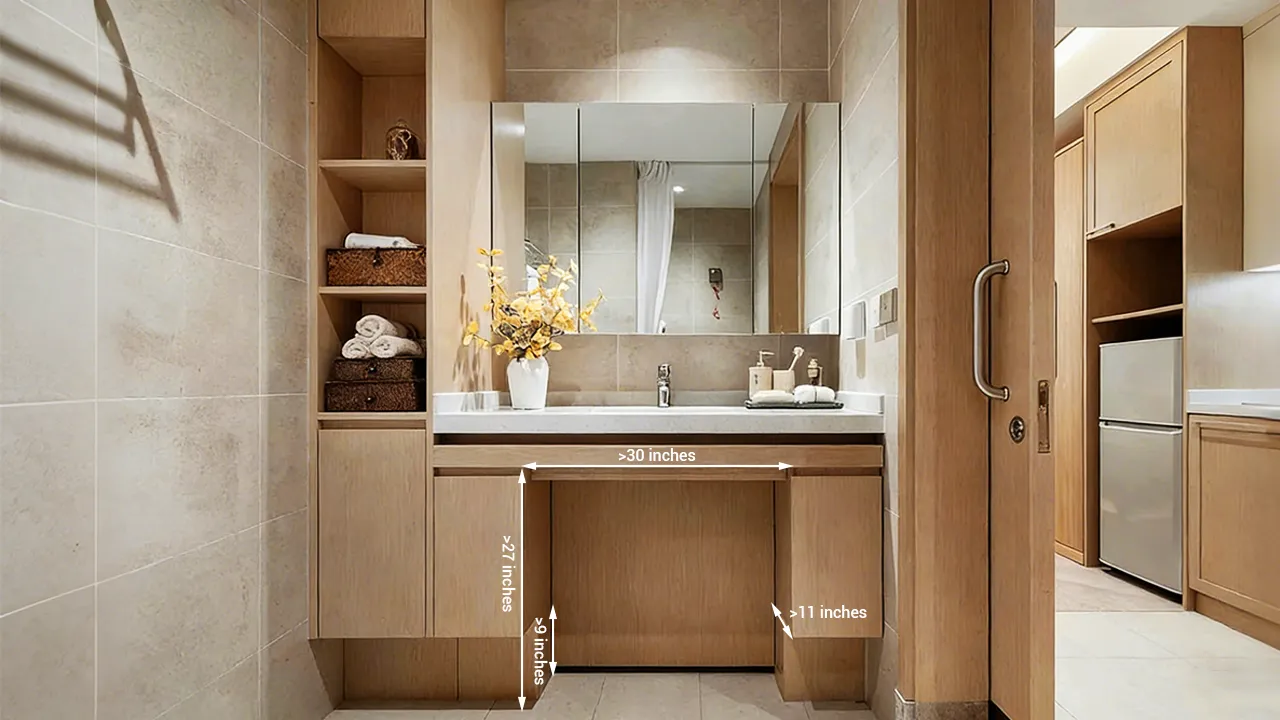
Knee clearance must be at least 27 inches high, 30 inches wide, and 11 inches deep at the top. Toe clearance requires 9 inches of height. These specific measures define usable handicap vanity dimensions.
Knee Space Height
The space from the floor to the bottom of the apron must be 27 inches. This height is non-negotiable for accommodating wheelchair armrests and knees. If the apron is lower, the wheelchair simply cannot fit under the sink.
Toe Space Height
You need a clear height of 9 inches at the very bottom of the unit. This allows the footrests of a wheelchair to slide under without hitting the cabinet base. It provides the final few inches needed for a close approach.
Depth Transition
At 27 inches high, the depth should be at least 8 inches back. Then it can slope down to the toe space. This slope prevents hitting the knees against the back panel. It creates a comfortable angle for the user’s legs.
| Zone | Height Min | Depth Min |
|---|---|---|
| Knee | 27 inches | 8-11 inches |
| Toe | 9 inches | 6 inches |
I learned this the hard way when a client’s custom vanities arrived with thick support beams. We had to cut them on-site to meet the code. Now, I advise using wall-mounted brackets instead of bulky legs or thick aprons. This method guarantees the open space needed for strict adherence to ada vanity dimensions. It creates a floating look that is both modern and functional for your hotel projects.
💡 Expert Solution for Hotels
Struggling with complex clearance codes? We customize vanities to fit your exact plumbing and ADA specs.
Custom ADA Vanities for Hotels →What About Faucets, Mirrors, and Hardware Accessibility?
A perfect vanity fails if the mirror is mounted too high. You must consider the entire user experience, not just the cabinet box, to ensure guest satisfaction.
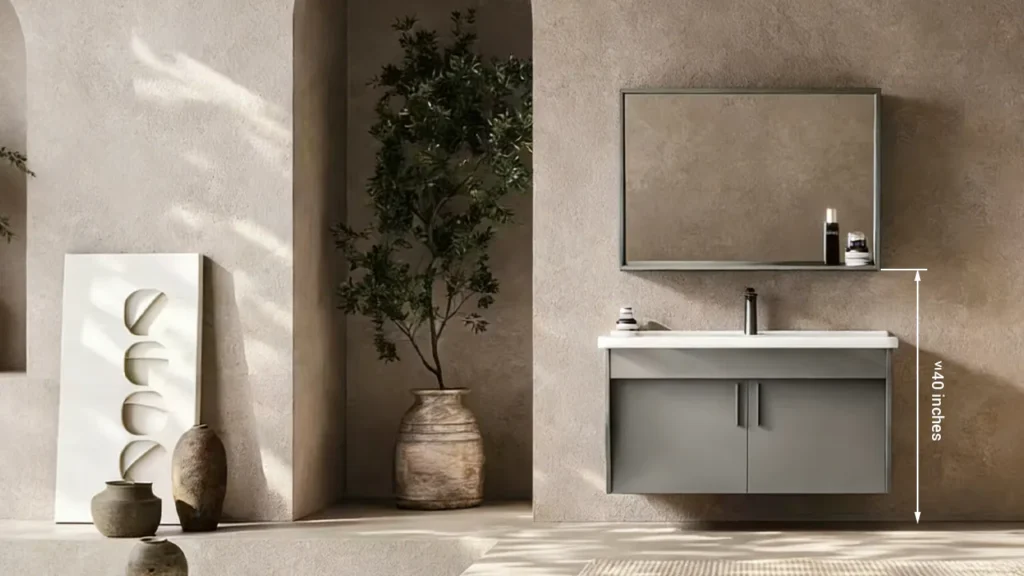
Mirrors above sinks must have the bottom edge of the reflecting surface no higher than 40 inches above the floor. Faucets should be lever-operated, push-type, or touchless, requiring no tight grasping to operate.
Mirror Mounting Height
Install the bottom edge of the mirror at 40 inches max from the floor. This allows a seated person to see themselves properly. You can consult a mirror size chart to ensure the proportions fit your specific wall space.
Faucet Operation
Choose faucets that operate with less than 5 pounds of force. Lever handles are best because they do not require twisting the wrist to turn on. This feature is vital for guests with limited hand strength or dexterity.
Hardware Location
Place soap dispensers and towel bars within 44 inches of height. This ensures all amenities are reachable without the guest having to stand up or stretch. Everything needs to be within the accessible zone to be truly usable.
| Item | Max Height | Feature |
|---|---|---|
| Mirror | 40" (bottom) | Reflective |
| Faucet | 44" (reach) | Lever/Sensor |
Visual consistency matters to Hotel Procurement Managers like you who value aesthetics. I suggest specifying full-height mirrors that start right from the backsplash. This covers the compliance requirement and makes the room look bigger. Using a mirror size chart helps select a model that fits the wall perfectly without breaking the rules. It integrates safety into the design seamlessly, so the room feels luxurious rather than clinical.
Is the ADA counter height 34 or 36?
Confusion about height numbers leads to costly rework and delays. You might think standard kitchen height applies here, but bathrooms have different rules that you must follow.
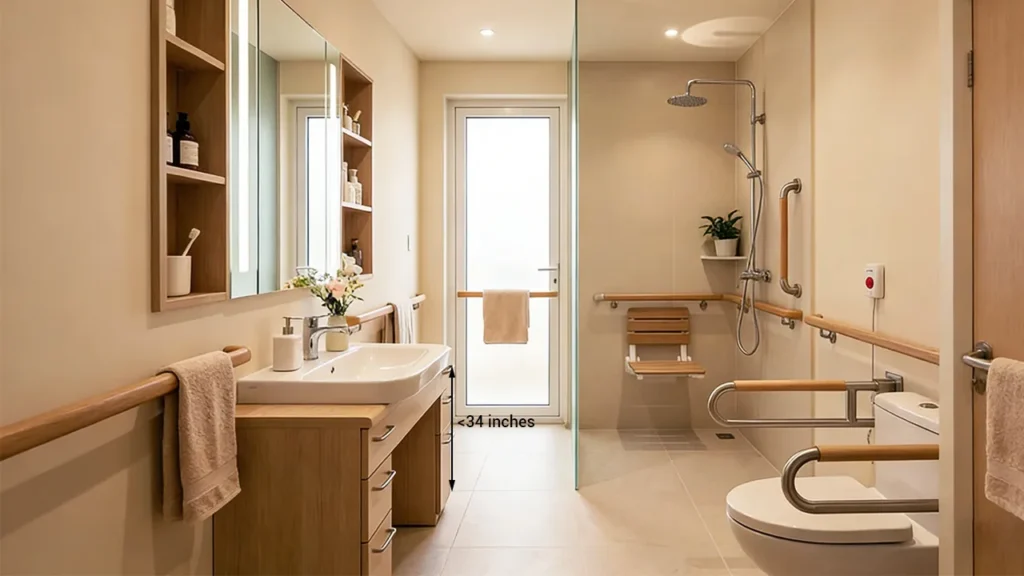
The ada vanity height is strictly a maximum of 34 inches from the floor. Standard residential vanities are often 36 inches, which is too high. You must specify 34 inches or lower for accessible rooms.
The 34-Inch Rule
The 34-inch maximum applies to the highest point of the vanity. If you use a vessel sink, the rim of the bowl must not exceed this specific height limit. You cannot simply place a vessel sink on a 34-inch cabinet.
The 36-Inch Myth
Many builders default to 36 inches because it is comfortable for standing users. However, for ADA compliance, this height is a violation and must be avoided. It is physically too high for a seated person to use effectively.
Adjustable Options
Some modern hotels install adjustable height vanities to solve this dilemma. This solution accommodates both standing and seated guests comfortably. While it is often more expensive than fixed units, it offers the ultimate flexibility for guest comfort.
| User | Height Ideal | ADA Compliant? |
|---|---|---|
| Standing | 36 inches | No |
| Seated | 34 inches Max | Yes |
I once helped a hotel in Dubai fix this exact issue during a renovation. They installed 36-inch cabinets in accessible rooms and failed inspection. We had to cut the bases to lower them. Always write “Max 34 inches” in your POs to avoid this. It ensures the ada vanity height is correct from the start. This simple specification saves you time and money on site.
📂 Project Snapshot: Luxury Resort Rescue
🔴 The Pain: A 200-unit Miami hotel project was delayed. Their stock vanities were 35" high—failing strict ADA inspection.
🟢 The George Solution: We quickly customized 34" quartz floating vanities with pre-drilled plumbing cutouts tailored to their specific pipe layout.
🚀 The Result: 100% Inspection Pass Rate. The client saved $15,000 in on-site rework costs and opened on time.
Conclusion
Navigating ada vanity dimensions protects your hotel from liability and welcomes all guests. We can help you source the perfect compliant vanities. Contact us at georgebuildshop today.
Equip Your Project with Compliant, Luxury Bathroom Solutions
Stop juggling multiple suppliers. Whether you are building a new resort or renovating a hotel, George Build Shop provides end-to-end bathroom customization, design, and manufacturing.
▼ Send us your project details below for a customized quote and design proposal ▼