
To choose the right commercial bathtub for a business hotel, prioritize durability, installation compatibility, and lifecycle cost over appearance. High-turnover hotels require non-porous, commercial-grade materials and engineering-ready designs that reduce maintenance labor, room downtime, and long-term operational risk.
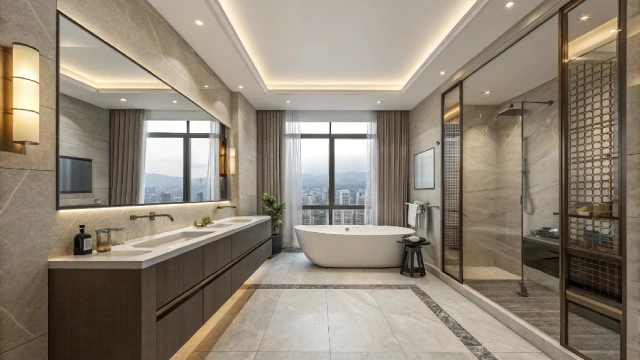
The success of a hospitality project often hinges on the details that guests never notice—until they fail. In the fast-paced world of business travel, the bathroom is the most high-stakes operational zone in the unit. In practice, selecting a commercial bathtub for business hotels requires a very different mindset from residential or resort-oriented projects.
With over 10 years of experience in the commercial bathroom fixtures industry, I’ve seen many projects struggle—not because of poor aesthetics, but because procurement decisions were made without operational foresight. As I often tell my clients:
“For business hotels, choosing the right bathtub is not a design decision—it’s an operational decision that directly affects maintenance cost, room downtime, and long-term profitability.”
To ensure your hotel bathroom fit-out remains profitable, we must address these five critical challenges. For a complete framework covering materials and technical sizing, see our commercial bathtub procurement guide for hotel projects.
Table of Contents
Why doesn’t one bathtub work for every business hotel type?
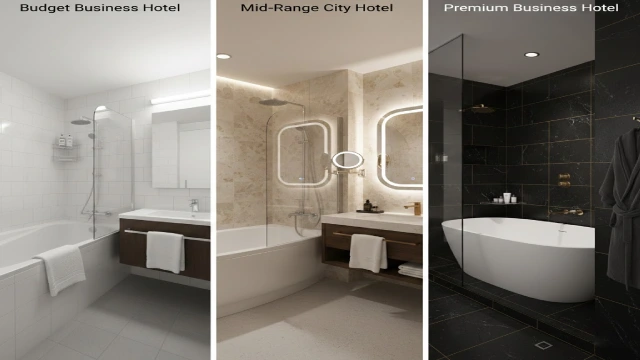
When selecting a business hotel bathtub, many teams apply a “one-size-fits-all” approach, often mirroring specifications from luxury resorts without considering the DNA of a high-turnover property.
The Problem: Lack of Project-Specific Standards
Developers often use a single SKU across multiple properties—from airport budget hotels to premium city-center branches. This ignores the vast differences in usage intensity inherent in a high-traffic hospitality project.
Business Impact: Premature Aging and Maintenance Spikes
Choosing a tub designed for light residential use in a high-traffic hotel leads to a rapid decline in surface integrity. Within months, the finish loses its luster, leading to guest complaints and an immediate drop in the room’s perceived value.
Principle: Project-Based Selection Over Visual Preference
I recommend a hotel bathtub selection logic based on “Project Intensity.” Focus on standard bathtub dimensions (typically 1500mm to 1700mm) that optimize water-volume efficiency and cleaning speed. The goal is to balance user comfort with a footprint that minimizes daily housekeeping labor.
Why do high-turnover hotels require higher-performance bathtubs?
A common misconception in hotel procurement is that business hotels can afford lower material grades. In reality, a bathtub for high-turnover hotels necessitates a much higher grade of durability.
The Problem: Prioritizing Initial Price Over Material Density
To meet tight budgets, some teams opt for thinner acrylic or inferior resin fillers. These materials lack the chemical resistance required to withstand industrial-strength cleaning protocols.
Business Impact: Permanent Staining and High Lifecycle Costs
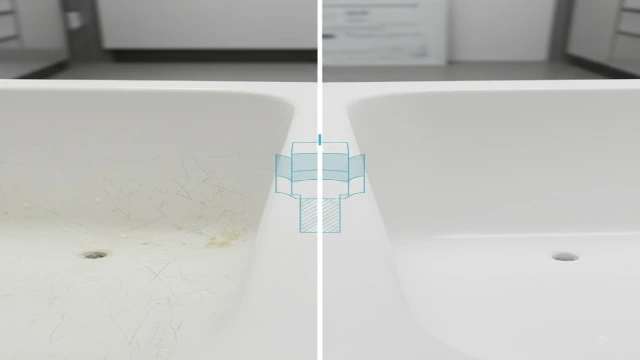
Inferior materials quickly develop “spiderweb” micro-cracks and surface porosity. Once the surface is compromised, how to clean a bathtub effectively becomes impossible for staff. This results in a tub that looks “dirty” even after being scrubbed, severely hurting your brand’s hygiene rating and increasing your lifecycle cost.
Principle: Commercial-Grade Durability Standards
Define your commercial-grade bathtub by performance, not price. Prioritize high-density, cross-linked acrylic or solid surfaces that offer high chemical resistance. This ensures the surface can be refinished on-site, minimizing operational downtime.
How do bathtub installation issues delay hotel projects?
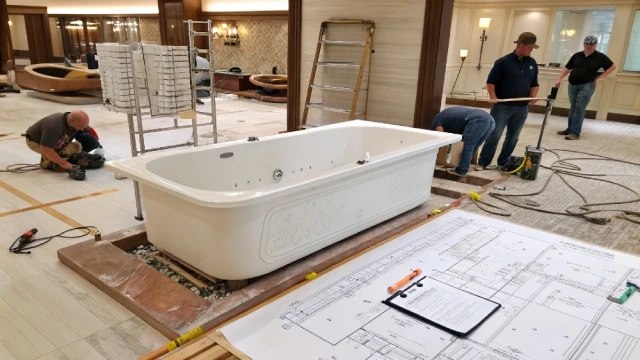
Even the best bathtub becomes a liability if it disrupts the construction timeline. In my experience, commercial bathtub installation errors are among the most expensive “hidden costs” in hotel development.
The Problem: Poor Alignment Between Design and Plumbing
Often, a bathtub is selected by a designer, but the floor-out pipes are laid by a contractor based on general assumptions. If the drainage alignment is off by even a few centimeters, it requires expensive floor-breaking work or hazardous “platform” workarounds.
Business Impact: Compounded Schedule Risks
In hotel construction, the bathroom is the “critical path.” If the installation is delayed, tiling cannot finish, and furniture cannot be moved in. This pushes back the “Grand Opening,” costing the developer thousands in lost daily revenue.
Principle: Engineering-Ready Implementation
Choose tubs designed with adequate installation clearance and adjustable leveling feet to accommodate installation tolerance and uneven subfloors. Ensure your supplier provides high-precision technical drawings (CAD/BIM) before the rough-in stage.
Why is maintenance planning critical when selecting commercial bathtubs?
The most expensive bathtub isn’t the one with the highest price—it’s the one that is hardest to fix. Efficient hotel bathtub maintenance must be engineered into the product at the procurement stage.
The Problem: Ignoring Spare Parts and Accessibility
Procurement teams often overlook “after-sales architecture.” If a specific drain cover or handle is proprietary and the supplier disappears, a minor part failure can render a premium room unusable.
Business Impact: Increased Operational Downtime
When maintenance teams cannot easily access the plumbing or find matching replacement parts, rooms stay “Out of Order” (OOO) for longer periods. This lost inventory significantly erodes the hotel’s long-term profitability.
Principle: Maintenance Accessibility and Lifecycle Thinking
Evaluate the lifecycle cost of the unit, not just the purchase price. Ensure the tub features a standardized fast-drain system with an accessible trap. Rely on suppliers who guarantee long-term model consistency so future replacements match your existing inventory perfectly.
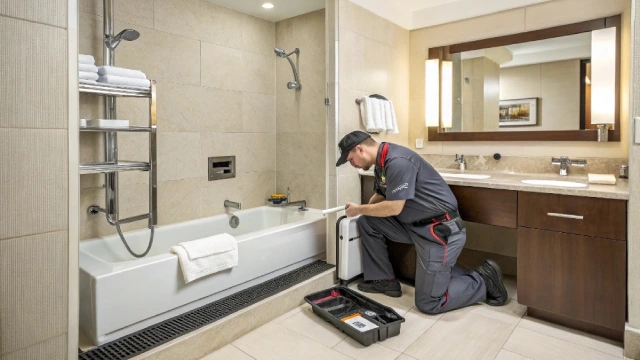
How can bathtub design affect buildability and hygiene in hotels?
There is a frequent disconnect between the aesthetic vision of the architect and the practical realities of the engineering team regarding cleaning efficiency and structural longevity.
The Problem: Complex Shapes in Tight Spaces
A designer may specify a deep, freestanding tub in a compact footprint. While visually striking, it often creates “dead zones” behind the tub that are impossible for housekeeping to reach, leading to mold and moisture buildup.
Business Impact: Structural and Hygiene Risks
Beyond hygiene, complex designs often lack a reinforced load-bearing structure. If a tub flexes under weight, the waterproof seals break, leading to leaks into the guest rooms below—a nightmare for hotel bathtub maintenance.
Principle: Prioritizing Buildability and Structural Integrity
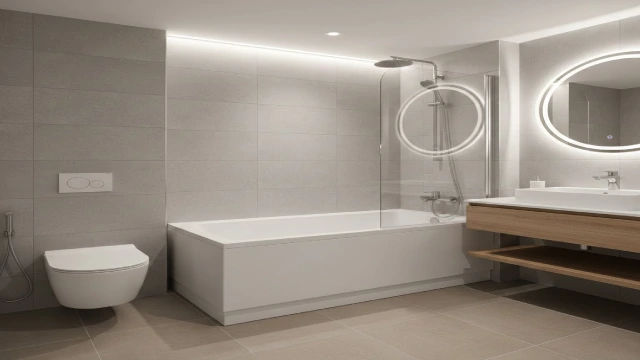
I advise clients to look for “Hybrid” designs—such as back-to-wall models—that offer the freestanding look while sealing flush against the wall. This ensures a stable load-bearing structure and eliminates hygiene dead zones.
Business Hotel Bathtub Procurement Checklist
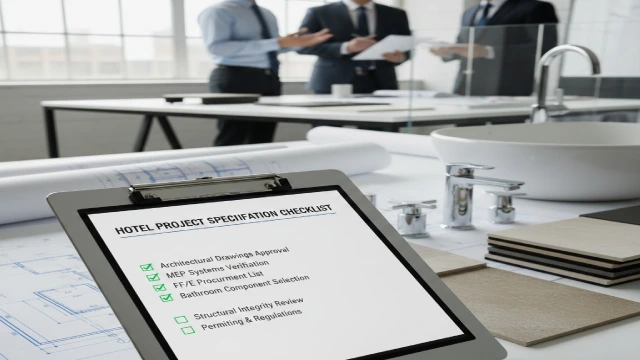
Use this checklist to ensure your selection meets the rigorous demands of high-turnover hotel operations:
✅ Designed for high-turnover hotel operations: Optimized for fast cleaning and heavy use.
✅ Commercial-grade, non-porous material: Resistant to industrial chemicals and staining.
✅ Standardized dimensions: To reduce installation variance and fit standard hotel layouts.
✅ Reinforced support structure: With adjustable feet to accommodate installation tolerance.
✅ Fast-drain system: Includes an accessible trap to simplify maintenance.
✅ Repairable surface finish: Allows for on-site refinishing without unit replacement.
✅ Long-term model consistency: 5+ years of availability for future phases.
✅ Engineering documentation: CAD / BIM available before rough-in for plumbing alignment.
✅ Minimum 5-year commercial warranty: Protection against hospitality environment defects.
Conclusion: Turning Your Bathrooms into Operational Assets
Selecting the right bathtub for a business hotel is not about aesthetics alone—it is a long-term operational decision. By focusing on durability, ease of installation, and maintenance accessibility, you protect your asset from unnecessary costs and ensure a seamless guest experience.
If you are planning a hotel or serviced-apartment project and need support with specification writing, value engineering, or bulk procurement, our team works closely with developers, designers, and contractors to deliver reliable, project-ready solutions.
You can request our latest technical catalog or a sample specification sheet to support your current tender or design stage. Contact us today to ensure your next project is an operational success.
References & Further Reading
1. Hotel and Airbnb Bathroom Trends for 2025 — Durable, Easy-to-Clean Surface Trends
2. Are Your Hotel Bathtubs Costing More Than They Should? — Impact of High Guest Turnover
3. How to Select a Solid-Surface Bathtub for a Hotel — Maintenance Practices
4. Designing Bathroom Finishes for High-Traffic Hotels — Durability & Cleanability
One-Stop Bathroom Solutions for Commercial Projects
We provide integrated one-stop bathroom solutions for hotel and commercial projects, supporting coordinated specifications and project execution.
▼ Submit the form below to connect with our team and explore project cooperation. ▼