

Buying vanities for a hotel project sounds simple — until your shipment gets flagged at customs. TSCA guidelines for American-style bathroom vanities can stop a whole delivery if you miss one document.
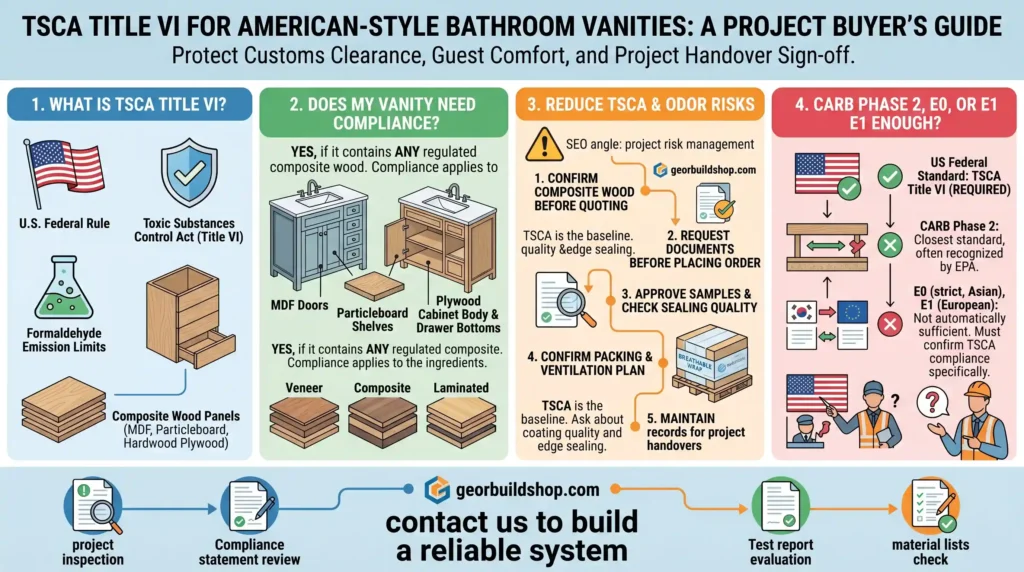
TSCA Title VI is a U.S. federal rule that limits formaldehyde emissions from composite wood products. Any finished good — including bathroom vanities — that contains MDF, particleboard, or hardwood plywood must meet these emission standards and carry proper compliance labeling to enter the U.S. market.
I have worked with hotel procurement teams across many markets, and I keep seeing the same problem. Buyers focus on finish, price, and lead time. Then the vanities arrive and either fail a receiving check or fill the guest rooms with a chemical smell. This article is my attempt to help you avoid that situation from the start.
Table of Contents
What Is TSCA Title VI and Why Does It Matter for Bathroom Vanities?
Most buyers hear “TSCA Title VI” and assume it is just a certificate to tick off. It is not. Missing it on a hotel order can mean delays, rejections, and a very uncomfortable conversation with your general contractor.
TSCA Title VI is the section of the Toxic Substances Control Act that sets formaldehyde emission limits for composite wood panels. It covers MDF, particleboard, and hardwood plywood. Any product containing these materials — including finished bathroom vanities — must comply before it can legally enter the U.S.
Why Composite Wood Materials Are the Core Issue
American-style bathroom vanities almost always use composite wood somewhere. MDF is common for door panels. Particleboard shows up in shelves and inner boxes. Plywood is used for cabinet bodies and drawer bottoms. Each of these materials involves adhesive resins that can release formaldehyde over time.
Expert Recommendation:
Avoid project delays by sourcing pre-certified materials that exceed EPA standards.
Get TSCA-Compliant Solutions →Why This Matters Beyond the Import Step
For hotel and apartment projects, compliance is not just a customs question. It affects guest comfort, project handover, and your brand reputation. A room that smells of chemicals on opening day creates complaints, delays acceptance sign-off, and puts pressure on everyone involved in the project.
I think of TSCA Title VI as a practical filter, not a legal obstacle. It forces both the buyer and the supplier to confirm what is actually inside the vanity before anyone signs a purchase order. That conversation almost always reveals something useful — sometimes something that saves the whole project.
Do American-Style Bathroom Vanities Need TSCA Title VI Compliance?
Here is the question I get most often from procurement managers: “Does my vanity actually need this?” The answer depends on what is inside it — and most American-style vanities do qualify.
If a bathroom vanity contains any regulated composite wood material, it falls under TSCA Title VI. This includes MDF door panels, particleboard shelves, plywood cabinet boxes, drawer bottoms, back panels, and any veneer or laminated composite boards used in the construction.
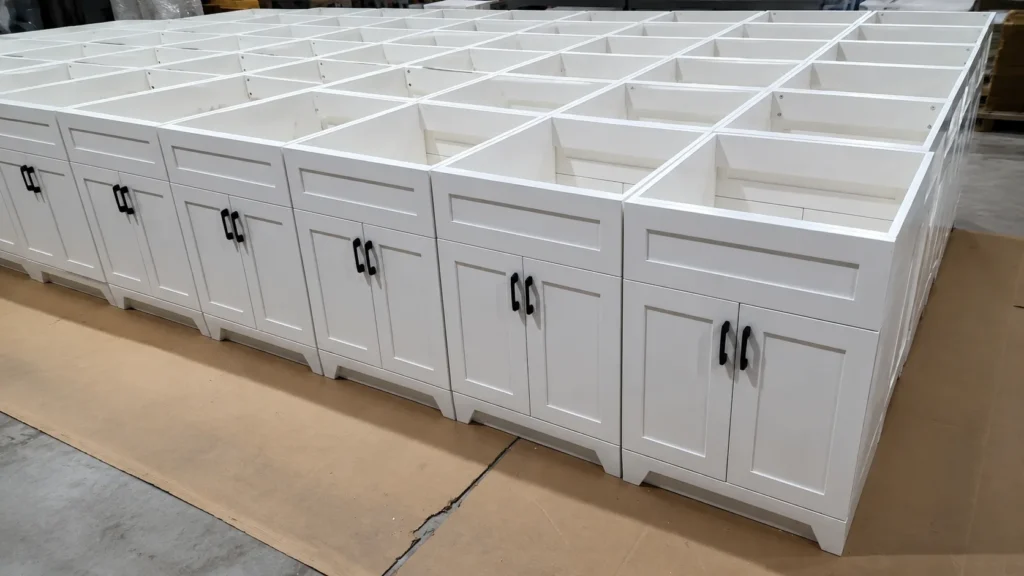
MDF Door Panels
MDF is one of the most common materials in American-style vanity doors. It machines cleanly and paints well, but it is also one of the higher-emission composite materials. Any MDF component inside a finished vanity triggers TSCA Title VI coverage.
Particleboard Shelves and Inner Structure
Particleboard is cheaper than MDF and is widely used for interior shelving and base structures. Many suppliers switch to particleboard on internal parts to reduce cost. Buyers often do not know this until they request a full material list.
Plywood Cabinet Boxes and Drawer Bottoms
Hardwood plywood is regulated under TSCA Title VI just like MDF and particleboard. Cabinet bodies, drawer boxes, and back panels made from plywood must also come from a TSCA-compliant panel supplier. This is a detail that many project buyers overlook.
Veneer and Laminated Composite Boards
Some vanities use veneer over MDF or particleboard, or laminated composite boards for decorative surfaces. These are still covered by TSCA Title VI. The surface finish does not change the compliance requirement for the substrate underneath.
The key point here is that TSCA Title VI applies to the materials inside the product, not just the product category. A vanity can look like solid wood on the outside and still require full compliance documentation because of what is underneath.
Which Vanity Materials Create the Biggest Formaldehyde and Odor Risks?
This is the question that hotel procurement managers ask me most urgently — not the legal side, but the practical one. Will my guest rooms smell bad?
MDF and particleboard carry the highest formaldehyde risk in bathroom vanities. However, glues, edge banding, coatings, and even packaging materials can also produce odors. TSCA Title VI compliance reduces emission risk, but it does not guarantee a completely odor-free product after installation.
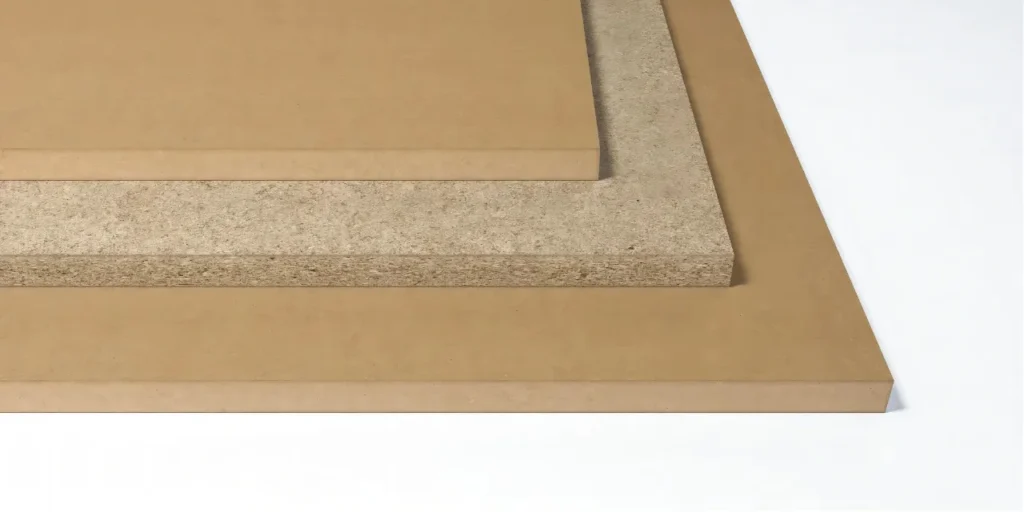
MDF and Particleboard: The Primary Sources
Both materials use urea-formaldehyde resins in production. Lower-grade versions release more formaldehyde, especially in the first weeks after installation. TSCA-compliant panels use low-emission resins that meet strict limits, but the risk does not disappear entirely — it is reduced to an acceptable level.
Glues, Edge Banding, and Coatings
These are the parts of the vanity that buyers almost never ask about. The adhesive used to bond edge banding, the paint or lacquer on door panels, and the sealer on cabinet interiors all contribute to total indoor air quality. I have seen vanities pass TSCA panel testing and still generate odor complaints because of poor coating quality.
Packaging and Shipping Conditions
A vanity sealed in plastic packaging inside a shipping container for 30 days can accumulate significant off-gas. By the time it is unpacked on-site, the smell can be strong. Good ventilation during storage and packing practices that allow some airflow make a real difference.
Why Hotel Projects Are More Sensitive
Hotels hand over rooms to guests immediately after renovation. There is no buffer period. If a vanity emits chemical odors on day one, the guest calls the front desk. That complaint becomes a maintenance ticket, then a management review, then a supplier dispute. Odor risk is a project risk.
I always tell buyers: TSCA Title VI is the floor, not the ceiling. A compliant product is the baseline. Beyond that, you need to ask about coating quality, edge sealing, and how the product is packed and transported. Those factors determine whether the vanity smells acceptable on the day your guests check in.
What Documents Should Project Buyers Request from Vanity Suppliers?
Most suppliers will say “yes, we are TSCA compliant” without blinking. The real test is whether they can back that up with actual documents. If they cannot, that answer means nothing.
Project buyers should request a TSCA Title VI compliance statement, panel supplier information, a full material list or BOM, batch or lot numbers, product label photos, third-party test reports or certifications, and a copy of the invoice or packing document that includes a compliance declaration.
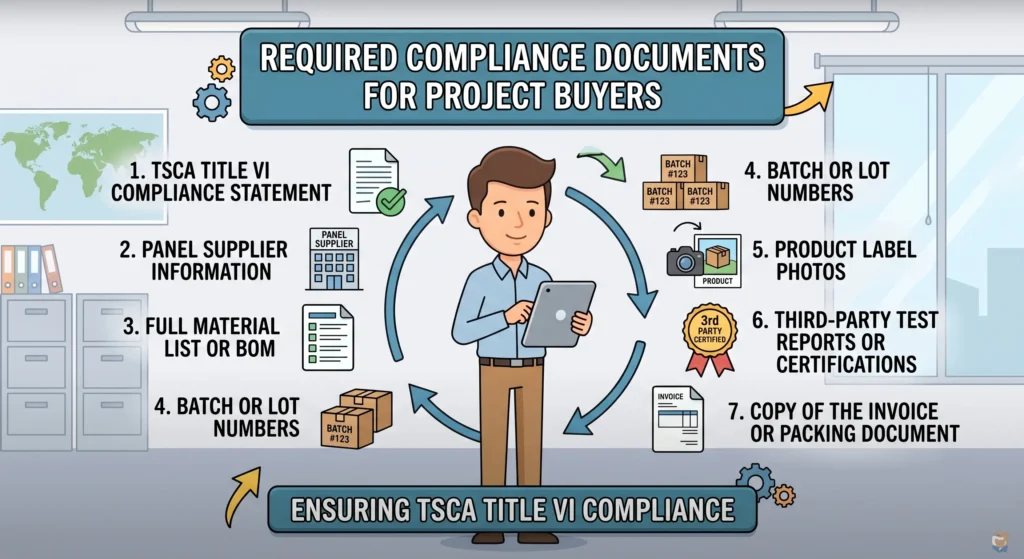
TSCA Title VI Compliance Statement
This is a written declaration from the supplier confirming that the composite wood panels used in the product meet TSCA Title VI emission standards. It should name the panel supplier and specify the material type. A generic statement with no supporting detail is not sufficient.
Panel Supplier Information and Material BOM
You need to know where the panels come from. A reputable supplier will provide the panel manufacturer’s name and, in many cases, their own TSCA certification. The material BOM (bill of materials) shows exactly which materials are used in each component, so you can verify that every composite wood part is covered.
Batch Numbers, Labels, and Test Reports
Batch numbers allow traceability. If a problem appears after delivery, you can link the product to a specific production run and a specific set of materials. Label photos show how the product is marked for compliance. Third-party test reports from accredited labs provide independent verification of emission levels.
I have found that asking for these documents early in the conversation separates professional suppliers from ones who are guessing. A supplier who has this documentation ready before you ask is a supplier who understands U.S. project requirements. That alone tells you a lot about how the rest of the order will go.
Is CARB Phase 2, E0, or E1 Enough for U.S. Bathroom Vanity Projects?
I hear this one constantly. A supplier says their board is E0 or CARB Phase 2, and the buyer assumes that covers everything. It does not always, and the difference matters.
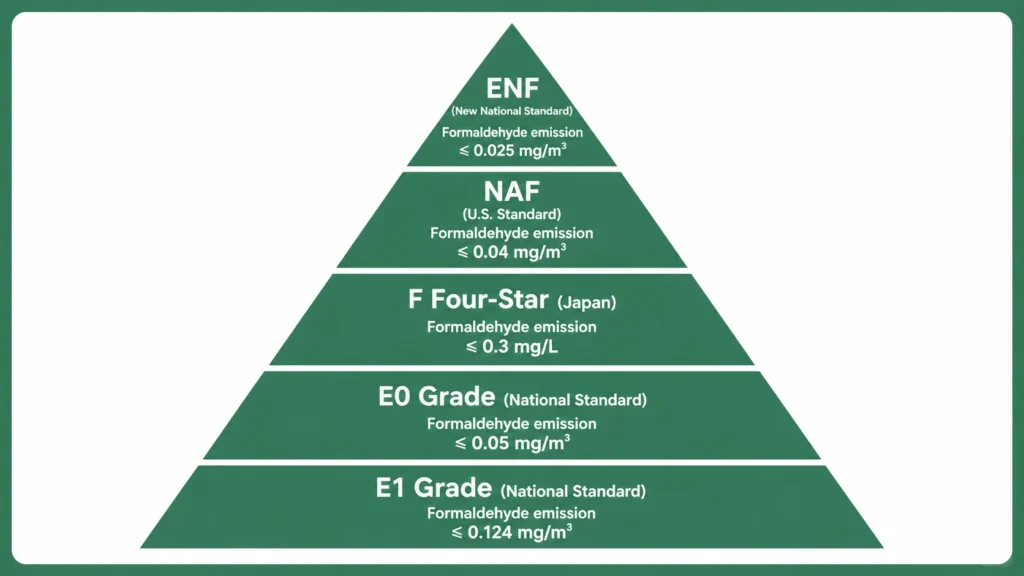
For U.S. market projects, CARB Phase 2 is the standard that aligns most closely with TSCA Title VI requirements. E0 and E1 are European or Asian standards that do not automatically satisfy U.S. import requirements. Buyers must confirm TSCA Title VI compliance specifically, with traceable documentation.
What "E0" and "E1" Actually Mean
E1 is a European emission standard. E0 is a stricter Asian standard used widely in Chinese manufacturing. Both indicate low-emission materials, but neither standard is recognized by the U.S. EPA as equivalent to TSCA Title VI compliance. Using E0 board is a good sign, but it does not replace proper TSCA documentation.
What CARB Phase 2 Means
CARB Phase 2 is California’s composite wood emission standard, which the EPA aligned with when writing TSCA Title VI. A product certified under CARB Phase 2 by an accredited third-party certifier is generally considered TSCA Title VI compliant. But the certification must be current, traceable, and issued by a recognized body.
How to Tell a Professional Supplier from a Basic One
A supplier who says “we use E0, that is better than E1” without mentioning TSCA Title VI does not understand U.S. import requirements. A supplier who provides CARB Phase 2 certification documents, identifies the certifying body, and can trace the certification to the actual panels used in your order understands what tsca title vi compliant furniture means in practice.
This section matters because it helps you evaluate the supplier, not just the product. When a supplier understands the difference between E1, CARB Phase 2, and TSCA Title VI, and can explain which one applies to your project and why, you are dealing with someone who can actually protect you when a customs officer or a project inspector asks the same question.
PROJECT SNAPSHOT: FLORIDA RESORT UPGRADE
PAIN: A 150-unit shipment was flagged at Miami port due to inconsistent formaldehyde labeling from a previous vendor.
SOLUTION: George Group stepped in, providing full material BOMs, traceable batch numbers, and third-party lab reports within 24 hours.
RESULT: Customs cleared in 48 hours. The project stayed on schedule with zero VOC odor complaints at the grand opening.
How Can Hotel and Apartment Buyers Reduce TSCA and Odor Risks Before Ordering?
The best time to fix a compliance problem is before the order is placed. Once production starts, your options shrink fast. Here is the checklist I recommend to every project buyer I work with.
Hotel and apartment buyers can reduce TSCA and odor risk by confirming all composite wood materials before quoting, requesting full compliance documents before ordering, approving samples before mass production, and keeping all compliance records for project handover.
Confirm All Composite Wood Materials Before Quotation
Ask the supplier to list every composite wood component in the vanity during the quotation stage. This is the moment when you have the most leverage. If a material is unknown or unverified at this point, it will be a much bigger problem after the container ships.
Request TSCA Documents Before Placing the Order
Do not wait until delivery. Ask for the compliance statement, panel supplier details, and test reports before you sign the purchase order. If the supplier cannot provide them before production, they almost certainly cannot provide them after.
Approve Samples and Check Edge Sealing Quality
A physical sample review lets you check edge banding adhesion, coating finish, and any off-gassing odor before 200 units are made. Poor edge sealing is one of the most common sources of odor complaints after installation.
Confirm Packing and Ventilation Plan
Ask how the vanities will be packed. Fully sealed plastic wrap inside an airtight container traps off-gas. Suppliers who understand this issue use breathable materials or include a ventilation plan for long-distance ocean shipping.
Keep All Compliance Documents for Project Records
Hotel and apartment projects often require compliance sign-off at handover. Keep every document — compliance statements, test reports, batch records, and invoices — in a project file. If a question comes up six months after delivery, you will be glad you have them.
I think the most important shift a buyer can make is to move compliance from a receiving question to a sourcing question. By the time a vanity arrives at your site, the risk is already set. The materials were chosen, the panels were cut, and the coating was applied weeks ago. What you do before the order is placed determines what you receive — and what your guests experience on day one.
Conclusion
TSCA Title VI is not just a regulatory term. For hotel and apartment vanity projects, it is a practical tool for controlling risk, protecting delivery timelines, and ensuring the guest experience is not compromised by chemical odors or compliance disputes. If you are sourcing American-style bathroom vanities for a project, start with the right questions — and make sure your supplier has the right answers. Feel free to reach out to us at georgebuildshop.com if you need support evaluating a supplier or reviewing compliance documents for your next project.
Secure Your Hotel Project Supply Chain
Navigating TSCA Title VI is just the first step. At George Group, we provide a complete one-stop bathroom solution—including custom vanities, shower doors, and luxury fixtures—all pre-vetted for international standards.
Partner with us for:
- Full TSCA Title VI & CARB Phase 2 Documentation
- Custom Bathroom Space & Material Design
- Bulk Procurement for Resorts & Apartments
- Strict Quality Control & Odor-Free Packaging