
Siphonic vs Washdown Toilets: Which Is Better for Luxury Villa Projects? (Developer’s Decision Guide)
Quick Answer (For Developers): The most effective strategy for luxury villa projects is a mixed configuration:
Use siphonic toilets in master and guest bathrooms for a quiet, premium experience.
Use washdown toilets in staff or high-traffic areas to minimize maintenance and simplify installation.
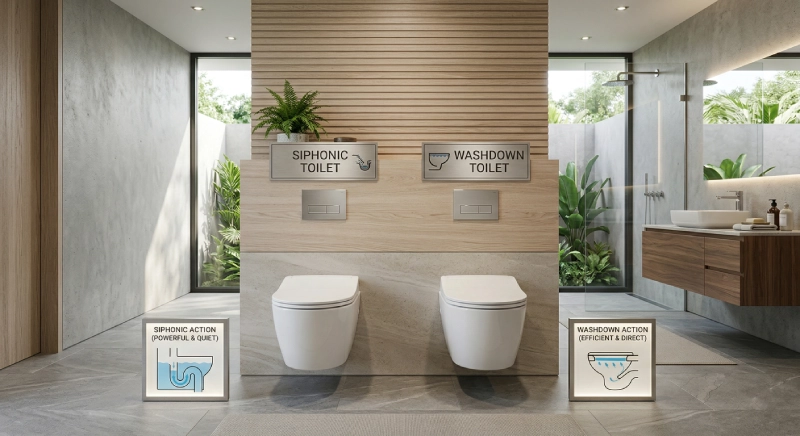
Table of Contents
Why Does Flush System Choice Matter in Luxury Villa Toilet Projects?
Hi, I’m Helen, a sanitary ware project consultant with 10 years of experience supporting international villa developers and procurement teams. Together, we’ve optimized plumbing fixtures for high-end residential developments across the globe.
When selecting a luxury villa bathroom toilet, I often see project managers make a critical error: they look only at the exterior ceramic design or the base unit price. From a project perspective, focusing solely on upfront cost can compromise your project’s overall ROI and severely damage buyer satisfaction.
The flushing mechanism you choose—specifically in the siphonic vs washdown toilets debate—acts as the hidden engine of your bathroom. It directly impacts three critical B2B metrics that developers care about:
User experience: Noise levels during late-night use and the effectiveness of odor control.
Maintenance frequency: The likelihood of plumbing clogs and the ease of daily bowl cleaning.
Long-term operating costs: Water consumption rates, replacement part availability, and expensive emergency plumbing interventions.
A poor flushing system choice can increase maintenance costs by 20–30% over a 5-year lifecycle and negatively impact buyer satisfaction.
At George Group, we understand that developers need reliable, scalable solutions. A noisy, easily clogged toilet will instantly degrade the perceived value of a multi-million-dollar property. Let’s dive into a detailed toilet flushing system comparison to help your procurement team make the smartest, most profitable decision.
For a complete procurement strategy, read our guide on how to choose toilets for luxury villa projects.
What Is a Siphonic Toilet and Why Is It Used in Villas?
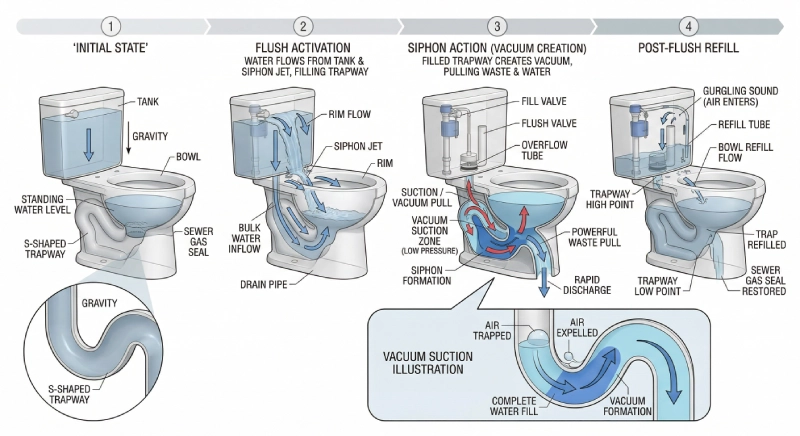
A siphonic toilet relies on a unique, highly engineered vacuum mechanism. When flushed, water fills the bowl rapidly, creating a powerful siphon effect in the specially designed, S-shaped trapway. This vacuum literally pulls the waste down into the drainage system, rather than just pushing it.
Why is this considered the ultimate high-end bathroom toilet?
Quiet operation: Because it relies on vacuum suction rather than gravity-fed crashing water, the flush is smooth, muffled, and incredibly quiet.
Strong suction: The vacuum pull effectively clears waste and leaves the ceramic bowl remarkably clean, greatly enhancing hygiene.
Higher water seal: Siphonic models maintain a higher water level in the bowl. This acts as a superior, natural barrier against sewer gases and unpleasant odors.
The B2B Value: This system is the preferred standard for premium residential projects where user experience directly influences property value.
What Is a Washdown Toilet and Why Do Developers Need It?
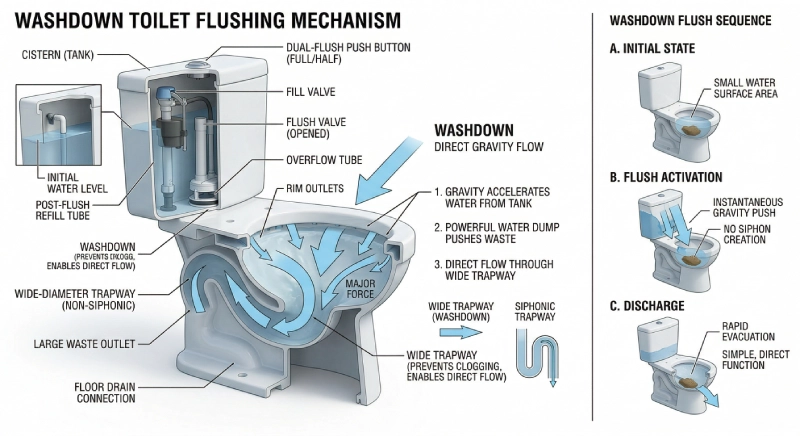
A washdown toilet is the traditional, gravity-powered workhorse of the global sanitary industry. When flushed, water pours rapidly from the tank into the bowl. It uses sheer weight and push force to drive waste down a wider, much shorter trapway.
While it lacks the silent elegance of its siphonic counterpart, the washdown system is incredibly engineering-friendly and highly practical for developers managing large-scale estates.
Direct flushing: The powerful push force and wide trapway severely limit the risk of clogs, even under heavy, unpredictable use.
Low water consumption: Washdown models are highly water-efficient. This is a massive bonus if your project is aiming for eco-friendly building certifications like LEED.
Simple structure: Fewer complex internal components mean less wear and tear over time.
The B2B Value: Washdown toilets are widely used in cost-sensitive, high-usage, and staff environments where heavy-duty durability and low maintenance are essential. This makes washdown toilets a strategic choice for developers aiming to control operational costs at scale.
Siphonic vs Washdown Toilets: Specs, Cost, and ROI Comparison
To make the absolute best toilet configuration for villa projects, your procurement team needs hard, quantifiable data. Vague descriptions don’t help you build a budget.
Here is a quick side-by-side comparison your procurement team can use for fast decision-making:
Technical Feature Comparison
Cost and ROI Comparison (Per Unit Estimate)
Note: The following data reflects general industry averages to help developers forecast project budgets and long-term property management costs.
Developer Insight: While siphonic toilets increase upfront investment by approximately 20–30%, using them selectively in high-value spaces allows developers to maximize perceived property value while controlling overall project costs.
Which Toilet Type Is Best for Each Bathroom in a Villa?
If you are asking me “which toilet is better for luxury villa projects,” the answer isn’t a simple A or B.
Standardizing one single type of toilet across a sprawling, 10-bathroom luxury estate is a strategic error. It means you are either overspending on staff areas or under-delivering on master suites.
To achieve the highest return on investment, I recommend using this simple, proven formula for your project planning:
Flush System Selection = Bathroom Function + User Expectation + Maintenance Feasibility
By applying this formula room by room, you will realize that the best strategy is undoubtedly a mixed toilet configuration for villa projects. This formula allows developers to standardize decision-making across large-scale villa projects while maintaining flexibility.
How Should You Configure Each Space in a Luxury Villa?
Here is the exact layout blueprint and luxury villa bathroom toilet recommendations that we provide to our top-tier developers at George Group.
Why Choose Siphonic for Master Bathrooms?
Our Recommendation: Siphonic Toilet (or a Smart Toilet with a Siphonic Flush).
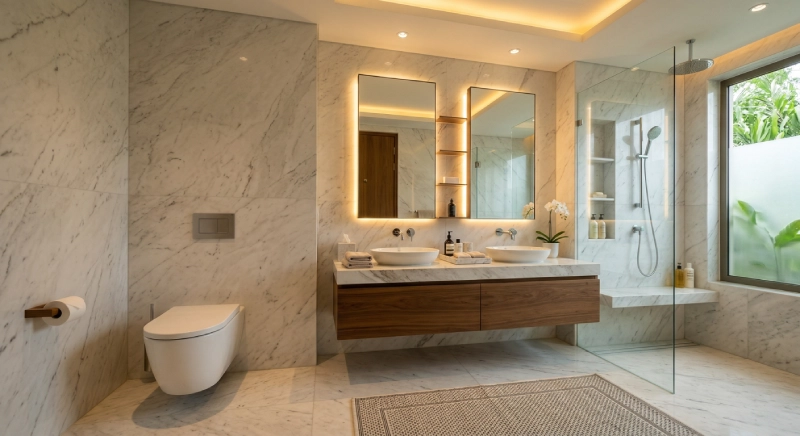
The B2B Value: Luxury is non-negotiable in the master suite. Buyers spending millions on a villa demand a premium, quiet experience. If someone uses the bathroom at 2 AM, the flush shouldn’t disturb their sleeping partner. The superior odor control of siphonic systems also maintains a high-end, sanctuary-like atmosphere. This directly supports higher selling prices and stronger buyer perception.
If you want to upgrade this space further, check out our breakdown of smart toilet vs traditional toilet features.
How Should You Configure Guest Bathrooms?
Our Recommendation: Siphonic or High-End Hybrid.
The B2B Value: Consistency of user experience is critical for buyer satisfaction. Homeowners want their visiting friends and family to experience the same level of quiet luxury found in the master suite. A consistent experience across bathrooms strengthens overall property positioning in the luxury segment.
Why Are Washdown Toilets Best for Staff Bathrooms?
Our Recommendation: Washdown Toilet.
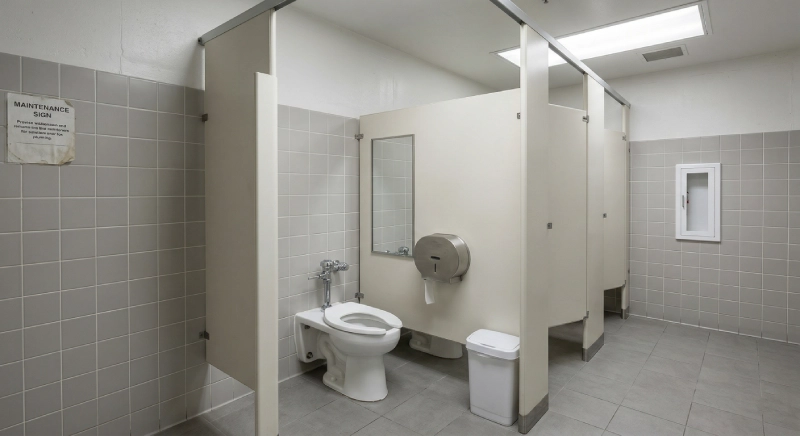
The B2B Value: Practicality and budget win here. Staff quarters, service areas, basement bathrooms, and outdoor pool changing rooms see high-frequency use. Washdown systems simplify installation, drastically reduce maintenance costs, and almost never clog. This reduces lifecycle costs and minimizes maintenance disruptions in high-frequency usage zones.
Real-World Case Study: Optimizing a 40-Unit Luxury Villa Estate
Real-World Case Study: Applying the Mixed Toilet Strategy
To show you exactly how this mixed strategy plays out in the real world, let me share a recent project we handled at George Group (Côte d’Ivoire Luxury Villa Bathroom Solution).
The Challenge: We partnered with a developer building a 10-unit luxury villa estate in Southeast Asia. Initially, the procurement team specified premium siphonic toilets for all 280+ bathrooms across the estate to ensure a uniform “luxury feel.” However, during our free architectural layout review, we noticed that the staff quarters, basement utility rooms, and outdoor pool houses had longer, more complex plumbing runs and slightly lower water pressure.
The George Group Solution: Instead of letting the developer overspend on fixtures that would likely clog in low-pressure zones, our B2B engineering team intervened. We proposed a strict mixed configuration:
Retained high-end siphonic toilets for the master suites and main guest bathrooms to secure the premium buyer experience.
Switched the 80+ staff, basement, and utility toilets to our high-efficiency washdown models.
The ROI: By making this single layout adjustment, the developer saved 15% on total sanitary ware procurement costs. More importantly, the property management team reported zero clogging complaints in the service areas during the first year of handover, while buyers consistently praised the quiet luxury of their master suites.
Case Takeaway: This project illustrates how a strategic mixed toilet configuration not only protects the procurement budget but also ensures optimal user experience and operational efficiency across every villa bathroom. It’s a proven, practical blueprint for developers seeking to balance luxury, durability, and ROI.
How Does Regional Infrastructure Affect Toilet Selection?
Your project’s geographical location dictates your plumbing realities. A toilet that works perfectly in a New York penthouse might fail in a remote island villa. Ignoring regional infrastructure differences is one of the most common causes of post-handover complaints.
As an exporter to over 100 countries, George Group always advises developers to align their fixtures with local infrastructure.
Africa / Middle East
Recommended Toilet: Washdown
Reason: Low/unstable water pressure, limited local maintenance skills.
Europe / North America
Recommended Toilet: Siphonic
Reason: Highly stable water pressure, high user comfort and acoustic expectations.
The African & Middle Eastern Market Reality
In many developing or arid regions, developers frequently experience water pressure instability. Additionally, skilled plumbing maintenance and spare parts availability can sometimes be limited outside major urban centers. Therefore, washdown toilets are preferred. They perform reliably even under low water pressure and require almost zero specialized technical maintenance.
The European & North American Market Reality
Buyers in Western markets have stringent expectations for user comfort, acoustic control, and hygiene. Furthermore, the local plumbing infrastructure provides excellent, stable water pressure. Siphonic toilets dominate these markets because the infrastructure easily supports the vacuum mechanism, and buyers simply demand the quiet, premium experience.
What Common Toilet Selection Mistakes Should Developers Avoid?
Over the past decade, I’ve watched project managers lose thousands of dollars—and damage their brand reputation—by making these highly avoidable errors. If you want a masterclass in reducing maintenance cost in villa toilets, avoid these four traps:
Choosing based on price only: Installing cheap, noisy toilets in a multi-million dollar villa leads to immediate buyer pushback. Consequence: Lower buyer satisfaction scores and delayed property handovers.
Ignoring regional infrastructure: Installing a siphonic toilet in a low-water-pressure zone guarantees a weak flush. Consequence: Constant buyer complaints and an increase in maintenance costs by approximately $20–30 per bathroom annually.
Using one type across all bathrooms: This misses a massive opportunity to optimize your procurement budget. Consequence: Overspending by 15-20% on sanitary ware for staff and utility areas.
Overlooking the maintenance team: Installing complex, high-maintenance systems in staff or public areas frustrates facility managers. Consequence: Inflated operational budgets and frequent emergency plumbing bills.
Avoiding these pitfalls is the first and most crucial step in protecting your project margins. For more on optimizing your installation budget, read our comparison on one-piece vs two-piece toilets.
What Is the Final Configuration Strategy for Villa Projects?
To wrap up our siphonic vs washdown toilets analysis, my final recommendation centers on strategy, not just a single product.
A mixed configuration strategy delivers the best balance between cost control, user experience, and long-term maintenance efficiency.
Remember the formula: Flush System Selection = Bathroom Function + User Expectation + Maintenance Feasibility
Master Bathrooms: Siphonic (Maximum luxury, low noise).
Guest Bathrooms: Siphonic (Consistent premium experience).
Staff/Service Bathrooms: Washdown (Maximum durability, lowest TCO).
By giving every room exactly what it needs, you protect your procurement budget while exceeding your buyer’s highest expectations. This approach ensures that every dollar spent on sanitary ware contributes to either user experience or cost efficiency.
FAQs: Siphonic vs Washdown Toilets
Q1: Which toilet type is better for low water pressure areas?
Washdown toilets perform better due to their direct gravity flushing system.
Q2: Are siphonic toilets worth the higher cost?
Yes, in high-end bathrooms where user experience impacts property value.
Q3: Can I use both types in one villa project?
Yes, a mixed configuration is the most cost-effective and widely recommended strategy.
Ready to Maximize ROI on Your Next Villa Project?
Choosing the right sanitary ware shouldn’t be a guessing game. Maximize ROI and buyer satisfaction — let our B2B experts configure the optimal toilet layout for your villa project.
At George Group, we provide comprehensive project solutions, combining high-quality manufacturing with expert architectural layout advice. We know what it takes to build profitable, beautiful developments. Our engineering team supports a limited number of international projects each month to ensure quality. Projects scheduled this quarter receive priority engineering support.
Let’s elevate your next villa project
Not ready yet? Start with our free toilet selection checklist.
References & Data Sources
EPA WaterSense Residential Toilets – Industry standards for water consumption and flush efficiency.
Orton Baths Technical Guide – Mechanical specifications for siphonic vs. washdown systems.
Angi Plumbing Cost Data – Baseline estimates for commercial plumbing installation and labor costs.