
One-Piece vs Two-Piece Toilets: Which Is Better for Villa Projects?
Quick Answer
The main difference between one-piece and two-piece toilets is that a one-piece toilet integrates the tank and bowl into a single unit, while a two-piece toilet separates them.
One-piece toilets offer premium aesthetics and seamless design, ideal for luxury villa projects, whereas two-piece toilets are cost-effective and easier to transport for large-scale developments.
For projects with 50+ units, the best choice depends on installation efficiency and logistics strategy.
For villa developers, choosing between one-piece and two-piece toilets balances aesthetics, cost, and installation efficiency.
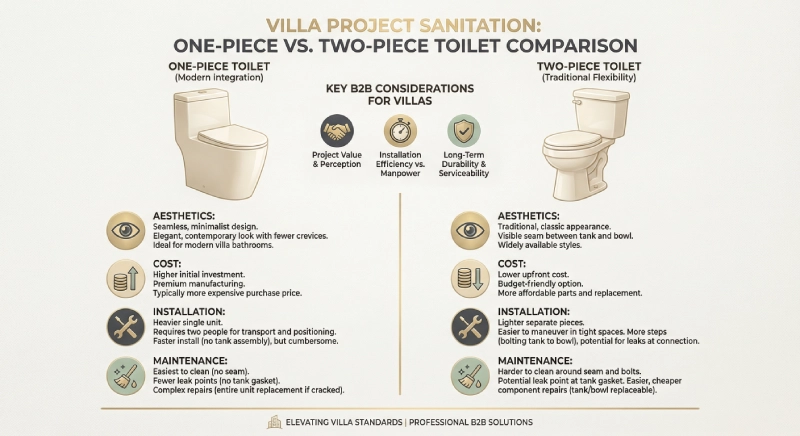
In large-scale villa projects, choosing between one-piece and two-piece toilets directly impacts cost, installation efficiency, and buyer perception in villa projects, especially when deciding which toilet is better for large-scale developments. This guide will help you quickly understand which toilet is better for large-scale villa projects, balancing aesthetics, cost, and installation efficiency.
I’m Helen, and over my decade in the sanitary ware industry, I’ve partnered with hundreds of developers, architects, and project managers. At George Group, we supply comprehensive building materials globally. When procuring fixtures for multi-unit estates, the classic debate of one piece vs two piece toilet models always arises. Let’s break down exactly what you need to consider to make the most profitable and design-appropriate choice for your next build.
Table of Contents
What Is the Difference Between One-Piece and Two-Piece Toilets?
Before calculating logistics, it’s important to understand the core difference between one-piece and two-piece toilets, especially for developers planning multiple-unit projects.
What is a one-piece toilet?
A one-piece toilet is a fully integrated unit designed for a seamless appearance and easier cleaning. The water tank and the seating bowl are cast and fired together in the kiln.
Project Impact: With no gap between the tank and bowl, there is nowhere for dirt or bacteria to hide. This provides an exceptionally easy-to-clean fixture, which is a major selling point for high-end buyers and reduces turnaround time for cleaning crews.
What is a two-piece toilet?
A two-piece toilet separates the tank and bowl into two distinct components that must be bolted together during installation.
Project Impact: While the seam requires slightly more cleaning effort, the modular design means that if a tank is damaged during transit or a clumsy installation, you only need to replace the tank rather than the entire ceramic fixture.
One-Piece vs Two-Piece Toilets: What are Key Differences That Matter for Developers?
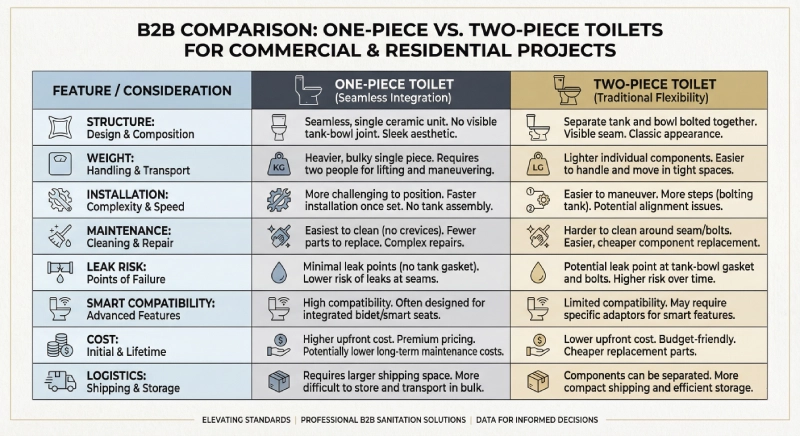
The table below highlights the key differences that directly impact project cost, installation, and long-term maintenance. When weighing the one piece vs two piece toilet pros and cons, developers must look past just the aesthetic.
One-Piece vs Two-Piece Toilet: Villa Project Implications
👉 Swipe horizontally on mobile to see full details
| Feature | One-Piece Toilet | Two-Piece Toilet | Implications for Villa Project |
|---|---|---|---|
| Structure & Design | Seamless, sleek, modern | Traditional, segmented with visible seam | Aesthetics: One-piece models signal premium build quality |
| Weight & Handling | Heavy (40–50kg+), single mass | Lighter, tank & bowl separate | Labor: One-piece requires 2 workers; two-piece easier to move |
| Installation Complexity | Simpler plumbing, harder to place physically | More steps (bolt tank to bowl), easier handling | Timeline: One-piece faster with strong crew; two-piece easier for tight spaces |
| Maintenance | Easy wipe down, whole unit replacement if cracked | Seam collects dust, individual parts replaceable | Facility Mgmt: One-piece cleaner look; two-piece cheaper repairs |
| Leak Risk | No tank-to-bowl connection, minimal leak risk | Gasket may degrade over time | Maintenance Risk: One-piece reduces long-term service calls |
| Smart Toilet Compatibility | Ideal base for bidet/electronic upgrades | Limited space, may need adapter kits | Future-proofing: One-piece allows seamless smart upgrades |
| Unit Cost | 20–50% higher per unit | Lower, cheaper to mass-produce | Budget: Two-piece offers immediate procurement savings |
| Logistics | Takes more CBM per container | Packed densely (nested tanks) | Shipping: Two-piece lowers international freight cost per unit |
Which Is Better for Villa Projects? (Quick Decision by Scenario)
Quick Decision Guide for Developers:
Choose one-piece toilets for premium positioning and high-end buyers.
Choose two-piece toilets for cost-sensitive, large-scale projects.
Use a mixed strategy to balance total cost and visual impact.
Here is how I advise our clients at George Group to allocate their budgets across a development:
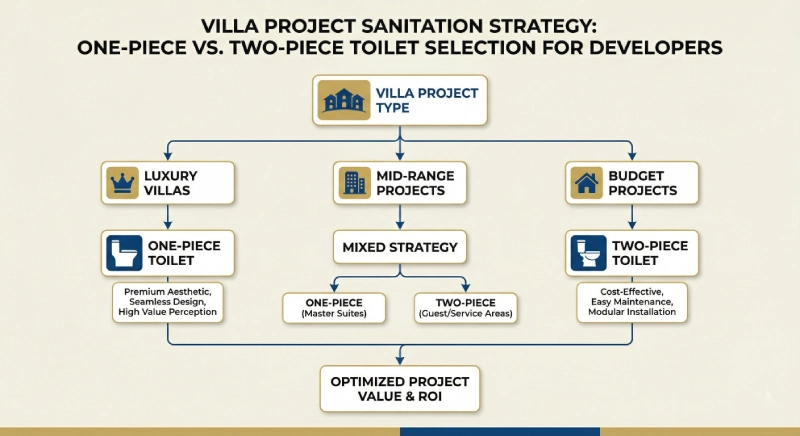
For luxury villa projects → One-piece toilets
You cannot cut corners in a luxury master bathroom. A sleek, one piece elongated toilet instantly elevates the perceived value of the space. In these projects, the higher unit cost is easily absorbed by the premium selling price of the property. The best one piece toilet will look like a deliberate architectural choice. For luxury projects, factors like toilet height also matter—see our guide on [chair height vs standard toilets] to further optimize comfort and positioning for your high-end buyers.
For mid-range developments → Mixed strategy
Specify a premium one-piece model for the master suites to impress the primary homeowners, and utilize cost-effective two-piece toilets for the guest bathrooms or powder rooms. This perfectly balances your budget constraints with high-impact appeal where it matters most.
For budget or rental projects → Two-piece toilets
When dealing with massive volume and strict caps, the two-piece toilet is the clear winner. The lower unit price and incredible shipping efficiencies make a massive difference to the total project overhead.
Ultimately, the right toilet choice depends on balancing visual impact, total project cost, and long-term maintenance strategy.
Cost Comparison: Which Option Is More Cost-Effective for Large Projects?
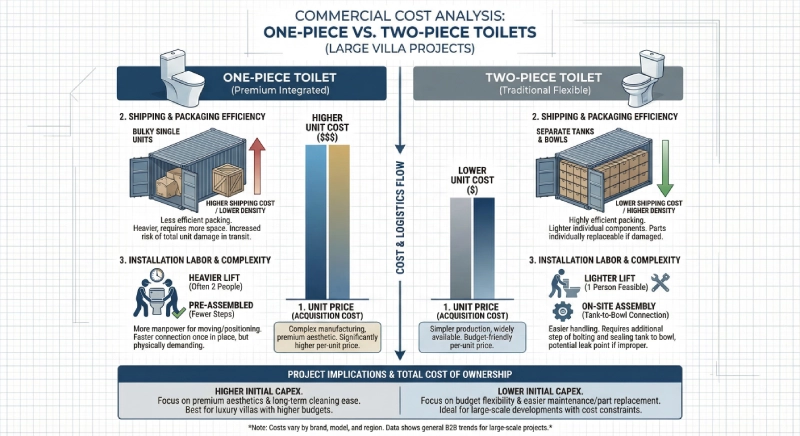
In large-scale villa developments, even a $10 difference per unit can translate into tens of thousands of dollars in total cost variation. This is why developers should always calculate the total project cost—including labor, logistics, and replacement parts—rather than relying solely on unit price.
Unit price difference
Casting a massive, intricate one-piece ceramic mold has a higher factory rejection rate, meaning one-piece toilets inherently cost more to produce. Expect a 20% to 50% premium on the base EXW price.
Shipping, packaging & damage risk
Two-piece toilets can be packed highly efficiently into a 40ft HQ container, drastically lowering your freight cost per unit. However, at George Group, we utilize reinforced export packaging for both styles to ensure your bulk order arrives safely without halting your construction timeline.
Installation and replacement cost
While a one-piece toilet skips tank assembly, its weight requires two laborers. A two-piece takes longer to assemble, but one worker can carry it. Furthermore, if a contractor cracks a two-piece tank, a $30 replacement fixes it. Cracking a one-piece ruins the entire $150+ unit.
Which Toilet Is Easier to Install, One-Piece or Two-Piece?
Two-piece toilets are generally easier to handle, while one-piece toilets are simpler to assemble. In large villa projects, installation efficiency can significantly affect project timelines.
A one-piece toilet is technically faster to plumb because the contractor doesn’t have to carefully align gaskets or perfectly torque the tank bolts to prevent cracking the porcelain. They simply set the wax ring, position the toilet, and bolt it to the floor. However, because they are incredibly heavy, maneuvering them into tight villa bathrooms is physically taxing.
Two-piece toilets are universally familiar to plumbers, making them easy to install and easy to source generic replacement parts for down the line. If you are looking for even more advanced, space-saving installation options for your luxury builds, you may also want to explore the differences between wall-hung vs floor-mounted toilets to see what best fits your architectural plans.
What are Common Mistakes Villa Developers Make When Choosing Toilets?
Avoid these costly procurement mistakes when evaluating one piece vs two piece toilet options:
Choosing based only on unit price: This can lead to higher total project costs due to unforeseen installation labor and international logistics inefficiencies.
Ignoring installation constraints: Ordering heavy one-piece toilets for a multi-story project without service elevators leads to exhausted laborers and a high rate of dropped, shattered ceramics.
Overlooking transportation damage risk: Partnering with low-tier suppliers using cheap packaging results in massive breakage rates, delaying your entire construction schedule.
Lack of product standardization: Mixing too many models creates a nightmare for facility management, leading to bloated inventory costs for spare parts across the estate.
What Do Luxury Villa Developers Prefer? (Market Insight)
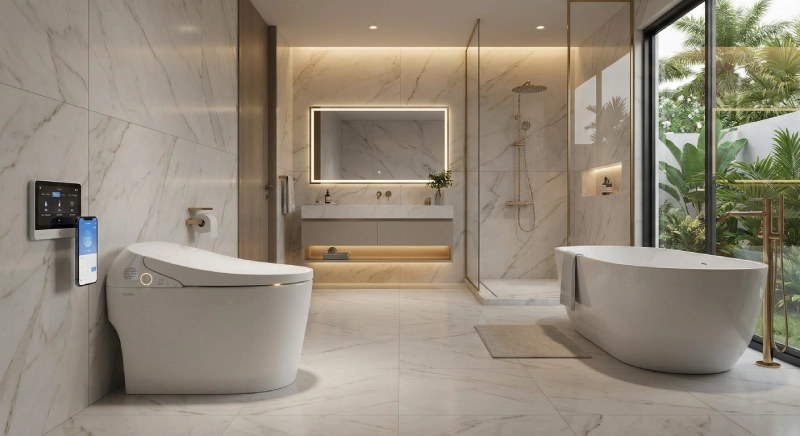
In today’s luxury villa market, toilet selection is no longer just functional—it plays a key role in perceived property value.
Based on recent export data and 50-unit luxury villa projects, luxury developers are increasingly choosing one-piece toilets for master bathrooms. Buyers view the master bathroom as a spa retreat, and a bulky two-piece tank disrupts that vision. Furthermore, a sleek one piece elongated toilet provides the perfect, sturdy base for smart bidet seat upgrades, which are now standard in premium builds.
Here is a real example from one of our recent villa projects:
Case Study Insight: Ethiopia Villa Complex
We supplied the complete building materials for the Ethiopia Villa Complex Project. The developers initially requested two-piece toilets to save upfront costs on the 50 luxury units. After reviewing their target demographic, our consultants advised them to upgrade to premium one-piece models for the master bathrooms. The developers made the switch, and the master bathrooms became a major highlight during presale tours, perfectly matching the opulent feel of the villas.
Our Recommendation for Villa Projects
For most villa developers, the decision should align with positioning, budget, and long-term maintenance strategy.
Primary Recommendation: We advise specifying one-piece toilets for premium and luxury developments. The superior aesthetics, hygiene, and elimination of leak risks drastically improve the end-user experience and elevate your property’s value.
Alternative Strategy: If you are developing a massive residential project where strict cost control and container shipping efficiency are your top priorities, high-quality two-piece toilets remain a financially sound choice.
Optimize Your Bathroom Fixture Selection and Reduce Total Project Costs
Selecting the right toilet reduces project costs and enhances buyer satisfaction—work with experienced consultants to avoid procurement mistakes. At George Group, we provide end-to-end building material solutions tailored for overseas developers.
Request full specification sheets for our commercial-grade sanitary ware.
Get bulk pricing including calculated freight costs to your nearest port.
Get personalized recommendations for your next villa project, and read our comprehensive [toilet selection guide] to find the exact models that fit your architectural vision.
Contact our team today to secure the best fixtures for your development.
FAQ: One-Piece vs Two-Piece Toilets for Villa Projects
1. Is a one-piece toilet better than a two-piece toilet?
Yes, for luxury villa developers, one-piece toilets are generally better due to their seamless design, improved hygiene, and zero risk of tank-to-bowl leaks, which simplifies facility management across multiple units. However, two-piece toilets are better for strict budgets and easier part replacement.
2. Why are one-piece toilets more expensive?
For multi-unit projects, developers will find one-piece toilets are more expensive because casting a heavy, complex ceramic shape as a single piece requires massive molds, more raw materials, and results in a higher factory rejection rate, all of which raise the procurement cost.
3. Which toilet is easier to install, one-piece or two-piece?
For contractors on villa projects, a one-piece toilet is faster to assemble since it has no tank bolts, but a two-piece toilet is physically easier for on-site laborers to carry and maneuver into place because the weight is divided.
4. Are two-piece toilets more durable?
For facility managers handling multi-unit estates, the ceramic material is equally durable in both, but two-piece toilets have a rubber gasket connecting the tank and bowl that can degrade and leak over time, a long-term maintenance weakness that one-piece toilets do not have.
5. Which toilet is better for large construction projects?
For large-scale villa developers, two-piece toilets are highly favored for massive, budget-driven housing developments due to their low unit cost and dense shipping capability, while one-piece toilets are the standard for high-end, multi-unit luxury complexes.
References & Industry Data Sources
George Group Project Portfolio: Ethiopia Villa Complex Project Case Study. (Procurement data on luxury sanitary ware upgrades for 50-unit developments).
Forbes Home: Toilet Installation Cost Data. (Industry pricing data verifying labor, handling, and manufacturing cost premiums).
Freightos Logistics: Global Freight and CBM Shipping Standards. (Supply chain data detailing volumetric weight calculations and shipping efficiency).