
How Do You Achieve ADA Toilet Clearance in Small Hotel Bathrooms?
Achieving compliant ADA toilet clearance is one of the most difficult challenges in small hotel bathroom design. The problem becomes significantly more complex inside a tight 4.5’–7’ hospitality bathroom footprint. In small hotel bathrooms, ADA clearance effectively dictates the entire room geometry.
Across hospitality projects and accessibility reviews, a consistent pattern appears: boutique hotel bathrooms often fail ADA inspection even when drawings appear correct. These failures repeatedly surface in accessibility reviews and post-inspection reports.
Many hotel projects pass drawing reviews but fail inspection on site due to minor physical intrusions, finish tolerances, or late product substitutions. In small hotel bathrooms, ADA failure is rarely caused by incorrect drawings — it is caused by physical intrusion.
Quick Answer:
To achieve compliant ADA toilet clearance in a small hotel bathroom, designers must:
Allocate a strict 60-inch wide clear floor space.
Provide 56–59 inches of depth depending on toilet type.
Fix the toilet centerline at exactly 16–18 inches from the side wall.
Design the entire room layout around this clearance zone before selecting secondary fixtures.
Most failures occur not because designers misunderstand the rules, but because physical intrusions reduce the planned clearance during construction.
Achieving ADA toilet clearance is fundamentally a layout challenge, not just a dimensional requirement. Understanding this shift is essential for designing small hotel bathrooms that are both compliant and operationally practical. Let’s explore how we can overcome these challenges to design an ada bathroom that succeeds both on paper and in reality.
Table of Contents
What Are the Exact ADA Toilet Clearance Dimensions Explained?
According to the 2010 ADA Standards for Accessible Design, there are strict geometric baselines you must follow. Before we look at layout strategies, let’s establish these rules. You cannot reliably design a compliant space without understanding these exact ada toilet dimensions. Why start here? Because even a half-inch intrusion from tile or drywall can cause a costly inspection failure.
Width: A minimum of 60 inches of unobstructed clear floor space.
Depth: 56 inches minimum for wall-hung toilets, or 59 inches minimum for floor-mounted toilets.
Placement: The ada toilet clearance from wall to the exact centerline of the toilet bowl must be 16 to 18 inches.
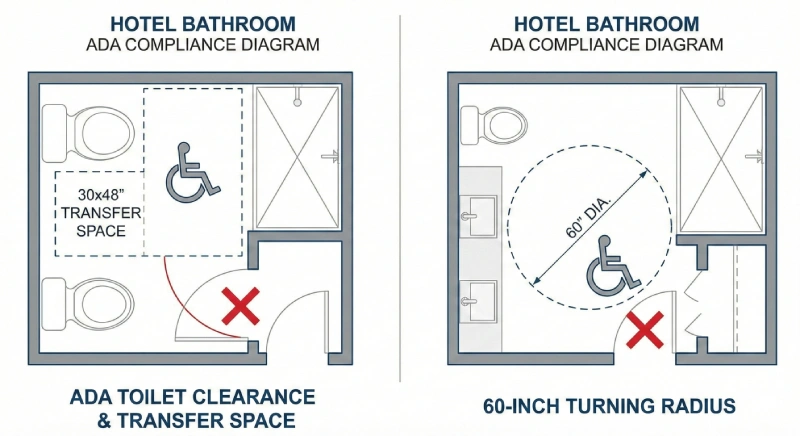
Imagine a rigid 60″x56″ (or 59″) box painted on your floor plan. Absolutely no door swings, vanity counters, or non-associated fixtures can enter this zone. Even the thickness of your wall tiles or a slight floor slope deviation can eat up a half-inch of space and fail the room. In small hotel bathrooms, these dimensions effectively define the entire room layout — not just the toilet zone. Understanding these dimensions is step one—next, let’s see how to plan a layout that respects them from day one.
How Do You Create an Example Layout for a Small Hotel ADA Toilet Clearance Plan?
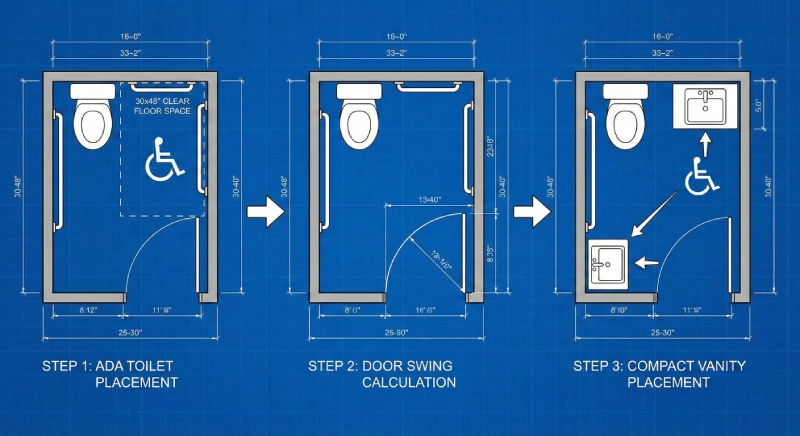
Clearance-first layout planning is the most reliable method used by experienced hospitality designers. Below is a typical layout strategy used in compact hotel bathrooms.
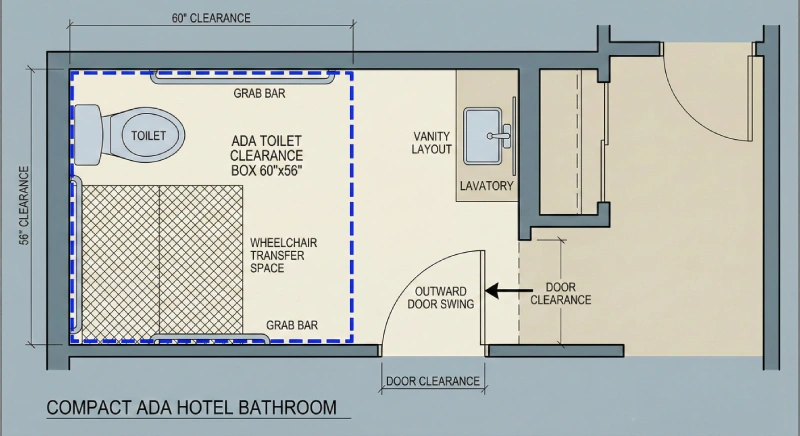
To get this right every time, follow these step-by-step layout tips:
Step 1: Place the ada toilet according to the strict 16–18″ centerline.
Step 2: Map the absolute clear floor boundary around the toilet. Pro Tip: Create a dedicated “clearance layer” in your CAD or BIM software that cannot be hidden or overwritten. This makes on-site verification much easier.
Step 3: Arrange the vanity, shower, and door swing strictly outside of this mapped boundary.
Why Do Small Hotel Bathrooms Struggle With ADA Toilet Clearance Requirements?
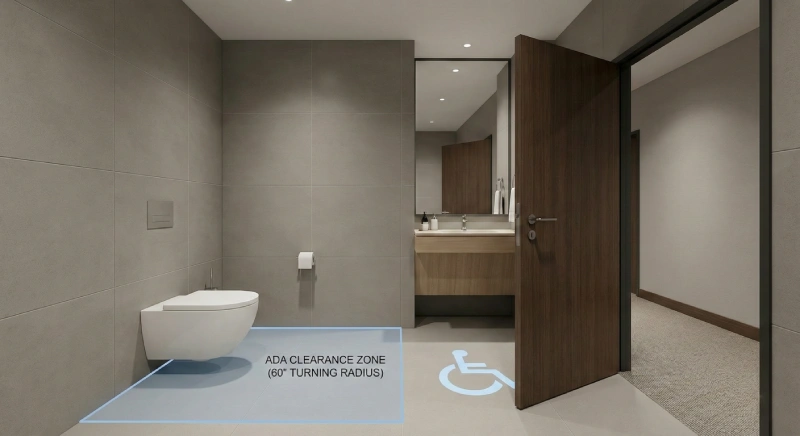
I’ve seen countless plans fail on-site because what works on a screen doesn’t always translate to the physical room. One of the most common real-world failures we see is a 1/2″ door swing intrusion breaking clearance in a tiny 4.5’x7’ boutique bathroom, forcing a complete door frame teardown!
These constraints explain why ada toilet clearance requirements are one of the highest-risk compliance areas in hotel bathroom design:
1. Severe Space Constraints
Whether you are building an urban high-rise or a boutique retreat, square footage is premium real estate. Every inch given to the ada bathroom is taken from the guest room.
2. Fixture Priority Conflicts
Designers often fall into the “vanity-first” mistake. They want to impress guests with expansive countertops, leaving the ada toilet as an afterthought.
3. Renovation Constraints
In retrofits, the plumbing stacks are fixed in the slab, and adjusting the ada toilet clearance from wall by even two inches is a massive headache.
These spatial and structural constraints often hide the top overlooked failures, which we’ll cover next.
What Does ADA Toilet Clearance Actually Mean in Layout Planning?
We need to translate code numbers into design language. Drawing compliance ≠ actual usage compliance.
🛡️ The Forcefield Concept: Think of the clear floor space as an untouchable forcefield. In technical terms, this is defined as the required unobstructed clear floor space. Inspectors measure intrusion, not design intent. In one boutique hotel project, a 1/2″ overhang from a custom stone vanity breached this forcefield and caused a failed inspection, despite a perfectly correct CAD drawing.
Transfer Space vs. Turning Space: The ada toilet clearance is specifically for a wheelchair user to transfer onto the seat. This overlaps with, but is functionally distinct from, the 60-inch turning radius needed in the room.
Door Interaction: The bathroom door cannot swing into the clear floor space unless there is adequate maneuvering space beyond the swing (which small hotels rarely have).
What Are the 5 Biggest Clearance Conflicts in a Small Hotel Bathroom?
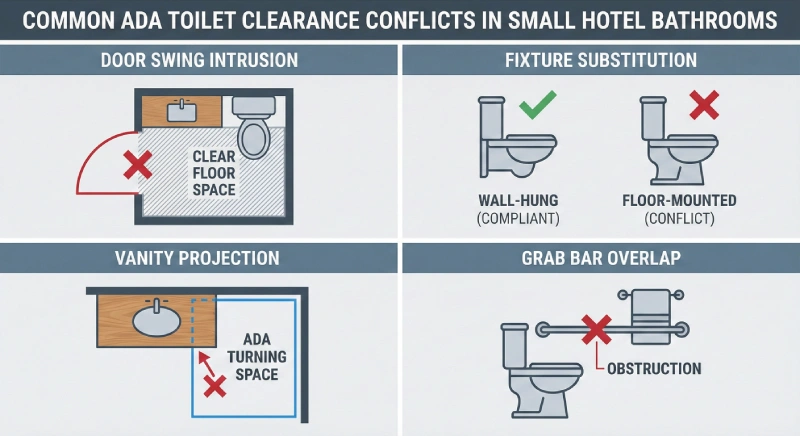
To give you a realistic look at what goes wrong, I’ve compiled data from dozens of recent B2B hotel projects. These failures rarely appear in drawings — they appear during construction and daily operation.
These conflicts are responsible for the majority of real ADA inspection failures. Here are the top conflicts that ruin your ada toilet clearance:
Common ADA Toilet Layout Conflicts & Solutions
Vanity Projection
Door Swing Intrusion
Miscalculated Depth
Grab Bar Overlap
Housekeeping Additions
Which Layout Strategies Work Best for an ADA Bathroom?
If you are a project manager optimizing your next hotel build, the sequence of your design is your strongest weapon. In compact hospitality bathrooms, sequencing decisions often determine compliance success more than fixture size.
The sequencing rule is simple: Toilet → Door → Vanity
Strategy 1: Wall-Hung Toilets 🚽
By utilizing a wall-hung ada toilet, you reduce the required clearance depth from 59 inches to 56 inches.
Impact: This reduces depth intrusion by 3 inches and preserves critical wheelchair transfer space in tight layouts.
Strategy 2: Pocket or Sliding Doors 🚪
If an outward-swinging door disrupts the guestroom corridor, use a sliding door.
Impact: This completely removes the door swing from your ada toilet clearance calculations, freeing up massive floor space.
Strategy 3: Compact ADA Vanity Planning 🚰
Design a customized, narrow-depth vanity that tapers away from the toilet zone.
Impact: This ensures the guest has premium counter space without violating the clear floor space forcefield.
Strategy 4: Concealed Tank Systems ⚙️
Concealed in-wall tanks look highly premium and push the bowl closer to the wall.
Impact: Maximizes usable floor space in front of the toilet, perfect for luxury boutique hotels.
What Product Selection Rules Should Designers Apply Early?
Product selection drives ADA compliance — don’t wait until the layout is complete to pick your fixtures! In hospitality projects, teams often discover that you cannot draw a generic box and hope your purchasing team finds an ada toilet that fits it later. Late-stage product substitution is one of the most common causes of ADA clearance failure.
Select the Toilet Type First: Floor-mounted vs. wall-hung changes your math instantly.
Fix the Centerline Early: Nail down the exact ada toilet clearance from wall (16″ to 18″) and lock this dimension in your CAD files.
Verify BIM Dimensions: Ensure the 3D models your architects use match the exact ada toilet dimensions of the physical products.
Need help verifying product dimensions for your hotel project? Contact George Buildshop for expert B2B guidance and precise specification sheets.
How Can We Solve Retrofit Challenges for Existing Hotel Bathrooms?
Retrofit projects present the highest ADA clearance risk. Retrofitting an older property is incredibly tough because the bones of the building fight against modern ada toilet clearance requirements. Retrofit projects introduce geometry constraints that new builds do not face.
The Cost Reality (Drain vs. Wall): Moving a drain line in post-tension concrete can cost several times more than wall furring or minor layout adjustments. (📊 Visual mental note: Jackhammering concrete =
vs. Adding drywall =$$). If the existing toilet flange is non-compliant, it is sometimes cheaper to build out the adjacent side wall by a few inches to correct the centerline geometry.
The Risk of Partial Compliance: Partial compliance may be tempting in old buildings to save money, but legal liability and guest safety risks make it highly dangerous. Do it right the first time.
Door Replacement Strategy: Consider offset hinges, which can sometimes provide that extra inch of clearance without tearing down the frame to widen the door.
Inspection Failures: What Do ADA Reviewers Commonly Flag?
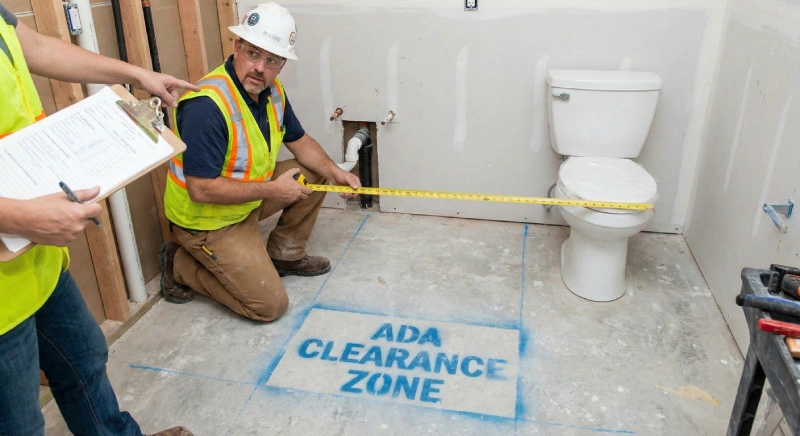
Inspectors evaluate finished conditions, not design intent or drawings. Inspection failures are almost always caused by intrusion into the clearance box. Even a 0.5-inch violation can trigger a failure because inspectors measure precisely.
❌ Clearance Intrusion: Even a vanity counter overhanging by a fraction of an inch into the minimum 60″ box will fail a small hotel bathroom.
❌ Incorrect Toilet Position: They will measure the ada toilet clearance from wall. A 15.5″ or 18.5″ centerline triggers an immediate failure.
❌ Door Conflict: Reviewers will open the door fully to ensure the swing does not cross into the ada toilet clearance space.
❌ Grab Bar Misplacement: Specifically, the side wall grab bar not extending far enough past the front of the ada toilet bowl.
What is Your Practical Checklist for Small Hotel ADA Toilet Clearance?
This checklist reflects the most common failure points flagged during ADA inspections. Download or print this checklist for your project team. Use this as a cross-disciplinary checklist for designers, contractors, and hotel operators. Using this across different construction phases will keep everyone accountable.
🔴 Pre-Construction (Design Phase)
- [⭐ MOST OVERLOOKED] Construction Tolerance: Did you add a 1/2-inch buffer for tile thickness and drywall buildup to protect your clearance?
Toilet Centerline Verified: Is the ada toilet clearance from wall strictly set between 16 and 18 inches?
Fixtures Locked In: Are the exact ada toilet dimensions confirmed and protected from mid-project substitution?
🟡 During Construction (Framing & Rough-In)
[⭐ MOST OVERLOOKED] Door Intrusion Checked: Is the door frame installed so the swing stays completely clear of the forcefield?
Turning Space Verified: Is the 60-inch turning circle completely unobstructed by framing?
🟢 Post-Construction (Finishes & Housekeeping)
[⭐ MOST OVERLOOKED] Accessories Mapped: Are dispensers, trash bins, and grab bars mapped to exact ADA requirements without intruding on the transfer space?
FAQ
1. Can a door swing into ADA toilet clearance?
No, the bathroom door generally cannot swing into the required clear floor space. The only exception is if there is adequate clear floor space beyond the door swing, which is practically impossible in small hotel bathrooms. This is why designers often use outward-swinging or pocket doors to protect the clearance.
2. Is a wall-hung toilet better for ADA clearance?
Yes. Using a wall-hung ada toilet reduces the required depth from 59 inches to 56 inches. In a compact hotel bathroom layout, gaining those extra 3 inches of clear floor space is often the key to passing inspection. This is why wall-hung systems are widely preferred in compact hospitality projects.
3. What is the most common ADA inspection failure?
The most common failure is physical intrusion into the clear floor space. This is frequently caused by construction tolerance shrinkage (like unexpected drywall or tile thickness) or a vanity counter that overlaps the boundary required by strict ada toilet dimensions.
Conclusion
ADA toilet clearance is primarily a layout sequencing problem, not a fixture selection problem.
In small hotel bathrooms, ADA clearance is not a final verification step — it is the foundation of the layout. Clearance decisions made during early layout planning determine inspection success. ADA clearance decisions must be made first, before any vanity or door placement.
If you plan your clearance zones early, select your products precisely, and prioritize your layout strategy over massive fixture sizes, you will avoid expensive teardowns. Using this guide can literally save you weeks of rework and costly inspection failures.
Remember, you don’t just need to meet the ada toilet clearance requirements on paper; you need to create a safe, accessible, and comfortable experience for your hotel guests.
At George Buildshop, we specialize in supplying B2B hotel projects with high-quality, fully compliant sanitary ware. Early specification prevents late-stage compliance risk.
Ready to ensure your next project passes inspection the first time?
👉 Design Review: Our team can review your small hotel bathroom layouts and identify potential clearance conflicts before construction begins.
👉 Product Sourcing: Would you like me to connect you with our specialists at George Buildshop today to source the perfect compliant fixtures tailored to your exact project needs?
Reference
U.S. Department of Justice, ADA Standards for Accessible Design (2010). “2010 ADA Standards for Accessible Design.” Accessed March 2026. https://www.ada.gov/law-and-regs/design-standards/2010-stds/
CORADA, ADA Toilet Clearance in Toilet Compartments. Accessed March 2026. https://www.corada.com/documents/2010ADAStandards/604-8
Commercial Restroom Design. “ADA Restroom Design Fundamentals: Clearances, Sizes, and Architects’ Best Practices.” Accessed March 2026. https://commercialrestroomdesign.com/uncategorized/ada-restroom-design-fundamentals-clearances-sizes-and-architects-best-practices/
U.S. Department of Justice, ADA Standards Guidance. “Guidance on Clear Floor Space and Protrusions.” Accessed March 2026. https://www.ada.gov/law-and-regs/design-standards/standards-guidance/