Short Answer: Luxury villa steam room failures are primarily caused by vapor sealing defects, installation sequencing errors, and late-stage design changes rather than equipment quality. To avoid costly structural damage, developers must treat steam rooms as sealed vapor engineering systems and fully define design, electrical, plumbing, and waterproofing requirements before construction begins.
Table of Contents
Hi, I am Helen. I have spent over 10 years working in sanitary ware and luxury villa bathroom system engineering, supporting B2B developers and architects in high-end residential projects. I specialize in vapor system engineering for high-end residential and hospitality projects across Europe, the Middle East, and Asia.
If you manage luxury villa developments, you already know that high-end buyers expect resort-level amenities. A private steam room is a major selling point and a standard expectation in premium real estate. But here is the reality I see every day: steam room installation is one of the most common sources of margin loss in luxury villa developments. Most steam room installation cost overruns are not caused by equipment prices, but by poor construction sequencing and moisture control failures.
Here is how experienced developers ensure steam rooms are installed correctly and consistently across multiple villa projects. Once installed incorrectly, most issues remain hidden behind walls until repair costs become unavoidable.
This guide explains the engineering logic of steam room installation in luxury villas. I will show you how to scale it seamlessly and engage system-level suppliers during early design coordination to keep your buyers happy and your margins secure.
Why Is Steam Room Installation More Complex Than a Standard Bathroom System?
Many developers ask me: “Helen, can we just use our standard wet-area contractors for the steam rooms?” My answer is always a firm no.
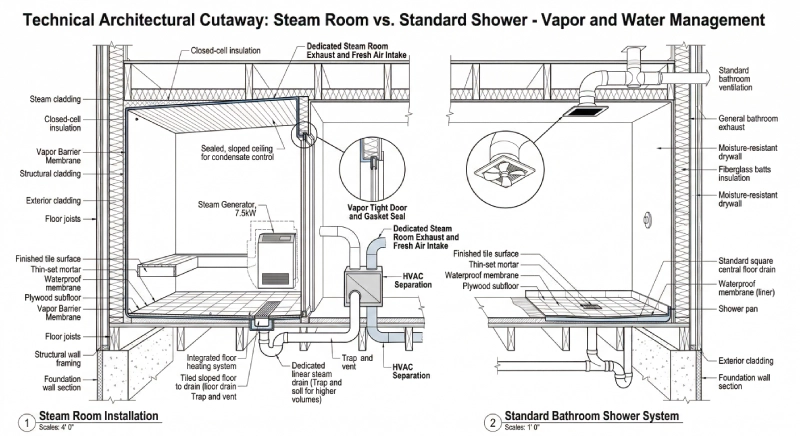
A standard shower handles liquid water, which relies on gravity to reach the drain. A steam room handles water vapor, which is an expanding gas. It has pressure. It must control heat, vapor pressure, and moisture simultaneously—conditions that standard bathroom construction systems are not designed to handle.
If you build a steam room using normal shower waterproofing, that pressurized vapor will force its way through standard grout and drywall. Moisture will escape into the villa’s wall cavities. Within months, you will face rotting timber, structural damage, and severe mold remediation.
To avoid a massive spike in your overall commercial steam room cost, you must view this space as a completely sealed system. It is a controlled thermal and vapor environment. Steam rooms are controlled vapor engineering systems, not plumbing fixtures.
What Are the Minimum Engineering Requirements for Steam Room Installation in Luxury Villas?
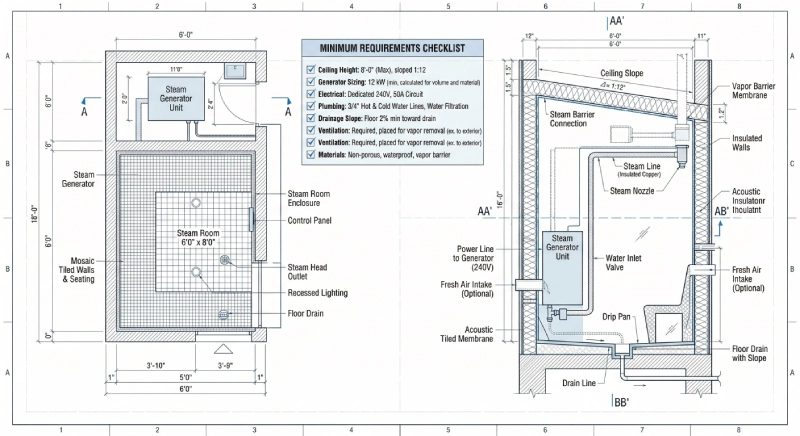
These parameters determine whether a steam room performs reliably or fails within months. You cannot just order a generator and figure the rest out on site. At a minimum, developers must define the following engineering parameters before construction begins:
Room Size & Ceiling Height: Keep ceilings relatively low. The ideal height is between 7 and 8 feet. Anything higher wastes heat and significantly increases generator capacity requirements and system cost.
Generator Sizing Logic: You must calculate the room’s total cubic footage. Then adjust for material heat absorption, as natural stone requires significantly higher output than tile or acrylic finishes.
Steam Room Electrical Requirements: You must provide a dedicated 208V or 240V circuit. Ensure the breaker is properly sized for the kW rating of the generator.
Steam Room Plumbing: You need a reliable cold water supply line with a shut-off valve. Drainage is critical. You must route the generator’s pressure relief valve to an appropriate, safe drain.
Ventilation Basics: Never put an HVAC exhaust fan inside the steam enclosure. Instead, place it just outside the shower door to capture the steam when the user exits the room.
Meeting these basic steam room installation requirements early prevents expensive rework and project delays later. These parameters must be defined during design coordination, not during construction.
What Construction Details Are Critical for Preventing Steam Room Vapor Failure?
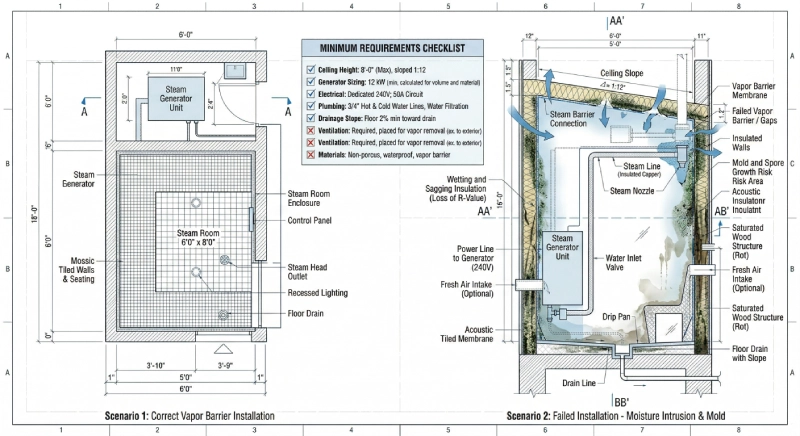
Vapor sealing is the most critical failure point in steam room construction. This is where most steam room failures occur—not in equipment selection, but in construction execution. Let’s break down the technical bottom line.
First, we must look at steam room waterproofing versus vapor-proofing. Standard shower waterproofing is inadequate. You must install a dedicated vapor barrier on all walls, the ceiling, and the floor. The vapor barrier must maintain a perm rating below 0.1 to prevent vapor diffusion into surrounding wall assemblies.
Next, consider your steam room design requirements. Your ceiling cannot be flat. It must slope at least 2 inches per foot. If it is flat, condensation will gather and drip cold water onto your clients, ruining the luxury experience.
Pay close attention to door sealing. The enclosure must be watertight, and the heavy glass door should open outward for safety. The floor must also slope precisely toward the drain to prevent water pooling. Do not forget thermal insulation behind your vapor barrier to ensure rapid heating and maximum energy efficiency.
What Are the Most Common Steam Room Installation Mistakes Developers Should Avoid?
Field failure analysis across villa projects shows recurring installation errors:
No Vapor Barrier: Treating the room like a normal shower is the number one cause of structural rot.
Flat Ceilings: As mentioned, this causes cold water to drip on users.
Wrong Generator Sizing: An undersized generator runs constantly and burns out early. An oversized one cycles off too fast, leaving the room cold and uncomfortable.
No Maintenance Access: Generators need routine descaling. Sealing the generator behind a finished wall with no access panel makes maintenance impossible.
Poor Ventilation: Failing to manage the moisture outside the enclosure damages the adjoining master bathroom finishes.
In a recent villa project in Dubai, missing vapor barriers caused widespread moisture damage across 15 units, resulting in multi-unit reconstruction and significant capital losses across the development. George Group was brought in to supply the proper equipment and guide the rebuild. You can avoid this easily by planning ahead.
When Should Developers Plan Steam Room Installation During a Project?
Timing is everything. If you wait until the drywall is up, your costs will skyrocket. Steam room installation must be integrated across three critical project phases:
Concept Design -> System Definition: Determine the size of the room, the finish materials, and the generator size early. This dictates the entire engineering flow.
MEP Stage -> Infrastructure Integration: Lock in your steam room electrical requirements and steam room plumbing. Run the 240V lines, copper pipes, and drainage lines while the walls are completely open.
Construction Stage -> Irreversible Execution: Once you apply the vapor barrier and begin tiling, you cannot go back to change a pipe or a wire without destroying the seal.
Once waterproofing begins, all major design decisions become irreversible. Involving a specialized system supplier at the concept stage is the smartest way to keep your project on schedule.
What Safety and Compliance Requirements Apply to Steam Room Installation?
Compliance defines the legal liability boundary of steam room systems in residential developments. If a homeowner gets injured or sick, the developer is held responsible.
Strict electrical protection is mandatory. All systems must be grounded, and you must use GFCI (Ground Fault Circuit Interrupter) protection where required by local codes. Equipment must carry the proper certifications (UL, CE, etc.).
Moisture and mold risks are serious health hazards. Proper vapor sealing and ventilation are your only defense. Furthermore, you must ensure the generator has a safe, accessible maintenance panel. Do not cut corners on these steam room installation requirements.
How Can Steam Room Installation Be Standardized Across Multiple Villas?
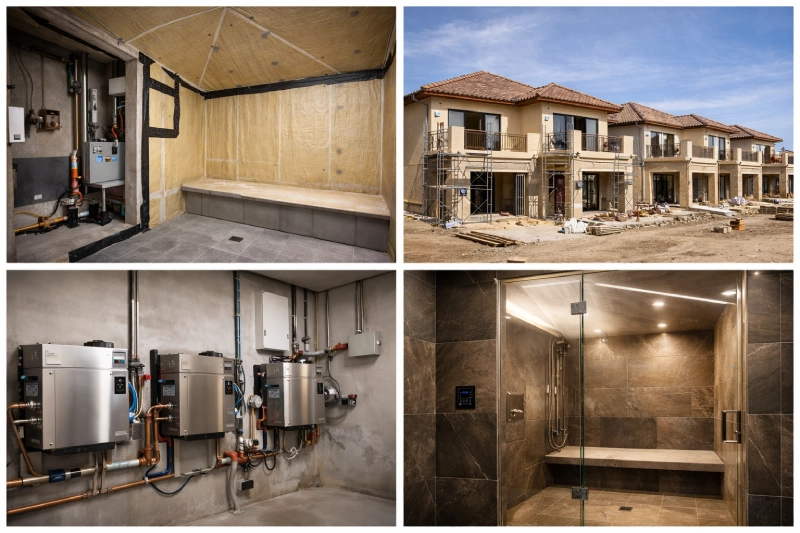
Standardization is widely adopted in large-scale luxury villa developments to reduce execution variance and ensure system-level consistency. At scale, steam room installation must shift from bespoke execution to a standardized engineering deployment framework across villa portfolios. If you are developing 50 or 100 villas, you cannot custom-design 50 different wellness spaces. For developers, the goal is not to build a single optimized steam room, but to create a repeatable engineering system across multiple villas.
Standardization controls your commercial steam room cost and ensures quality control. At George Group, we help B2B clients build standardized modules based on the villa floor plan.
Here is a simplified standard matrix we often use:
Guest Suite
Room Size: Up to 100 cu. ft.
Standard Generator: 5 kW – 7 kW
Finish Material: Porcelain Tile
Installation Strategy: Pre-fab / Modular
Master Suite
Room Size: 101 – 250 cu. ft.
Standard Generator: 7.5 kW – 10 kW
Finish Material: Ceramic / Light Stone
Installation Strategy: Hybrid Model
Presidential Suite
Room Size: 251 – 450 cu. ft.
Standard Generator: 12 kW – 15 kW
Finish Material: Heavy Natural Stone
Installation Strategy: Fully Custom Build
This approach transforms steam room home installation from a project-by-project challenge into a repeatable, quality-controlled engineering deployment system across multiple units.
We recently applied this exact standardization model to our Ethiopia Villa Complex Project, a luxury community of 55 independent villas spanning 11,300 square meters.
The Challenge: Executing high-end steam room installation across 55 units presented immense logistical and quality-control risks for the local workforce.
The Solution: By utilizing our standardized matrix, we engineered distinct schemas with pre-defined generator sizes, vapor barrier specs, and plumbing nodes. This allowed site teams to follow a strict, repeatable installation protocol, eliminating execution errors while reducing per-unit variance and total lifecycle cost.
What Design Features Make a Steam Room Feel Truly Luxury?
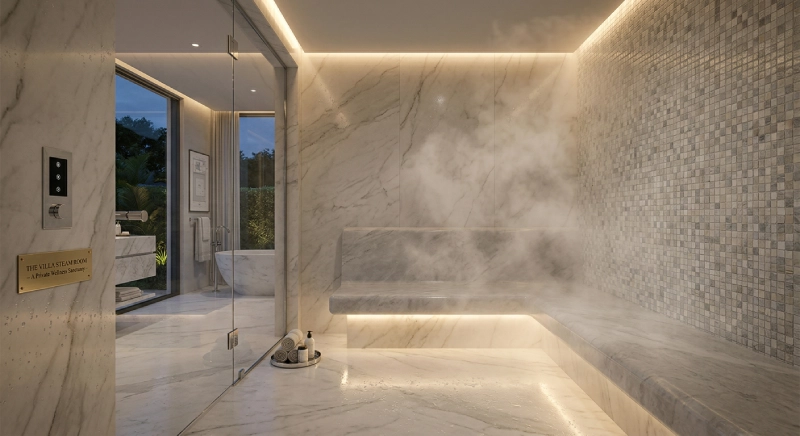
In luxury villa projects, steam rooms function as premium architectural wellness assets that directly influence property valuation. Buyers do not just want steam; they want a high-end spa experience.
Ergonomics matter. A floating bench design looks incredibly modern and makes the floor easy to clean. Position the steam outlet carefully. It must be low to the ground and away from where users sit or walk to prevent accidental burns.
Do not overlook steam room lighting requirements. Standard bathroom downlights will short circuit in the vapor. You must specify IP67-rated, vapor-proof LED fixtures. Adding chromatherapy (color-changing lights), a built-in aroma pump, and a sleek glass smart-control pad elevates the space instantly. We integrate all these steam room design requirements into our engineered packages.
Is It Better to Choose Prefab or Custom Steam Room Solutions?
When looking for a steam room for sale for your project, should you choose prefabricated units or custom builds?
Prefabricated acrylic or composite units are much faster to install. They are inherently vapor-proof, which drastically reduces your steam room home installation risk. They are excellent for secondary bathrooms or large-scale townhouse projects.
Custom built-in steam rooms allow you to match the high-end tile and stone used in the rest of the master bathroom. For luxury villas, buyers usually expect custom finishes.
As a developer, I highly recommend a hybrid strategy. Source a complete, engineered system (generator, controls, lighting, and specialty glass doors) from a reliable B2B supplier, and let your local tile contractors handle the finishes. The decision should be based on installation risk, finish requirements, and portfolio-scale construction efficiency considerations.
Frequently Asked Questions (FAQ) About Steam Room Installation
To help project managers clarify the engineering scope quickly, I have answered some of the most common questions developers ask about steam rooms:
1. How do developers estimate the commercial steam room cost per villa?
The commercial steam room cost per villa is primarily determined by room volume, material selection, and generator capacity. Your cost is driven more by engineering specifications than equipment pricing, especially in large-scale villa developments. While a fully sealed steam chamber requires a larger initial investment, standardizing your designs significantly reduces the per-unit material and labor costs.
2. Can we retrofit a regular shower into a steam room for an existing villa project?
A standard shower cannot be converted into a steam room without full demolition and rebuild. It lacks the required vapor barrier and the properly sloped ceiling. Attempting a retrofit over normal drywall guarantees structural rot within months, meaning you must strip the space down to the studs to build a safe system.
3. Do we need specialized enclosures, or can standard shower doors meet steam room design requirements?
A standard shower enclosure cannot meet vapor control requirements. Standard shower doors have gaps that allow expanding vapor to escape and damage adjacent drywall. Your steam room design requirements must include a heavy-duty, vapor-sealed glass door that opens outward.
4. Where is the best location to install the steam generator in a villa layout?
Generator placement directly affects system efficiency, maintenance access, and long-term reliability. The generator should be installed within 25 to 60 feet of the steam room, typically in heated attics or dedicated utility closets. The most critical steam room plumbing requirement is ensuring the space allows for routine descaling without tearing down finished walls.
How Can Developers Reduce Steam Room Installation Risks and Maintenance Issues?
Reducing risk comes down to respecting the engineering. Follow the correct construction sequence, pre-plan your maintenance access, and do not buy components piecemeal. Sourcing a generator from one factory, controls from another, and doors from a third is a recipe for system failure.
Choosing a complete system supplier mitigates these issues. At George Group, we do more than just provide a steam room for sale. We provide end-to-end B2B solutions, helping developers manage their commercial steam room cost, meet technical parameters, and execute proper steam room waterproofing and plumbing steps.
Developers can implement structured engineering specifications to reduce installation risk and improve system consistency across villa projects. A properly engineered steam room increases property value. A poorly executed one creates long-term hidden liabilities.
References & Industry Engineering Standards
Project Case Studies & Field Reports
Ethiopia Villa Complex: George Group. “Delivering Excellence in East Africa: The 55-Villa Luxury Community.” Details on supply chain protocol and luxury steam room module standardization.
Dubai Moisture Remediation Case: George Group Internal Field Failure Analysis (2023). Multi-unit reconstruction audit detailing the structural impact of missing vapor barriers in luxury residential steam systems. (Internal Data – Not Publicly Available)
Technical & Engineering Specifications
Vapor Permeance & Ceiling Slope Standards: Tile Council of North America (TCNA). TCNA Handbook for Ceramic, Glass, and Stone Tile Installation (Methods SR613/SR614). Mandates a vapor retarder perm rating of 0.1 or less and a minimum ceiling slope of 2 inches per foot.
Electrical Safety Codes: National Fire Protection Association (NFPA). NFPA 70: National Electrical Code (NEC) Article 680, and Underwriters Laboratories (UL) Standard 499. Outlines mandatory GFCI protection and dedicated 208V/240V circuit sizing for environmental heating appliances.
We provide integrated one-stop bathroom solutions covering tubs, sanitaryware, fittings, and system coordination for hotel and commercial projects.
▼ Submit the form below to connect with our team and explore project-based collaboration. ▼