
Quick Guide: Sourcing Faucets in 2026
Use this summary to validate supplier specs or challenge quotations during procurement.
Best Material: Low-lead Brass (HPb59-1) is the non-negotiable standard for hotel durability.
Core Component: Specify Ceramic Cartridges rated for 500,000+ cycles (brands like Sedal/Kerox).
Top Finish: PVD (Physical Vapor Deposition) offers superior scratch resistance compared to electroplating.
Compliance: Mandatory certifications include cUPC (USA), CE (Europe), and WaterMark (Australia).
The 2026 Benchmark: Success isn’t about the lowest FOB price; it’s about Total Lifecycle Value—durability, compliance, and ESG readiness.

Table of Contents
Introduction: The "Hidden Risk" in Hotel Projects
Hello there. I’m Helen. If we haven’t met yet, I’ve spent the last ten years in the sanitary ware industry, specifically focusing on the bathroom supply chain. I’ve walked through hundreds of factories, inspected thousands of production lines, and, unfortunately, seen plenty of hotel projects go wrong because of a small but critical component: the faucet.
As we look toward 2026, the landscape for sourcing bathroom sink faucets is shifting. It is no longer just about picking a style that matches the rendering. This shift is driven by stricter lead regulations, ESG pressure, and rising labor costs for maintenance.
I remember a project manager I worked with back in 2019—let’s call him David. David was managing a mid-range hotel renovation in California. Under pressure to cut costs, he bypassed the standard bathroom faucet specs we recommended and went with a “look-alike” supplier offering a 15% lower FOB price.
Six months after the grand opening, the calls started. The faucets weren’t just dripping; the zinc-alloy bodies were corroding from the inside out due to local water hardness. David didn’t just lose money replacing the units; he lost room revenue and brand reputation.
David’s case is not unique. We see similar failures across mid-range and even luxury hotel projects every year.
Here is the reality for 2026: The benchmark for profitable faucet sourcing has shifted from “Lowest FOB Price” to “Total Lifecycle Value.” This value is defined by the durability of Low-Lead Brass, the resilience of Global Compliance, and the stability of an ESG-ready supply chain.
This guide breaks down the full decision logic behind faucet sourcing—from materials and finishes to compliance, cost, and long-term risk.
Why Bathroom Sink Faucets Matter More Than Most Hotel Teams Expect?
In the grand scheme of a hotel build, bathroom sink faucets often get treated as “finish hardware”—a minor detail to be decided after the big-ticket items like HVAC and flooring.
This is a dangerous misconception.
In a hotel environment, a faucet is not just a water dispenser; it is a high-frequency mechanical device. A standard residential faucet might be used 10 times a day. A hotel lobby or suite faucet might be used 50 to 100 times a day.
If a chair breaks, you remove the chair. If a faucet fails, you have water damage to the vanity, potential mold issues in the drywall, and a room that must be taken out of inventory for repairs. I have seen 5-star ratings drop to 3 stars purely because of “plumbing issues” that started with a cheap cartridge.
“A faucet failure is rarely a maintenance issue — it is a sourcing decision failure.”
At George Buildshop, we encourage clients to view faucets as “System Critical” components. Understanding why faucets fail in hotel projects requires looking deeper into materials, finishes, and installation realities—which we break down below.
The 5-Step Framework for Sourcing Bathroom Sink Faucets in 2026
Over the last decade, I have developed a repeatable methodology for sourcing. This isn’t just about buying; it’s about eliminating risk. This is the framework we apply internally when supporting international hotel projects.
This framework is designed for hotel developers, project managers, and procurement teams managing overseas sourcing.
We treat this article as a “Master Guide.” In each step below, I will give you the executive summary and point you toward our specific deep-dive articles for more technical details.
The George Buildshop Sourcing Logic:
Step 1: Core Materials & Internal Components (Defining the “Engine”)
Step 2: Surface Finish & Environmental Fit (Defining the “Skin”)
Step 3: Compliance & Certification (Defining Market Access)
Step 4: Project Economics & Installation Reality (Defining ROI)
Step 5: Supply Chain Stability & ESG Readiness (Defining Future-Proofing)
Let’s unpack these, one by one.
Step 1: Core Materials & Internal Components
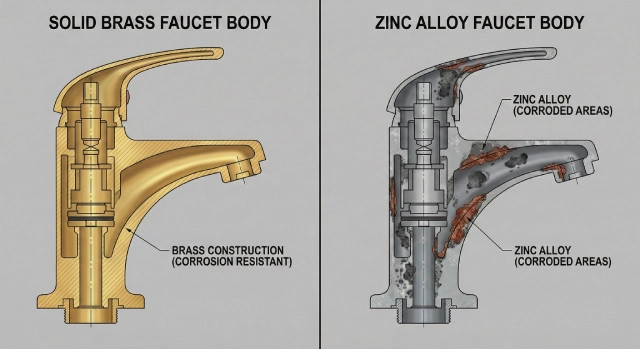
When you browse catalogs from various bathroom faucet manufacturers, you will see many faucets that look identical on the outside. However, the “DNA” inside determines whether that faucet lasts 5 months or 15 years.
The Brass vs. Zinc Debate
The most common question I get asked is: What is the best material for bathroom faucets?
For hotel projects, the answer is unequivocally Solid Brass. While Zinc alloy is cheaper, it is brittle and prone to intergranular corrosion. Brass (specifically HPb59-1) offers the perfect balance of castability and corrosion resistance.
Comparison Table:
Faucet Material Comparison for Hotel Projects
Brass (HPb59-1)
Stainless Steel (304)
Zinc Alloy
Decision Conclusion: For any hotel project targeting a lifespan beyond 10 years, zinc alloy should be excluded at the specification stage.
Source: Zinc vs Brass Faucets: Which is Better?
How to Choose the Best Faucet Material for Long-Term Durability
The Heart: Ceramic Cartridges
If the body is the skeleton, the cartridge is the heart. Inferior rubber washers drip; diamond-hard ceramic discs do not. When writing your spec sheet, demand cartridges rated for 500,000 cycles (Standard: EN 817 / ASME A112.18.1). Brands like Sedal or Kerox are the industry benchmark.
Note: There is much more to say about lead content and alloy composition. For a detailed comparison of brass grades and cartridge performance, please see our dedicated guide on [Understanding Faucet Materials].
Source: 5 Must-Ask Questions Before Choosing a Faucet Supplier
Step 2: Surface Finish & Environmental Fit
In 2026, selecting a finish is about more than just matching the “Warm Minimalism” trend (though Brushed Gold and Nickel are indeed replacing chrome).
Finish selection is not an aesthetic decision—it is an environmental compatibility decision.
The Salt Spray Test Reality
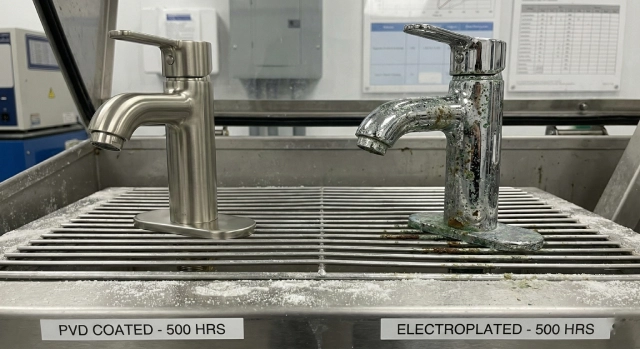
If your hotel is located near the ocean (like a resort in the Maldives or Miami), a standard electroplated faucet will likely show pitting within 12 months due to salty air.
For these environments, we strongly recommend PVD (Physical Vapor Deposition).
PVD creates a molecular bond that is 10x harder than chrome plating.
Electroplating is a coating that sits on top.
At George Buildshop, we test our finishes using the 24-hour Acid Salt Spray Test (ASS). If a sample shows even a pinpoint of oxidation after this test, we reject the batch. We recommend specifying ASS test performance directly in tender documents, not just finish names.
For a deeper dive into PVD technology vs. Chrome plating, refer to our article: [The Ultimate Guide to Faucet Finishes].
Step 3: Compliance, Certifications & Regional Market Access
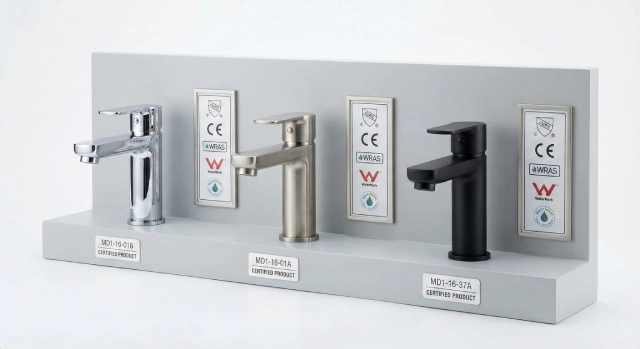
I cannot stress this enough: Compliance is not optional.
I once helped a client in Melbourne who imported 500 uncertified mixers. The building inspector failed the entire plumbing inspection because the faucets lacked the WaterMark certification. They had to rip them all out.
Certification gaps often surface late—during inspection or handover—when replacement costs are highest.
Your Global Checklist:
North America: cUPC, NSF/ANSI 61 (Lead-free), WaterSense.
Europe: CE, WRAS (UK), ACS (France), KTW (Germany).
Australia/NZ: WaterMark, WELS rating.
Helen’s Pro Tip: A CE mark alone does not guarantee compliance for drinking water applications; always verify specific hygiene standards like KTW or ACS.
At George Buildshop, we ensure our partners meet these rigorous standards. We don’t just send you a product; we send you the test reports and certificates you need to pass inspection smoothly.
Source: How to Choose the Best Faucet Material for Long-Term Durability
How to Choose a China Faucet Manufacturer (Guide for Importers)
Step 4: Project Economics — Cost Beyond the Unit Price
The lowest unit price rarely delivers the lowest project cost.
When you look at a quotation, you are seeing the FOB price. But as a Project Manager, you need to calculate the Total Cost of Ownership (TCO).
The Hidden Costs of “Cheap” Faucets:
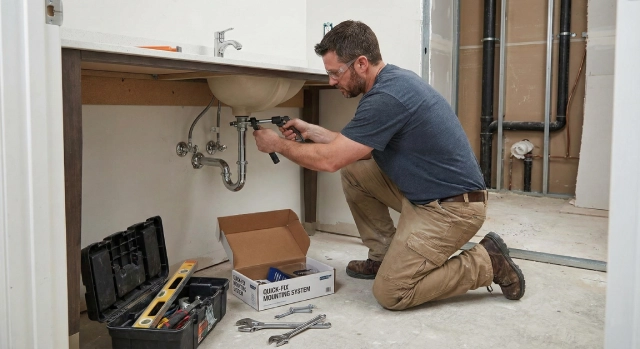
Installation Speed: Does the standard bathroom faucet come with “Quick-Fix” installation nuts? If a plumber saves 5 minutes per faucet, and you have 300 rooms, that is 25 hours of labor saved. Across multiple trades, these small efficiencies compound into measurable schedule and cost advantages.
Spare Parts: Does the manufacturer provide a 2% spare parts kit free of charge?
Water Consumption: An aerator that flows at 2.2 GPM vs 1.2 GPM (WaterSense standard) can cost your hotel thousands of dollars in water bills annually.
We help our clients model these costs before they sign the PO.
We provide a step-by-step ROI calculator and cost model in our separate guide: [Calculating the True Cost of Hotel Sanitary Ware].
Step 5: Supply Chain Stability & ESG Readiness
Finally, we must look at the macro picture. In 2026, bathroom faucet trends are heavily influenced by Environmental, Social, and Governance (ESG) criteria.
Navigating the New Standards
Plastic-Free Packaging: New EU tax rules and global anti-plastic sentiments are forcing a change. We use honeycomb cardboard packaging that is 100% recyclable but stronger than foam.
Lead-Free Compliance: The definition of “Lead-Free” is tightening (<0.25% weighted average).
Resilience: How does your factory manage stock to combat shipping delays?
Increasingly, ESG failures surface not in audits, but in brand reputation and tender disqualification. In 2026, faucet sourcing decisions are a Board-level concern, not just a procurement task.
Quick Self-Check for Project Teams
Before you finalize your order, check your specification sheet against this list:
If your current faucet specification does not clearly define Brass Grade (HPb59-1), Cartridge Cycle Rating (500k), ASS Test Hours (24h), and Regional Certifications, you are exposed to hidden cost and compliance risks.
FAQ
Questions we typically receive during the quotation and specification stage.
Q: What is the most common mistake in hotel faucet sourcing?
A: Treating faucets as finish items instead of system-critical components. This leads to prioritizing aesthetic rendering over internal durability (cartridges and brass grade), often resulting in premature failure within 24 months.
Q: When should faucet specifications be finalized in a hotel project timeline?
A: Ideally before tendering MEP (Mechanical, Electrical, and Plumbing) packages. Late changes often trigger re-approval delays and significant cost overruns in the plumbing rough-in stage.
Q: What is the difference between OEM and ODM?
A: OEM is manufacturing your specific design (you own the mold). ODM is using our design with your branding.
Q: How do I test the quality of a faucet sample?
A: Check the weight (heavier often means brass), inspect the surface for plating waves, and request a salt spray test report.
Q: What is the standard lead time for wholesale faucet orders?
A: Typically 35-45 days for production, plus shipping time.
Conclusion: Partnering for Long-Term Value
Sourcing bathroom sink faucets for a hotel project is a balancing act. You are juggling budget constraints, design aesthetics, and strict engineering requirements.
If there is one thing I hope you take away from this article, it is this: Do not let the initial FOB price blind you to the total cost of ownership. A cheap faucet that rusts in two years costs three times as much as a quality brass faucet that lasts twenty.
Our role at George Buildshop is not just to sell faucets, but to help hotel teams avoid costly sourcing mistakes.
If you are responsible for protecting budget, schedule, and brand standards, this decision matters more than it appears.