

The Ultimate Guide to Commercial Toilets: Silence Janitor Complaints & Boost Your Bottom Line
Discover how the right toilet selection can transform your operational costs and guest satisfaction. This guide reveals the secrets to eliminating your cleaning team's biggest headaches and turning your restrooms into a strategic asset.
Let's be direct. Have you ever truly considered what your cleaning crew faces every day? Their complaints about hard-to-clean restrooms aren't just operational noise; they are the most valuable, unfiltered data you will ever receive about a critical—and costly—part of your facility.
When your team talks about a "bad bathroom day," they aren't talking about a few stray paper towels. They're talking about confronting what they grimly call a "Poo-casso"—feces intentionally smeared on walls, sinks, and mirrors[1]. They're battling a persistent urine smell that never goes away, because porous tile grout acts like a sponge, trapping waste and becoming a permanent breeding ground for odor-causing bacteria[2][3]. They're on their hands and knees scrubbing the impossible-to-reach grime that collects around the base of every single floor-mounted toilet[4].

This isn't just unpleasant; it's a financial drain.
This brutal work environment is a primary driver of burnout and turnover in the janitorial industry, which suffers from an astonishing average turnover rate of 200% to 400%[5][6]. Every time a good employee quits, you absorb the cost—either through your own HR department or through the inflated price of your cleaning contract.
And the impact doesn't stop there. An incredible 84% of customers say a dirty restroom damages a business's image, and 75% will think twice before returning after just one bad experience[7]. For restaurants, the connection is even more devastating: customers assume a dirty restroom means a dirty kitchen[8].
This guide is built on a simple but powerful premise: the secret to a better bottom line, happier guests, and a more stable workforce lies in solving your cleaning team's biggest problems. Their complaints are your roadmap. By understanding their pain, you can make smarter procurement decisions that design these problems out of existence. Let's begin.
Why Are Your Janitors So Frustrated? (Decoding the Daily Battlefield)
Before we talk about toilets, we need to talk about the people who clean them. Their daily complaints aren't just the cost of doing business; they are the most accurate, real-time feedback you will ever get on the design failures within your facility. Let's step onto their battlefield and see the problems through their eyes.
The Daily Biohazard: More Than Just a Mess
The most soul-crushing part of a janitor's job isn't the routine dirt. It's the deliberate, almost hostile, acts of vandalism that turn a restroom into a recurring biohazard zone. Staff have a grim internal slang for the most common offense: the "Poo-casso"[1]. This is when a user decides to engage in what can only be described as "finger painting" with their own feces, smearing it on walls, sinks, mirrors, and even inside toilet paper dispensers[2][3].
This isn't a rare occurrence. Custodians regularly report cleaning stalls "drenched in... vomit," dealing with used sanitary products stuck to ceilings, and finding toilets intentionally clogged with everything from beverage bottles to vape pens, leading to overflows that flood the very floors they have to clean[1][4]. Add to this the constant threat of finding needles in trash cans, and you have a job that is not just disgusting, but genuinely dangerous[5].
Helen's Insight:
When you see this level of malice, you have to accept a hard truth: you aren't designing for "users." You are designing against "abusers." Your material choices for partitions, walls, and fixtures can't just be "durable"; they must be defensible. They need to be non-porous, graffiti-resistant, and able to withstand a level of hostility that most designers simply can't imagine.
The Unwinnable War: Odors, Grout, and Flawed Fixtures
Here's the complaint that truly breaks a custodian's spirit: the restroom still smells bad right after it's been cleaned. This isn't a failure of their effort; it's a catastrophic failure of the materials they were given to clean.
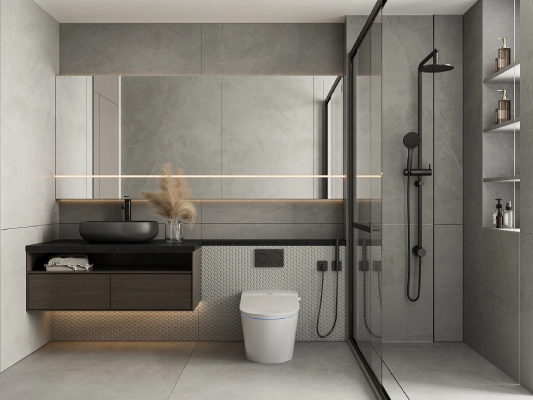
The main culprit? Tile grout. I've heard it described perfectly by cleaning pros: grout lines act "like a squeegee"[6]. When you mop a tiled floor, the porous grout actively scrapes filth, urine, and bacteria *off* the mop and locks it deep inside its own structure. The mop isn't cleaning the floor; it's feeding the grout. That grout then becomes a permanent food source for odor-causing bacteria, releasing a foul ammonia-like smell as the uric acid crystals reactivate with humidity[7][8].
This problem is made worse by the "impossible-to-clean" zone: the grimy, unreachable area around the base of a floor-mounted toilet. Custodians describe having to get on their hands and knees with stiff brushes to attack the "stuck on dust, hair and grime" that collects there, a task that is both demeaning and inefficient[9][10]. Add in the nooks and crannies of an exposed trapway and the hidden underside of a toilet rim, and you've designed a perfect habitat for filth[11].
Helen's Insight:
The complaint "the floor still stinks" is the single most compelling argument for investing in seamless, non-porous flooring. It is not a cleaning failure; it is a material specification failure. Any architect or designer who specifies porous tile and grout in a high-traffic commercial restroom today is committing long-term maintenance malpractice. Period.
The Human Cost: Burnout, Turnover, and the "Turnover Tax"
This daily battle against filth and flawed design takes a severe psychological toll. It's the frustration of blocking off a restroom for cleaning, only to have customers push past the signs and walk all over a wet floor[12]. It's the feeling of being invisible, of your hard work being undone in minutes by people who think messes just magically disappear[13].
This isn't just about feelings; it's about burnout, and it has a staggering financial cost. The janitorial industry suffers from an average annual employee turnover rate between 200% and 400%[14][15]. This isn't just your cleaning contractor's problem. The costs of recruiting, hiring, training, and lost productivity for that revolving door of new employees are passed directly on to you in the form of higher contract prices and lower quality service[16].
Helen's Insight:
Think of it as a "turnover tax." You are paying a premium on your cleaning contract because your restrooms are so difficult and demoralizing to clean that they burn through staff. This is a hidden, recurring expense baked into your operational budget, all stemming from initial design choices. Solving your janitors' frustrations isn't just good management; it's a direct path to cutting that hidden tax.
How Do Cleaning Complaints Actually Cost You Money? (The Hidden Financial Drain)
We've walked through the daily battlefield your cleaning crew faces. Now, let's translate that frustration into the language every property owner, manager, and investor understands: dollars and cents. The truth is, every complaint about a hard-to-clean restroom is a symptom of a deeper financial issue. Ignoring them is like ignoring a slow leak; eventually, the damage becomes impossible to miss.
The "Time Tax": Paying for Inefficient Design Every Single Day
Think of poor restroom design as a "time tax" on your operations. Every feature that's difficult to clean adds minutes to each cleaning cycle. According to ISSA, the worldwide cleaning industry association, cleaning a standard restroom fixture takes about 3 minutes[1]. But that's for a well-designed fixture. What about the extra time spent on hands and knees scrubbing the grimy base of a floor-mounted toilet[2]? Or fighting the endless battle against urine-soaked grout[3]?
These extra minutes add up. A design that's easier to clean, like a wall-hung toilet, can reduce cleaning time by up to 30%[4]. For a 150-room hotel, saving just one minute per toilet per cleaning cycle, four times a day, adds up to over 3,600 hours of saved labor per year. At an average janitorial wage of $17.27/hour, that's over $62,000 in direct labor savings annually[5].
Helen's Insight:
I call this the "Architect's Ghost." It's the lingering financial consequence of a decision made years ago, likely to save a few hundred dollars on the initial purchase. That "cheaper" floor-mounted toilet haunts your operating budget every single day. The initial price tag is a one-time event, but the labor cost is a recurring bill you pay for the next 20 years.
The Revolving Door: How Bad Bathrooms Fuel the $60,000 "Turnover Tax"
The janitorial industry has a staggering employee turnover rate, averaging between 200% and 400% annually[6][7]. This isn't just an HR problem; it's a massive, hidden cost passed directly on to you. Every time an employee quits due to burnout from a demoralizing work environment, it costs thousands to replace them.
Research from Cornell University estimates the cost of replacing a single hospitality worker is $5,864, factoring in recruitment, training, and lost productivity[8]. If a difficult work environment causes just ten employees to leave per year, that's nearly $60,000 in turnover costs. This is the "Turnover Tax" you pay for maintaining a workspace that frustrates and devalues your staff.
The Brand Reputation Balance Sheet: Where a Dirty Toilet Becomes Lost Revenue
This is where the cost becomes most visible—and most damaging. In today's digital world, your restroom is a silent, brutally honest ambassador for your brand. And customers are listening.
The numbers are unforgiving. A landmark survey by Bradley Corp. found that 84% of customers say a dirty restroom damages a business's image, and a shocking 75% will think twice before returning after just one bad experience[9]. For restaurants, it's even more direct. A Harris Interactive poll revealed that 88% of people believe a dirty restroom reflects the cleanliness of the kitchen[10].
This isn't just about perception; it's about revenue. A Cornell University study quantified the impact of online reputation, finding that a 1-point increase on a 5-point rating scale allows a hotel to raise its price by 11.2% while maintaining the same market share[11]. Every negative review that mentions your "disgusting restroom" isn't just a complaint—it's a direct downward pressure on your pricing power and your property's value.
Helen's Insight:
Think of your restroom as the ultimate litmus test. A customer might forgive slow service, but a dirty bathroom feels like a personal insult. It sends a clear message: "We don't care about your comfort or your health." In an era where a single photo on Google Maps can reach thousands, that's a message no business can afford to send.
What Is the Secret to an "Easy-to-Clean" Restroom? (A Solutions-Based Blueprint)
After years in this industry, I can tell you the secret to a low-maintenance restroom isn't a magic cleaning product. It's about making smart, proactive design choices that eliminate cleaning headaches before they ever begin. "Easy-to-Clean Design" isn't an aesthetic; it's an operational strategy. It's about systematically designing away the very things your cleaning crew complains about. Here's the blueprint.
Pillar 1: The Wall-Hung Revolution (Get Everything Off the Floor)
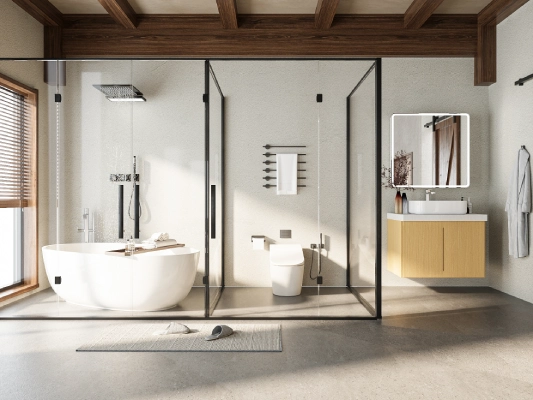
Remember the "impossible-to-clean" zone we talked about? That grimy, disgusting area around the base of a floor-mounted toilet? The single most effective way to eliminate it is to get the toilet off the floor entirely. Wall-hung toilets are a game-changer for maintenance staff. By suspending the bowl from the wall, you create a completely open, obstruction-free floor that can be mopped quickly and thoroughly[1]. No more kneeling, no more special brushes, no more permanent ring of filth.
This isn't just about looks; it's about labor. Eliminating the need to navigate around a toilet pedestal can cut cleaning time by up to 30%[2]. When you multiply that by every toilet, every day, the savings are enormous. The tank and plumbing are concealed within the wall, which not only saves 8-12 inches of precious floor space but also eliminates multiple surfaces that would otherwise collect dust and grime[3].
Helen's Insight:
I've heard every concern about wall-hung toilets, especially about maintenance. "What if something breaks inside the wall?" Modern in-wall carrier systems are engineered for this. All the working parts—the fill and flush valves—are accessible through the flush plate opening, without ever touching a tile[4]. It's a myth that you have to break open the wall for routine service. The higher initial cost is an investment in decades of lower labor costs.
Pillar 2: The War on Grout (Choose Seamless, Non-Porous Surfaces)
The second unwinnable war for janitors is against the persistent smell of urine, which is almost always caused by one thing: porous tile grout[5]. Grout acts like a sponge, absorbing urine and other contaminants, creating a permanent food source for odor-causing bacteria. No amount of surface mopping will ever fix it.
The solution is to eliminate grout. For floors, materials like epoxy terrazzo or polished concrete create a seamless, non-porous surface. There are no joints for filth to hide in, making cleaning incredibly simple and effective[6]. For walls, especially in shower areas, solid surface panels offer a grout-free, waterproof, and antimicrobial alternative to tile, resisting mold and mildew growth from the start[7].
Pillar 3: Engineered Cleanliness (Specify Smarter Toilets)
Not all toilets are created equal. Modern toilet design has evolved specifically to combat the biggest cleaning pain points. When specifying, look for these three features:
- Skirted Trapway: This design conceals the S-shaped pipe at the base of the toilet with a smooth, continuous surface. It eliminates all the awkward curves and bolt caps that are so difficult to clean on a standard toilet[8].
- Rimless Bowl: Traditional toilets have a rim around the inside of the bowl where water flows during a flush. This area is impossible to see and nearly impossible to clean, making it a "breeding ground for unwanted bacteria"[9]. Rimless toilets eliminate this channel, allowing for a more powerful, direct flush that cleans the entire bowl and leaves no place for germs to hide[10].
- Advanced Glaze: Leading manufacturers have developed nano-technology glazes, like TOTO's CEFIONTECT, that create an ultra-smooth, ionized barrier on the porcelain. This super-slippery surface prevents waste from sticking in the first place, reducing the need for frequent scrubbing and harsh chemicals[11].
Helen's Insight:
Combining these three features—a wall-hung toilet with a skirted design and a rimless bowl with an advanced glaze—is the ultimate hat-trick. You've just designed away the three biggest toilet-related complaints from your cleaning staff: the dirty floor, the grimy exterior, and the filthy interior rim. This is how you move from reactive cleaning to proactive design.