
You need to outfit your hotel with new vanities, but large furniture often causes shocking shipping surcharges. Oversized fees and dimensional weight penalties can quickly add 20-40% to your bulk order costs. You need a logistics-friendly size strategy to keep your project budget in check.
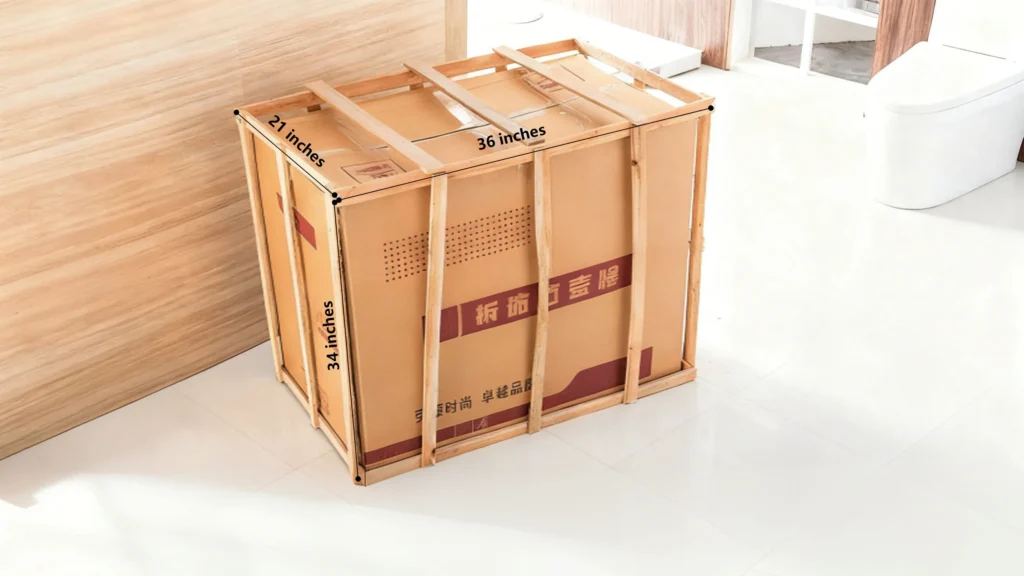
The most effective bathroom vanity sizes to reduce shipping costs are generally compact units: 24-36 inches wide, 16-21 inches deep, and 30-34 inches high. These dimensions fit standard courier parcel limits, avoiding expensive oversized freight surcharges and enabling easier consolidation for bulk container shipments, leading to significant savings.
I started my career in a bathroom cabinet factory, and believe me, I’ve seen logistics turn into a nightmare just because a vanity was one inch too big. This is why I want to share my expertise: understanding size restrictions is your secret weapon against ballooning project costs. Let’s dive deep into the specific sizes and packaging strategies that will save your hotel project budget.
Table of Contents
What is an ADA-compliant bathroom vanity, and is it cost-effective for shipping?
Accessibility is important for any modern hotel, so you are looking at ADA-compliant vanities.You might worry that their required size and open-space design will make shipping complex and expensive. Understanding the exact specifications helps you choose compliant units that are still shipping-friendly.
An ADA-compliant bathroom vanity is designed to be accessible to guests using a wheelchair, primarily requiring a clear floor space of 30 inches by 48 inches and a maximum counter height of 34 inches, with clearance underneath. While their dimensions may seem larger, the “open-bottom” design, often a floating vanity style, can reduce the overall volume of the packaged unit compared to traditional cabinet models, sometimes making them more cost-effective to ship.
The Standard Height and Depth Requirements of ADA
The countertop rim must be no higher than 34 inches above the finished floor, and the unit must be installed to allow for a minimum clearance of 27 inches high by 30 inches wide under the sink. This required space for knees and toes means that a large portion of the vanity’s volume is empty, which can be an advantage for packaging and dimensional weight calculation.
The Importance of Clearance and Mounting for Shipping
The typical ADA unit is a floating or wall-mounted design to achieve the required under-sink clearance. This often means the cabinet structure itself is shallower than a standard floor-standing vanity. The reduced depth of the cabinet (often 18 to 21 inches) is a key factor in keeping the shipping package smaller.
Why ADA Vanities Can Be Logistics-Friendly
Because the unit is often sold without a large, fixed base cabinet, the shipping package is less bulky. If the required sink and counter are separate pieces, the entire order can be knocked-down (KD) and shipped in several smaller, flat boxes, which dramatically saves on dimensional weight charges.
| ADA Feature | Typical Requirement | Shipping Impact |
|---|---|---|
| Counter Height | Max 34 inches | No major impact on shipping size. |
| Under-Sink Clearance | 27 inches high, 30 inches wide | Reduces cabinet volume, favoring lighter, open designs. |
| Depth (Typical) | 18 to 21 inches | Stays within crucial depth limits for pallet and container loading. |
I always advise my hotel procurement clients like Emma to look at ADA vanities not as a cost burden but as a design opportunity. Their floating or wall-mounted nature naturally lends itself to a modular, knock-down packaging strategy. In my experience, a shipment of 50 wall-mounted ADA units often takes up less cubic volume than 50 traditional 36-inch freestanding units because the base structure is removed or simplified. The key is communicating with your supplier to ensure the design can be disassembled efficiently, and that the packaging protects the sink and countertop while minimizing air space. This focus on minimized packaging volume, even on a physically large unit, is what truly drives shipping cost down.
Why is the volume of a bathroom vanity more critical to shipping costs than its unit price?
You might be focusing on negotiating the lowest price per unit from your supplier. However, you are overlooking a huge hidden cost that can negate all your savings: the shipping volume. You must shift your focus to the dimensional weight of the package, which is how carriers actually determine the freight cost.
The volume of a bathroom vanity is more critical to shipping costs than its unit price because carriers charge based on the greater of the package’s actual weight or its dimensional weight (DIM weight). DIM weight is calculated using the formula: $$(Length \times Width \times Height) / DIM \ Factor$$. A low-priced but bulky vanity will have a high DIM weight, leading to massive shipping charges that often exceed any unit price savings.

The Dimensional Weight Calculation Explained
Carriers use DIM weight to ensure they are paid for the space a package takes up on a truck, plane, or ship, not just its mass. If your 36-inch vanity box is $40 \times 25 \times 45$ inches, it will be charged as if it weighed a specific, much higher weight, even if the vanity itself is light. This is why minimizing the height, length, and depth of the packaged product is crucial.
Volume Penalties and Oversize Surcharges
If the longest side of your package exceeds a carrier’s standard limit (often 48 inches) or the combined length and girth exceed 108 inches, you will be hit with a $95+ Oversize Surcharge per package. I’ve seen this mistake wipe out the entire profit margin on a $50,000 order. This penalty is directly tied to the unit’s packaged volume, not its price.
Expert Advice
Custom B2B Sizes: Maximize ROIMaximize Container Utilization
For large bulk orders, like the 50-100 units a hotel needs, you are paying for space inside a 20-foot or 40-foot shipping container. The more vanities (volume) you can fit, the lower the cost per unit (CBM, or cubic meters) for shipping. A vanity that is just slightly too deep can mean you can only stack two units high instead of three, losing 33% of your container capacity.
| Cost Factor | Affected By | Impact on Total Cost |
|---|---|---|
| Unit Price | Raw Materials, Labor, Overhead | Fixed cost per vanity. |
| Shipping Cost | Dimensional Weight (Volume) | Highly variable and often greater than the unit price savings. |
| Project Total Cost | Unit Price + Shipping Cost | Volume is the single biggest variable risk. |
I always tell my clients to think of the shipping container as a fixed-cost box. When I was running my trading company, I learned that a 40-foot High Cube container is $X to ship, whether it’s half-full or completely full. My goal, and Emma’s goal, must be to maximize the number of vanities in that container. This means calculating the CBM of the vanities and comparing it to the container’s total capacity (a 40′ HC is about 76 CBM). The cost-saving doesn’t come from getting a $10 discount per unit; it comes from fitting an extra 20 vanities into the container because the packaging was optimized. For bulk hotel orders, every centimeter of packaging reduction translates directly into thousands of dollars in savings on the freight line.
Which vanity sizes are most container-friendly for bulk hotel projects?
You are planning a large-scale renovation and need to ensure maximum container utilization to lower your unit shipping cost. Choosing the wrong size could lead to wasted space and an unnecessary second shipment. You need to prioritize dimensions that stack perfectly inside standard shipping containers.
The most container-friendly vanity sizes for bulk hotel projects are those with a packaged depth of 20-22 inches and a width/height that allows for an even stack. The critical internal height of a 40-foot High Cube container is $106.3$ inches. Vanities with a packaged height of $34$ to $35$ inches can stack perfectly three high, and a $22$-inch depth allows for efficient front-to-back arrangement with minimal air gap.
The 34-Inch Height Rule
A packed height of 34 inches is the magic number. Since three $34$-inch packages stacked vertically equal $102$ inches, you leave enough headroom for pallet bases, strapping, and the required $4.3$ inches of clearance inside the $106.3$-inch internal height of a 40’ HC container. A package of $36$ inches is too tall and forces you to stack only two units high, a major inefficiency.
The 22-Inch Depth Sweet Spot
The depth of the package must be no more than 22 inches. This is because standard containers are $92.5$ inches wide internally. Four $22$-inch deep vanities side-by-side equal $88$ inches, leaving enough room for padding and secure fitting. A vanity package deeper than $23$ inches will only fit three units across, wasting one full row of space.
Why 24-inch and 36-inch Widths Work Best
Widths of 24 inches and 36 inches are favored because they allow for the best consolidation in hotel rooms. They are also common sizes that fit well when packed next to each other within the container width, maximizing the usable floor space without leaving large, unusable gaps.
| Dimension Target (Packaged) | Container Dimension | Container Efficiency |
|---|---|---|
| Height: 34 inches | 40' HC Internal Height: 106.3 inches | 3-High Stackable: 3 x 34 in = 102 in. Maximizes vertical space. |
| Depth: Max 22 inches | 40' Internal Width: 92.5 inches | 4-Across Fit: 4 x 22 in = 88 in. Maximizes horizontal space. |
I remember a client, a procurement manager in Dubai, who was moving 150 vanities for a resort project. We initially used a vanity design that packaged at 37 inches high. We quickly realized we were forced to ship two units high, wasting an entire third of the container’s height. We had to go back to the factory to redesign the base and packaging to hit the 34-inch mark. The extra effort meant we fit all 150 units into one 40-foot container instead of needing a full container and a less-than-container-load (LCL) shipment. The $5000 in saved LCL costs and the reduced complexity were worth more than the $15 saving on each vanity. This experience showed me that 34 inches is the most valuable number in bulk vanity logistics.
B2B SUCCESS SNAPSHOT
PAIN: A Bahamas resort project faced a 40% budget overrun due to oversized freight charges on custom luxury vanities.
SOLUTION: George Group redesigned the vanity base to a modular KD structure, hitting the "34-inch Rule" without compromising aesthetics.
RESULT: 100% container utilization, 32% reduction in shipping costs, and zero transit damage across 200 units.
How do flat-pack and knock-down designs help save costs for me?
You are evaluating the final cost of a fully assembled vanity versus a flat-pack one. You assume fully assembled is safer and easier, but it is often much more expensive to ship.You need to understand how the construction method fundamentally changes the shipping volume and, thus, the cost.
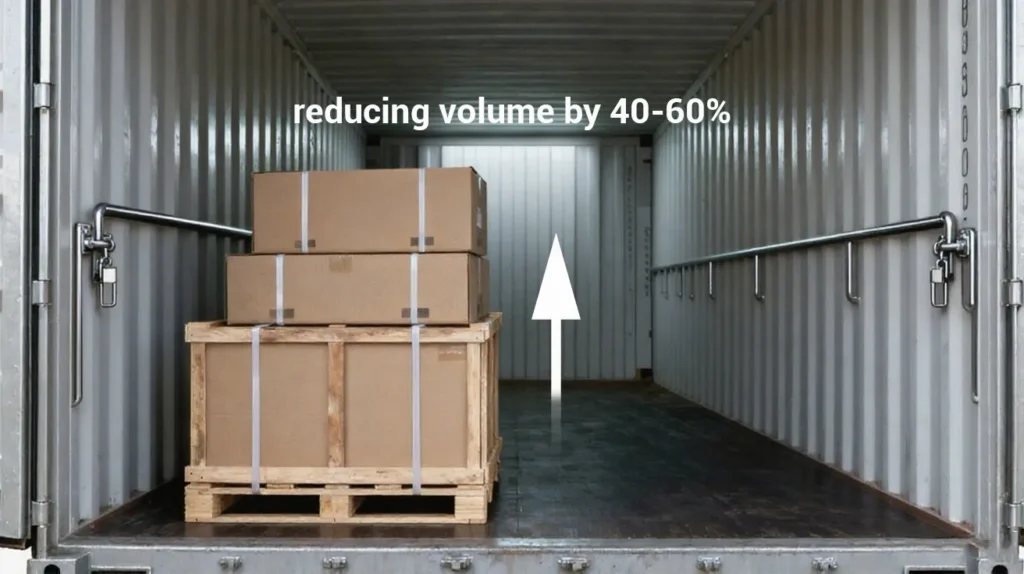
Flat-pack, or knock-down (KD), vanity designs save significant costs because they drastically reduce the shipping volume compared to fully assembled units. A KD design disassembles the cabinet body, allowing it to be packaged as a thin, flat box, potentially reducing the overall cubic meter (CBM) volume by 40-60%. This reduction is critical for minimizing dimensional weight and maximizing the number of units that fit into a container, directly lowering the cost per unit.
Volume Reduction Through Disassembly
A vanity is mostly empty space when fully assembled. Flat-pack design removes this air pocket. By unhinging the doors and breaking down the cabinet body into its six flat panels, the packaging goes from a $34$-inch cube to a flat box that is only 4-6 inches thick. This massive decrease in height is the main cost-saving factor.
The Trade-Off: Assembly Labor
Flat-pack design means you will have to pay for on-site assembly labor at your hotel, which is an extra cost. However, for bulk orders, the freight savings (40-60%) almost always outweigh the additional assembly labor costs at the destination. You must get a clear quote for both assembly labor and freight to find the true lowest total landed cost.
Easier Damage Handling
A fully assembled vanity has a higher risk of structural damage from rough handling because the entire structure bears the stress. A flat-pack design, when packaged correctly with internal foam, distributes the impact more evenly over individual panels, often leading to fewer in-service failures after installation.
| Packaging Method | Volume Reduction | Shipping Cost Impact | Labor Impact |
|---|---|---|---|
| Fully Assembled | 0% (highest volume) | Highest freight cost (freight class 150-300). | Zero on-site assembly. |
| Flat-Pack (KD) | 40-60% reduction | Lowest freight cost (freight class 70-100). | Requires on-site assembly labor. |
When I work with procurement managers, I encourage them to treat the flat-pack decision as a simple math problem: (Freight Savings per Unit) vs. (Assembly Cost per Unit). For a typical 40-foot container shipment of 150 vanities, I have seen freight costs drop from about $10,000 for fully assembled to $6,000 for flat-pack. That’s a $4,000 saving, or about $26.67 per unit. Even if the on-site assembly labor costs $15 per unit, you still save over $10 per unit in total landed cost. This is why for large hotel projects, flat-pack is the smarter financial choice. It allows us to Master Molding Right by controlling the entire lifecycle cost, not just the initial purchase price.
What are the recommended size and packaging combinations for bulk orders?
You need a simple guideline to use when placing your hotel’s next bulk order. You are tired of calculating CBM for every single product variation. You need a quick reference for the optimal size and packaging combination that ensures the lowest overall shipping cost.
For bulk hotel orders, the most cost-effective size and packaging combination is a 30-36 inch wide vanity, a 20-21 inch deep vanity, and a 34-inch finished height, shipped in a flat-pack (KD) structure. This combination maximizes the container count, avoids all dimensional and oversized freight penalties, and keeps the on-site maintenance and installation simple for your staff.
The Ideal Dimensions Checklist
- Width: 24, 30, or 36 inches. These are standard, room-friendly sizes that fit well in a container.
- Depth: 20-21 inches. This is the sweet spot for maximizing the number of units side-by-side in a container.
- Height (Packed): Max 34 inches. This is absolutely necessary for three-high stacking in a 40′ HC container.
Packaging Strategy for Maximum Savings
Always push your supplier to use a flat-pack design for the cabinet body. Then, have the sink/countertop packaged separately and placed on top of the KD cabinet boxes on the pallet. This prevents the large, irregular sink from creating unnecessary air pockets and dimensional weight charges around the entire package.
Hotel Procurement's Ideal Specs Summary
For a reliable, repeatable, and low-cost solution, hotel procurement managers like Emma should specify these dimensions in their Request for Quotation (RFQ). This upfront clarity saves months of logistics headaches later on.
| Category | Recommended Specification | Cost-Saving Reason |
|---|---|---|
| Vanity Width | 24 / 30 / 36 inches | Container consolidation, standard room fit. |
| Vanity Depth (Packed) | Max 22 inches | Maximizes 4-across fit in a container. |
| Vanity Height (Packed) | Max 34 inches | Critical for 3-high stacking in 40' HC. |
| Packaging Method | Flat-Pack (KD) | 40-60% CBM reduction, lowest freight class. |
I’ve found that the simple rule of “34×22” for the packaged height and depth has never failed to deliver the maximum container count for my clients. A hotel procurement manager’s main challenge is minimizing in-service failures and sticking to a budget. When you secure a fixed, low freight cost upfront by using these dimensions, you eliminate a huge source of project uncertainty. The focus then shifts back to the quality and durability of the product, which is what truly matters for guest experience and lifecycle cost. Remember, a smaller size that costs $10 less to ship is $10 of guaranteed savings, which helps you Master Molding Right by focusing on long-term value.
How can we measure the actual savings in transportation on my hotel project?
You have implemented the size and packaging strategies but need a quantifiable way to prove the savings to your financial controller. Without clear data, the cost-saving effort goes unrecognized. You need a simple formula that compares the “bad” shipping scenario against your optimized “good” one to show the direct budget impact.
You can measure actual savings by calculating the difference in the Cost Per Unit Volume (CPUV) between the fully-assembled, unoptimized package and the optimized, flat-pack package. The CPUV is calculated by dividing the total container freight cost by the total number of vanities that fit. Savings are the difference in the final CPUV.
-1024x768.webp)
The CPUV Formula
$$\text{CPUV} = \frac{\text{Total Container Freight Cost}}{\text{Total Number of Vanities in Container}}$$
If a 40′ HC container costs $$5,000$ to ship:
- Unoptimized (Assembled, $37 \times 23 \times 40$ in packed): Fits 100 units. $\text{CPUV} = $5,000 / 100 = $50.00$.
- Optimized (KD, $34 \times 22 \times 40$ in packed): Fits 150 units. $\text{CPUV} = $5,000 / 150 = $33.33$.
The Final Savings Calculation
The actual saving is the difference in the CPUV: $$50.00 – $33.33 = \text{$16.67 in savings per vanity}$. For a 150-unit hotel project, this is a total saving of $\text{$2,500}$. This is a clear, reportable budget win.
Documenting the Volume Difference
I recommend you ask your supplier for the CBM (Cubic Meters) for both the assembled and the flat-pack version of the same vanity. A CBM of $0.5$ for an assembled unit vs. $0.3$ for a flat-pack unit is a $40%$ volume reduction, which translates almost directly to a $40%$ saving in space-based freight costs.
When I present a cost-benefit analysis to my partners, I don’t just talk about “cheaper shipping.” I show the numbers. Emma, as a procurement manager, needs this quantifiable data. I tell my clients to demand the CBM from their suppliers upfront. If a supplier can’t provide the CBM for both assembled and KD versions, they are not serious about logistics cost control. For a typical hotel project with 100+ units, using the CPUV formula provides a simple, irrefutable metric. It clearly shows the direct financial benefit of choosing a vendor who prioritizes compact, logistics-friendly design over one who simply offers the lowest initial unit price.
How should buyers communicate size and packaging requirements with suppliers during project procurement?
You have the knowledge but need to communicate these complex requirements to a supplier clearly and professionally. Vague communication leads to misinterpretation and costly shipping mistakes. You need a precise, documented process to specify the exact packaged dimensions and required packaging method in your RFQ.
Buyers must communicate size and packaging requirements by creating a detailed Packaging Specification sheet as part of the Request for Quotation (RFQ), using exact, non-negotiable metric or imperial maximum dimensions for the packaged unit. The specification must clearly state the required packaging type: Flat-Pack (Knock-Down) only, and require the supplier to confirm the total CBM of the full container load in their bid.
-1024x576.webp)
The Non-Negotiable Specification Checklist
The most critical part is stating the maximum acceptable dimensions for the outer carton.
- MAXIMUM Packaged Height: 34 inches
- MAXIMUM Packaged Depth: 22 inches
- Required Packaging Type: Knock-Down (KD) Construction, separate packaging for stone tops.
Requiring a Container Loading Plan
Ask the supplier to provide a simple Container Loading Diagram showing how many vanities they can fit into a 40′ High Cube container based on their proposed packaging. This forces them to pre-calculate the CBM and proves they understand the requirements.
Post-Sale Communication for Delivery
For hotel renovations, timely delivery is vital. The packaging spec should also require the supplier to use durable packaging and clear external labeling to ensure that the vanities are delivered without damage and in the right order for easy on-site assembly.
| RFQ Section | Key Requirement (Non-Negotiable) | Why It Matters |
|---|---|---|
| Product Spec | MAX PACKAGED Height ≤ 34 in; Depth ≤ 22 in. | Guarantees 3-high stacking and 4-across fit. |
| Packaging | Mandatory Flat-Pack (KD) structure. | Ensures lowest CBM and reduced DIM weight. |
| Quotation Requirement | Must state CBM per unit and Total Container Count. | Allows for direct comparison of freight efficiency between suppliers. |
I always stress that the relationship with a supplier must be a partnership built on clear data. When you, as a buyer, provide non-negotiable dimensions, you immediately separate the professional manufacturers from the inexperienced ones. In my years of running a trading company, I found that demanding the Container Loading Diagram was the single most effective way to eliminate bad suppliers. A good supplier will happily provide it; a bad one will stall. This communication strategy helps Emma secure consistent finishes and minimizes in-service failures by ensuring the supplier is focused on all project elements, from molding quality to final delivery logistics. We aim to help you Master Molding Right from the design floor to the hotel room.
Conclusion
To cut bulk shipping costs by up to 40%, you must prioritize a flat-pack design with a packaged height of no more than 34 inches and a depth of 22 inches. These dimensions maximize container space, saving you thousands on freight. Visit georgebuildshop.com to learn more about our logistics-first manufacturing approach.
Scale Your Hotel Project with Logistics Expertise
Choosing the right vanity size isn't just about design—it's about protecting your project's ROI. At George Build Shop, we understand the specific pain points of resort procurement: shipping delays, dimensional surcharges, and the need for durable, ADA-compliant aesthetics.
Whether you need 50 units or 500, our team is ready to provide custom manufacturing, logistics optimization, and complete spatial design support to ensure your project stays on schedule and under budget.
Tell us about your project requirements below, and our senior project manager will reach out within 24 hours with a tailored quote.